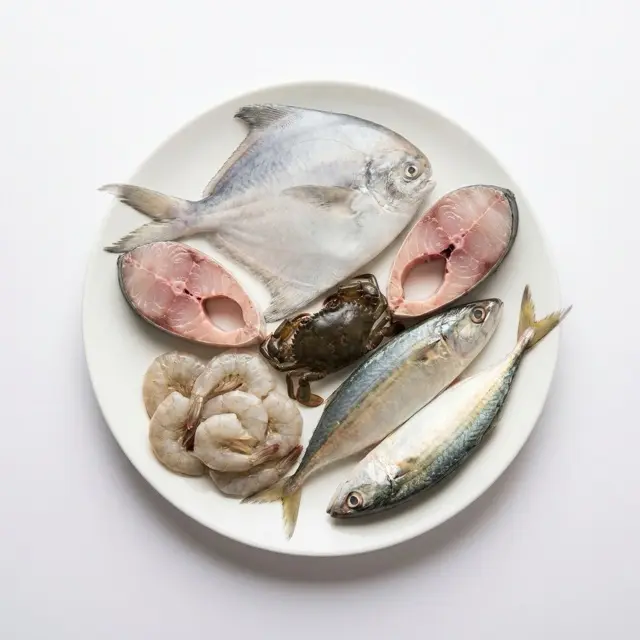
Fish in this guide: Bhetki (Barramundi)Rawas (Indian Salmon)Surmai (Kingfish)Pomfret Today's prices →
Jitada Fish in English: Asian Seabass, Barramundi and Bhetki
Jitada fish in English is Asian seabass, also called barramundi. Its scientific name is Lates calcarifer, and the same fish is sold as bhetki in Bengal. In Mumbai and Thane it is a favourite for boneless fish fry, because its thick white flesh is mild and easy to eat. You can see today’s jitada from verified sellers on the bhetki page, and its rates on fish price today.
Key points:
- Jitada (जिताडा) is Asian seabass, also called barramundi or bhetki.
- It is a very lean, mild white fish with thick, flaky flesh.
- Ask for boneless cubes or fillets for kids and older parents.
- 500 g of boneless cubes serves a family of 4 as a fry or side.
- Prefer it from December to February, as the Know Your Fish calendar suggests.
This is general food information, not medical advice. If you have a health condition or are pregnant, ask your doctor what suits you.
What is jitada called in English and other languages?
The most common English names are Asian seabass and barramundi. FishBase, the global database of fish species, gives barramundi as its main name. Its list of names used in India also includes giant sea perch and cock-up.
Jitada has a different name in almost every coastal state. These are all taken from FishBase’s list of common names for Lates calcarifer.
| Language | Name |
|---|---|
| English | Asian seabass, barramundi, giant sea perch |
| Marathi | Jitada (जिताडा), also listed as jiteda, khajura and fitadar |
| Bengali | Bhetki, bhekti (ভেটকি) |
| Gujarati | Bekti, gariyu |
| Odia | Bekkut |
| Tamil | Koduva (கொடுவா) |
| Malayalam | Narimeen |
| Kannada | Koliji |
| Telugu | Pandu-kopah |
| Scientific | Lates calcarifer |
The scientific name is the one to trust. The word “seabass” on its own is used for more than one kind of fish around the world. If a pack or menu just says seabass, ask the seller which fish it is. For 25 more Mumbai fish with their English and Marathi names, see our fish names chart.
Jitada, bhetki and barramundi: one fish, three names
Many buyers think bhetki is a Bengali fish and jitada is a Konkan fish. They are the same species. The name changes with the language, not the fish.
- Jitada is the Marathi and Koli name you hear in Thane, Mumbai and the creeks around them.
- Bhetki is the name Bengali families use, and the one you see on Bengali menus for fish fry.
- Barramundi is the name used in Australia and on many international menus.
On Relifish, all three are listed together on one bhetki page. Sellers may list it as jitada, seabass or bhetki, depending on how their buyers ask for it.
Where jitada lives: creek, sea and farm
Jitada is unusual because it moves between salt water and fresh water. FishBase describes it as a fish of coastal waters, estuaries and lagoons. Young fish live in brackish swamps and the upper reaches of rivers. Adults return to estuaries to spawn.
FishBase also notes two facts that surprise most buyers:
- It can grow very large. FishBase records a maximum length of 200 cm and a maximum published weight of 60 kg. What you buy in Thane is far smaller than that.
- It changes sex as it grows. Jitada starts life as a male and later becomes female. Biologists call this a protandrous hermaphrodite.
It is also farmed commercially. FishBase notes that under the right conditions, farmed fish reach 1.5 to 3 kg in one year in ponds. So some jitada in the market comes from creeks and the sea, and some from farms. Our guide to farmed vs sea fish explains how to think about the difference.
FishBase lists jitada as Least Concern on the IUCN Red List (assessed in 2019).
Jitada nutrition per 100 g
India’s own food tables (IFCT 2017, ICMR-NIN) list this fish as betki (Lates calcarifer). These values are for 100 g of raw fish, edible part only.
| Nutrient | Per 100 g raw |
|---|---|
| Energy | 68 kcal |
| Protein | 15.28 g |
| Fat | 0.29 g |
| Omega-3 (EPA + DHA) | 0.02 g |
Source: IFCT 2017, ICMR-NIN. Any one fish can differ with size, season and whether it was farmed.
What this means in practice:
- Very lean. Jitada is one of the lowest-fat fish in the table, which is why it appears in our best fish for weight loss list.
- Low in omega-3. If you want omega-3 fats, oily sea fish like surmai or bangda give much more.
- Mercury. Jitada is not on the US FDA’s fish chart. IFCT 2017 measured 5.87 µg of mercury per 100 g in samples from one region. Our low-mercury fish guide puts that figure in context.
How jitada is sold: cuts to ask for
Jitada is a big fish, so most buyers in Thane do not take it whole. These are the usual cuts:
| Cut | What it is | Best for |
|---|---|---|
| Whole, cleaned | Scaled, gutted, head on or off | Grilling or baking a small fish |
| Steaks (darne) | Slices across the body with one central bone | Tawa fry, curry |
| Fillets | Sides of the fish with the frame removed | Pan-fried fillets, fish fingers |
| Boneless cubes | Fillets cut into 3 cm pieces | Masala fry, tikka, kids’ meals |
Boneless cubes are the most popular. The seller removes the backbone, ribs and pin bones, so the flesh has no fine Y-bones. That makes it a good choice for children and older parents. See our list of the best fish for kids for other low-bone fish.
When you order on Relifish, you choose how the fish is cleaned and cut. Ask for skin on if you want a crisp fry, and skin off for curry.
How to buy fresh jitada
The US FDA’s seafood buying advice applies to jitada as to any fish. Check these before you buy:
- Smell: fresh and mild. Never fishy, sour or of ammonia.
- Eyes (whole fish): clear and shiny.
- Gills (whole fish): red, with no odour.
- Flesh: firm, and it springs back when you press it.
- Fillets and cubes: no darkening or drying at the edges.
Cook it the day you buy it if you can. If not, keep it in a covered box at 4°C or below and cook it within 2 days, as the FDA advises. Our guide on how to store fish at home has fridge and freezer times.
Season. The Know Your Fish west-coast calendar marks jitada as a fish to prefer from December to February, and to avoid in November. Our winter fish guide covers the other fish in season now.
How jitada is cooked in Mumbai and Thane
FishBase notes that around the world this fish is eaten steamed, pan-fried, grilled and baked. In Maharashtra homes, these are the favourites:
- Jitada masala fry: boneless cubes in Koli or Agri masala, dusted with rice flour and fried crisp. Our jitada masala fry recipe gives the full method.
- Air fryer jitada: fillets or cubes, crisp with very little oil. See our air fryer fish fry recipe.
- Jitada curry: steaks or thick cubes in a coconut and kokum gravy. Keep the pieces thick so they don’t break.
- Bengali bhetki fry: fillets in a crumb coat, the same fish under its Bengali name.
Because the flesh is mild, jitada takes on masala well. If you like a firmer, slightly richer white fish, try rawas steaks instead.
Order fresh jitada in Thane
On Relifish, verified sellers in Thane list jitada and seabass when they have it. Order for today or pre-order for a later day. Choose how it is cleaned and cut, pick a 2-hour delivery slot and pay online. The seller delivers across Thane and nearby Mulund and Bhandup.
What to do next: see today’s jitada and bhetki, check fish prices today, then try our jitada masala fry recipe.
Sources
- FishBase. Lates calcarifer, barramundi. Habitat, size, biology, uses, IUCN status.
- FishBase. Common names of Lates calcarifer. Names in Indian languages.
- ICMR-National Institute of Nutrition. Indian Food Composition Tables 2017. Betki (Lates calcarifer), proximate, fatty acid and mercury tables.
- US FDA. Selecting and serving fresh and frozen seafood safely.
- Know Your Fish. December calendar, January, February and November.
Related reading
Frequently asked questions
What is jitada fish called in English?
Jitada is called Asian seabass or barramundi in English. Its scientific name is Lates calcarifer. FishBase lists barramundi, giant sea perch and cock-up as English names used in India. It is a large fish with silver grey skin and thick, mild white flesh, usually sold in Thane as steaks, fillets or boneless cubes.
Is jitada the same as bhetki?
Yes. Jitada and bhetki are the same species, Lates calcarifer. Jitada is the Marathi and Koli name used in Mumbai and Thane, and bhetki or bhekti is the Bengali name. On Relifish, jitada and seabass are listed on the bhetki page, so you can compare all of them in one place before you order.
Is jitada a sea fish or a river fish?
Jitada lives in both. FishBase describes it as a fish of coastal waters, estuaries and lagoons that also moves into rivers. Young fish grow up in brackish swamps and upper rivers, and adults return to estuaries to spawn. It is also farmed commercially, so some jitada in the market comes from fish farms rather than creeks.
Does jitada fish have many bones?
No. A whole jitada has a central backbone, rib bones and some pin bones, like any large fish. It does not have the many fine Y-bones of rohu or katla. Steaks have one central bone, and fillets or boneless cubes have none once the seller removes the frame. Still run a finger over each piece before cooking for children.
When is the best season for jitada in Mumbai?
The Know Your Fish west-coast calendar marks jitada as a fish to prefer in December, January and February, and as one to avoid in November. Following that calendar gives the fish a chance to breed. Whatever the month, ask for adult-size fish rather than small juveniles, and check today's listings before you plan a meal.
What is sea bass called in Marathi?
Sea bass is called jitada (जिताडा) in Marathi. In Thane and Raigad, Koli and Agri families use this name for Asian seabass, Lates calcarifer, the same fish Bengal calls bhetki. Other fish are sometimes sold as seabass, so if a listing only says seabass, ask the seller which fish it is.
How we write and check these guides: editorial standards
Share this article: