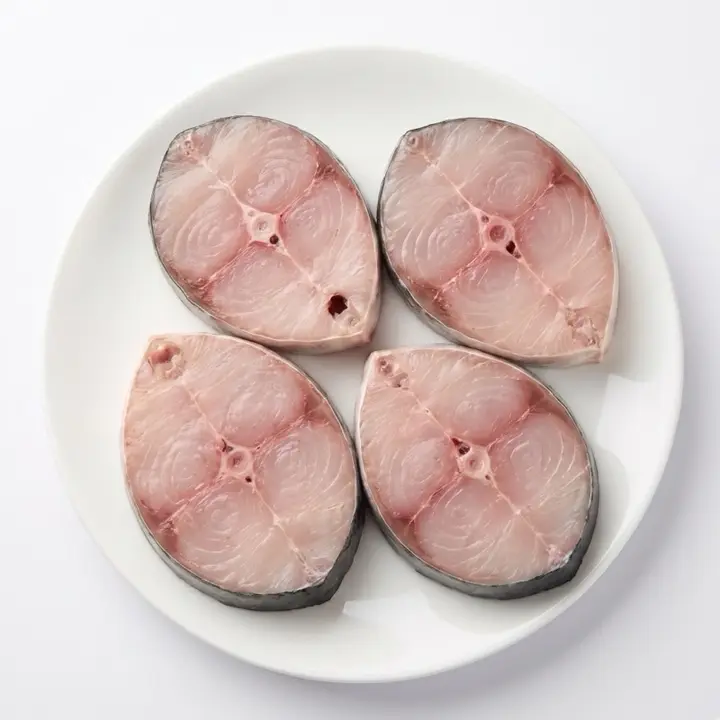
Fish in this guide: RohuKatlaBasaBangda (Mackerel)Surmai (Kingfish) Today's prices →
Farmed Fish vs Sea Fish in India: An Honest Comparison
In the farmed fish vs sea fish question, both are good protein, but sea fish win clearly on omega-3. In India’s food tables (IFCT 2017), surmai has 1.05 g of omega-3 (EPA + DHA) per 100 g and white pomfret 0.59 g, while pond-raised rohu has 0.07 g. Protein is close: every fish we compared gives 17 to 22 g per 100 g. So the healthiest plan is not “one or the other”. It is a mix, with sea fish for omega-3.
Quick answer
- Protein: close to a tie. Farmed rohu and katla and sea fish like bangda all give 17 to 22 g per 100 g.
- Omega-3 (a heart- and brain-friendly fat): sea fish win. Surmai has about 15 times rohu’s amount.
- Mercury: the farmed fish here tested low. For sea fish it depends on the species.
- Calories: basa (pangas) is much fattier than the rest.
- Best plan: eat both, with sea fish at least once or twice a week.
Every number below comes from a source listed under Sources.
This is general food information, not medical advice. If you have a health condition, are pregnant, or take regular medicines, ask your doctor what suits you.
Which fish are farmed and which come from the sea?
In Thane and Mumbai, the two groups look like this:
| Fish (Marathi name) | English name | Where it comes from |
|---|---|---|
| Rohu (रोहू) | Rohu, Labeo rohita | Freshwater carp, commercially farmed |
| Katla (कतला) | Catla, Catla catla | Freshwater carp, rivers, lakes and culture ponds |
| Basa (pangas) | Striped catfish | Freshwater catfish from the Mekong, farmed |
| Bangda (बांगडा) | Indian mackerel | Marine, caught at sea |
| Surmai (सुरमई) | Kingfish, seer fish | Marine, caught at sea |
| Pomfret (पापलेट) | Silver pomfret | Marine, caught at sea |
FishBase lists rohu as “highly commercial” in fisheries and commercially farmed. It describes catla as living in rivers, lakes and culture ponds, with commercial aquaculture. Basa (striped catfish) is native to the Mekong and has been introduced to other river basins for farming. Bangda is listed as a marine fish of coastal waters.
One honest caveat: “farmed” and “freshwater” are not quite the same thing. Some rohu and katla are still caught wild from rivers and reservoirs. But most of what reaches city markets is raised in ponds.
Is sea fish more nutritious than farmed fish?
Here are six common fish side by side, per 100 g raw edible portion, from IFCT 2017 (ICMR-NIN):
| Fish | Type | Energy (kcal) | Protein (g) | Fat (g) | EPA + DHA (g) | Vitamin D (µg) | Calcium (mg) |
|---|---|---|---|---|---|---|---|
| Rohu | Farmed | 102 | 19.71 | 2.39 | 0.07 | 1.7 | 39.37 |
| Katla | Farmed | 94 | 17.94 | 2.15 | 0.37 | 2.7 | 43.53 |
| Basa (pangas) | Farmed | 204 | 17.12 | 16.77 | 0.15 | 0.6 | 11.19 |
| Bangda | Sea | 101 | 21.51 | 1.53 | 0.33 | 1.4 | 31.27 |
| Surmai | Sea | 136 | 22.28 | 5.18 | 1.05 | 1.9 | 9.85 |
| Pomfret (white) | Sea | 123 | 19.02 | 5.12 | 0.59 | 1.1 | 13.64 |
We converted IFCT’s kJ to kcal and added EPA and DHA. Vitamin D is total activity, worked out the way IFCT does (D3 plus five times 25-hydroxy D3). Any single fish can differ with size, season and, for farmed fish, how it was raised.
What the numbers really tell you
1. Protein is a tie. All six fish give between 17 and 22 g of protein per 100 g. Sea fish edge ahead, with surmai at 22.28 g and bangda at 21.51 g. But rohu, at 19.71 g, beats pomfret. If protein is your goal, any of these works. See our fish protein guide.
2. Omega-3 is where sea fish pull ahead. Surmai has fifteen times rohu’s omega-3. White pomfret has more than eight times. These are the long-chain fats the American Heart Association has in mind when it advises fish twice a week, especially fatty fish. ICMR-NIN’s Dietary Guidelines for Indians (2024) also point to marine fish for these fats.
3. Katla is the surprise. At 0.37 g EPA + DHA, pond-raised katla has slightly more omega-3 than bangda (0.33 g). So “freshwater means no omega-3” is too simple.
4. Basa is the outlier on calories. IFCT measured pangas at 204 kcal and 16.77 g fat, roughly double rohu or bangda. Read more in is basa fish healthy?
5. River carps give more calcium. Rohu and katla have 39 to 44 mg of calcium per 100 g, against 10 to 14 mg in surmai and pomfret. Bangda sits in the middle at 31 mg.
6. Vitamin D is modest in all six. Katla leads this group at about 2.7 µg. For more, look to halwa or hilsa; see our vitamin D fish chart.
Which has more mercury, farmed or sea fish?
Fear often drives this debate. Here is what the data actually says.
Mercury in these fish
| Fish | IFCT 2017 mercury (µg per 100 g) | Same in ppm | Note |
|---|---|---|---|
| Basa (pangas) | 0.26 | 0.003 | Very low |
| Katla | 1.59 | 0.016 | Low |
| Rohu | 1.71 | 0.017 | Low |
| Bangda, surmai, white pomfret | Not measured | — | No IFCT figure |
For comparison, the US FDA’s testing gives a mean of 0.013 ppm for sardines and 0.979 ppm for shark.
- The farmed fish in this post all measured low in mercury.
- For sea fish it depends on the species. The FDA’s Best Choices include sardines, prawns and crab. Its Choices to Avoid include shark and king mackerel.
- Surmai is a close relative of king mackerel and has no Indian mercury figure. If you are pregnant, skip it. Our low mercury fish guide explains why.
Freshness and adulteration
FSSAI and ICAR-CIFT issued a guidance note on formalin in fish. It describes formalin as an adulterant some traders misuse to extend storage life. This is a handling problem, not a farmed-or-sea problem. It can affect any fish. The best defence is simple: buy from a trusted source and check freshness yourself.
How to pick good fish, farmed or sea
For any fish, farmed or sea:
- Eyes: bright, clear and bulging, not sunken or cloudy.
- Gills: red or pink, not brown or slimy.
- Skin: shiny, with scales firmly attached.
- Flesh: firm, and springs back when you press it.
- Smell: clean, like the sea or a river. A sour or ammonia smell means it is old.
Extra tips for farmed fish:
- Rohu and katla are big fish, often sold in pieces. Ask to see the whole fish before it is cut.
- A muddy smell in carp is common. Rub the pieces with salt and haldi and rinse well.
- Basa usually comes frozen. Avoid packs with heavy frost, and thaw in the fridge.
Extra tips for sea fish:
- Bangda and pomfret should be stiff, not floppy.
- Oily sea fish spoil faster. Cook bangda and surmai the same day.
- Catches change with weather and season, so supply changes too. During the monsoon fishing ban, sea fish get scarce and river fish like rohu and katla are the steadier choice. See our monsoon fish guide.
What does a balanced fish week look like?
You do not have to pick sides. Here is a simple mix:
| Day | Fish | Why |
|---|---|---|
| Monday | Bangda fry, little oil | Protein and some omega-3 |
| Wednesday | Rohu or katla curry | Protein and calcium |
| Friday | Surmai or pomfret tawa fry | Omega-3 |
| Sunday | Basa or prawns for the kids | Boneless, mild |
This meets the American Heart Association’s advice of fish at least twice a week, and ICMR-NIN’s suggestion of about 200 g of marine fish a week.
Cook with less oil. A light curry or tawa fry keeps the fish healthy. Cook finfish until it is opaque and flakes with a fork; the US FDA gives 63°C (145°F) as the safe internal temperature.
Getting farmed and sea fish in Thane
On Relifish, verified sellers in Thane list both river and sea fish every day. You can order for today or pre-order, choose how it is cleaned and cut, and pick a 2-hour delivery slot in Thane, Mulund and Bhandup. Prices change daily with the catch, so check today’s fish prices before you plan. Browse today’s fish.
You might also like: omega-3 fish ranked and fish names in English and Marathi.
What to do next: compare today’s rohu and bangda on fish price today, then pick one river fish and one sea fish for this week from the shop.
Related reading
- How to Check Formalin in Fish: Kits, Signs and Limits
- Pomfret Fish Benefits: White vs Black Pomfret Nutrition
Sources
- Longvah T, Ananthan R, Bhaskarachary K, Venkaiah K. Indian Food Composition Tables 2017 (IFCT 2017). ICMR-National Institute of Nutrition, Hyderabad. PDF at nin.res.in. Table 1 (protein, fat, energy), Table 3 (vitamin D3, 25-OH-D3), Table 5 (calcium, mercury), Table 7 (EPA, DHA). Entries: Rohu S006, Catla S002, Pangas S005, Mackerel P034, Vanjaram P087, Pomfret white P057.
- FishBase: Labeo rohita, Catla catla, Pangasianodon hypophthalmus, Rastrelliger kanagurta. Habitat, range, fisheries and aquaculture notes.
- US Food and Drug Administration. Advice about Eating Fish. Best Choices and Choices to Avoid.
- US FDA. Mercury Levels in Commercial Fish and Shellfish (1990-2012). Sardine and shark means.
- US FDA. Meat, Poultry & Seafood (Food Safety for Moms-to-Be). Cooking fish to 145°F.
- FSSAI and ICAR-CIFT. Guidance Note 01/2018 on formalin in fish.
- American Heart Association. Fish and Omega-3 Fatty Acids.
- ICMR-National Institute of Nutrition. Dietary Guidelines for Indians 2024, Guideline 7. PDF at nin.res.in.
Frequently asked questions
Is sea fish healthier than farmed fish?
For omega-3, yes. In India's food tables (IFCT 2017), sea fish like surmai (1.05 g EPA + DHA per 100 g) and white pomfret (0.59 g) carry much more omega-3 than rohu (0.07 g) or pangas (0.15 g). For protein, the gap is small: all six fish we compared give 17 to 22 g per 100 g. Both kinds fit a healthy diet.
Are rohu and katla farmed fish?
Mostly, yes. FishBase lists rohu and catla as freshwater carps native to India and its neighbours, both commercially farmed, and catla lives in rivers, lakes and culture ponds. So the rohu or katla you buy is usually pond-raised. Bangda, surmai and pomfret are marine fish caught by boats at sea, not farmed.
Which has more mercury, farmed fish or sea fish?
On available data, the farmed fish here are low. IFCT 2017 measured about 0.017 ppm mercury in rohu, 0.016 ppm in katla and 0.003 ppm in pangas. Mercury in sea fish depends on the species: the US FDA lists sardines and prawns as Best Choices but shark and king mackerel, a relative of surmai, as fish to avoid.
Which fish is better for omega-3, rohu or bangda?
Bangda. IFCT 2017 gives Indian mackerel 0.33 g EPA + DHA per 100 g, nearly five times rohu's 0.07 g. Katla is a surprise among river fish at 0.37 g, about the same as bangda. For the most omega-3, choose surmai, halwa or white pomfret, which are all above 0.5 g per 100 g.
How do I know if fish is fresh, farmed or sea?
The same checks work for both. Look for bright, bulging eyes, red gills, shiny skin and firm flesh that springs back when pressed. The fish should smell clean, like the sea or a river, not sour. Buy from a trusted source, keep it cold, and cook it the same day or freeze it at once.
How we write and check these guides: editorial standards
Share this article: