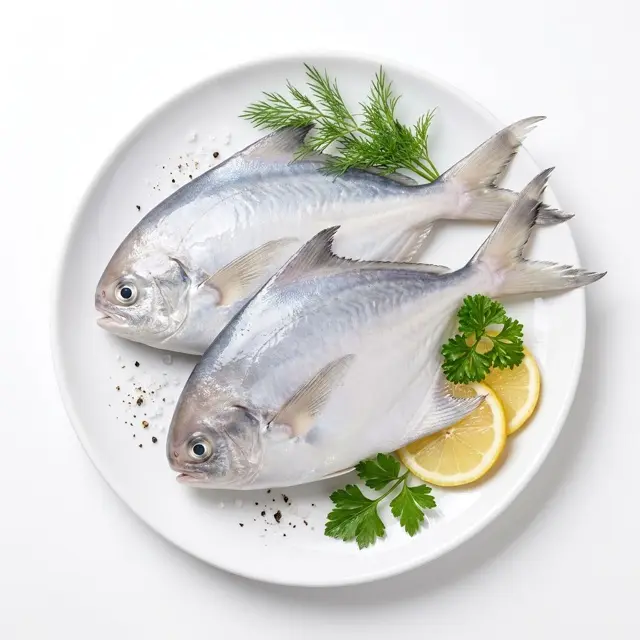
Fish in this guide: HilsaHalwa (Black Pomfret)PrawnsSardineTuna (Kupa) Today's prices →
Vitamin D Rich Fish in India: Which Fish Give You the Most?
The most vitamin D rich fish in India, by ICMR-NIN’s food tables (IFCT 2017), are hilsa at about 10 µg per 100 g raw, halwa (black pomfret) at about 5.6 µg, tiger prawns at about 4.8 µg and tarli (oil sardine) at 3.5 µg. Adults need 15 µg a day, so one good fish meal covers a real share, but rarely all of it.
- Top Indian fish: hilsa (palva), halwa, tiger prawns (kolambi) and tarli.
- Lower than you think: bangda and white pomfret, at about 1 µg per 100 g.
- Need: 15 µg (600 IU) a day for ages 1 to 70, 20 µg over 70 (NIH).
- Also: 2 to 3 fish meals a week, some real sun, and a blood test before any supplement.
Every number below comes from a source listed under Sources.
This is general food information, not medical advice. If you have low vitamin D, bone problems, kidney disease or take regular medicines, ask your doctor before changing your diet or taking supplements.
Why is vitamin D low in India, even with so much sun?
India gets plenty of sun, yet deficiency is common. ICMR-NIN’s Dietary Guidelines for Indians (2024) quotes the national CNNS survey. It found low vitamin D in 13.7% of children aged 1 to 4, 18.2% of those aged 5 to 9, and 23.9% of teenagers aged 10 to 19.
The NIH vitamin D fact sheet explains why sun alone may not be enough:
- Skin colour. More melanin means the skin makes less vitamin D from the same sun.
- Age. Older people make less vitamin D from sunlight.
- Glass. UVB rays do not pass through glass, so sun through a window does not count.
- Season, time of day, cloud, smog and sunscreen all cut the UVB that reaches your skin.
Think of a Thane office worker. Out before the sun is strong, in an air-conditioned cabin all day, home after dark. That person may see little direct sun on most days.
Very few foods have natural vitamin D. NIH names the flesh of fatty fish and fish liver oils as among the best sources. Egg yolk, beef liver and cheese have small amounts. Most vegetarian staples have none. That is why fish is worth a closer look.
How much vitamin D is in Indian fish?
IFCT 2017 measured two forms in fish. One is vitamin D3. The other is 25-hydroxy vitamin D3 (25-OH-D3), a form the body has already partly processed. NIH notes studies suggest it is about five times more potent at raising blood levels. So IFCT counts total vitamin D as D3 plus five times the 25-OH-D3. We used the same method for the last column.
Per 100 g raw edible portion:
| Fish (Marathi name) | D3 (µg) | 25-OH-D3 (µg) | Total vitamin D activity (µg) |
|---|---|---|---|
| Hilsa (palva) | 4.96 | 1.02 | 10.1 |
| Halwa (black pomfret) | 2.28 | 0.66 | 5.6 |
| Tiger prawns, orange (kolambi) | 1.62 | 0.63 | 4.8 |
| Tarli (oil sardine) | 3.51 | not reported | 3.5 or more |
| Tuna (kupa, Euthynnus affinis) | 0.11 | 0.63 | 3.3 |
| Katla | 1.90 | 0.16 | 2.7 |
| Clam, white shell (shimplya) | 2.08 | 0.10 | 2.6 |
| Bombil (Bombay duck) | 0.96 | 0.29 | 2.4 |
| Surmai (kingfish, vanjaram) | 1.57 | 0.07 | 1.9 |
| Rohu | 0.84 | 0.17 | 1.7 |
| Mud crab (khekda) | 0.94 | 0.14 | 1.6 |
| Bangda (Indian mackerel) | 0.22 | 0.23 | 1.4 |
| Salmon (Atlantic, imported) | 0.86 | 0.08 | 1.3 |
| Pomfret, white (paplet) | 0.61 | 0.10 | 1.1 |
D3 and 25-OH-D3 values are from IFCT 2017, Table 3 (Fat Soluble Vitamins). The last column is our sum using IFCT’s own method, rounded. Any one fish can differ with size, season and where it was caught.
What does the chart tell you?
Hilsa is the clear leader. At about 10 µg per 100 g, it is the only common fish here that comes close to the 15 µg adult RDA in one portion. Hilsa is a Bengali favourite. Its Marathi name is palva.
Halwa and tarli are the practical Mumbai picks. Both are everyday Konkan fish. Halwa gives about 5.6 µg per 100 g. Tarli gives at least 3.5 µg. IFCT did not report its 25-OH-D3, so its true total may be a little higher.
Prawns surprise. Tiger prawns score about 4.8 µg, higher than surmai or pomfret.
Bangda is lower than you might expect. NIH lists mackerel among the fatty fish that are good sources. But that is the Atlantic species. Indian mackerel measured only about 1.4 µg in IFCT 2017.
Salmon numbers differ by source. IFCT’s one sample of Atlantic salmon measured 1.3 µg by its method. The US database (USDA FoodData Central) lists farmed Atlantic salmon at 11.0 µg per 100 g raw. NIH lists cooked sockeye salmon at 14.2 µg per 3 ounces. Salmon in India is imported and varies a lot. Do not count on it as your main source.
How does fish compare with other foods?
NIH’s food table gives these vitamin D amounts per serving:
| Food | Vitamin D per serving |
|---|---|
| Cod liver oil, 1 tablespoon | 34.0 µg (1,360 IU) |
| Salmon (sockeye), cooked, 3 ounces | 14.2 µg (570 IU) |
| Milk, vitamin D fortified, 1 cup | 2.9 µg (120 IU) |
| Egg, 1 large, scrambled | 1.1 µg (44 IU) |
| Chicken breast, roasted, 3 ounces | 0.1 µg (4 IU) |
| Lentils, boiled, ½ cup | 0 |
Note that 1 µg equals 40 IU. Chicken and dal give almost no vitamin D. Fish is one of the few natural food sources most Indian families already eat. See our fish vs chicken guide for the protein side of that comparison.
How much vitamin D do you need a day?
NIH’s RDAs, set by the US Food and Nutrition Board:
- Ages 1 to 70, including pregnancy and breastfeeding: 15 µg (600 IU) a day.
- Over 70: 20 µg (800 IU) a day.
- Infants up to 12 months: 10 µg (400 IU) a day.
NIH notes these RDAs assume little sun exposure. The safe upper limit for adults is 100 µg (4,000 IU) a day. NIH says vitamin D toxicity almost always comes from supplements, not food or sun.
What does a simple vitamin D week with fish look like?
- Two or three fish meals a week. Rotate halwa, tarli and prawns. Add hilsa when you find it.
- Keep some fat in the dish. ICMR-NIN notes that fats help the body absorb fat-soluble vitamins like vitamin D. A tarli fry with a little oil, or a halwa curry with coconut, both work.
- Get real sun. ICMR-NIN suggests about 30 minutes of sun for children, preferably between 11 am and 2 pm. For pregnancy it suggests at least 15 minutes of direct sunlight. Arms and face, outdoors, not through glass.
- Add eggs. One egg adds about 1.1 µg.
- Test before you supplement. Only a blood test tells you your level. Your doctor can advise a dose.
For a family of four, about 500 g of cleaned halwa or tarli makes one curry or fry. At 100 g raw each, halwa gives about 5.6 µg per person, a little over a third of the day’s 15 µg (our calculation from IFCT 2017).
Pregnant? Tarli, prawns and clams are on the US FDA/EPA lowest-mercury list. Read our low mercury fish for pregnancy guide before choosing tuna or surmai, and see the pregnancy diet chart with Indian fish for a week-by-week plan.
How do you buy vitamin D rich fish in Thane and Mumbai?
- Hilsa is not listed every day. When a seller has it, ask for steaks, as it is very bony.
- Tarli is a small, bony fish. Ask the seller to scale and gut it for fry.
- Halwa is darker and firmer than white pomfret. Ask for slices for curry.
- Prawns come cleaned and deveined if you ask.
- Fresh fish has bright eyes, red gills and firm flesh that springs back.
Fish names change from market to market. Our fish names in English and Marathi chart helps. Prices change daily with the catch, so check today’s fish prices before planning your week.
Order vitamin D rich fish in Thane
Verified sellers on Relifish list halwa, tarli, prawns, tuna and other fish when they have them. You can order for today or pre-order for a later day. Choose how it is cleaned and cut, then pick a 2-hour delivery slot in Thane, Mulund or Bhandup.
What to do next: check today’s halwa and tarli, or see all of today’s fish.
Also read: omega 3 fish in India, vitamin B12 from fish, real fish vs protein powder and fish oil and fish oil capsules vs fish.
Sources
- Longvah T, Ananthan R, Bhaskarachary K, Venkaiah K. Indian Food Composition Tables 2017 (IFCT 2017). ICMR-National Institute of Nutrition, Hyderabad. PDF at nin.res.in. Table 3 (Fat Soluble Vitamins), pages 84 to 89: cholecalciferol (D3) and 25-OH-D3 for Hilsa P017, Pomfret black P055, Tiger prawns orange Q008, Sardine P071, Tuna P084, Catla S002, Clam white shell R002, Bombay duck P007, Vanjaram P087, Rohu S006, Mud crab Q005, Mackerel P034, Salmon P068, Pomfret white P057. Section 3.14 for the total vitamin D activity method.
- National Institutes of Health, Office of Dietary Supplements. Vitamin D: Fact Sheet for Health Professionals. RDA table, food table, sunlight factors, upper limit.
- ICMR-National Institute of Nutrition. Dietary Guidelines for Indians 2024. PDF at nin.res.in. Table II (CNNS 2019 data), sunlight advice for pregnancy and children, fats and fat-soluble vitamins.
- US Department of Agriculture. FoodData Central: Fish, salmon, Atlantic, farmed, raw (FDC 175167).
- US Food and Drug Administration. Advice about Eating Fish. Best Choices list.
Frequently asked questions
Which fish is richest in vitamin D in India?
In India's own food tables (IFCT 2017, ICMR-NIN), hilsa has the most vitamin D of the common fish, at about 10 µg per 100 g raw by IFCT's counting method. Halwa (black pomfret) has about 5.6 µg and tiger prawns about 4.8 µg. Tarli (oil sardine) has 3.5 µg of vitamin D3. The adult RDA used by NIH is 15 µg a day.
Is bangda a good source of vitamin D?
Bangda is a modest source. IFCT 2017 measured about 1.4 µg of vitamin D activity per 100 g of Indian mackerel. That is lower than hilsa, halwa, prawns or tarli. Bangda is still good everyday fish for protein, but if vitamin D is your reason for buying fish, pick hilsa, halwa or tarli more often.
Why is vitamin D deficiency common in India despite so much sun?
Sunlight makes vitamin D in skin, but many things cut it down: time indoors, clothing, smog, sunscreen, season and darker skin. NIH notes that people with darker skin and older people make less vitamin D from sun, and that sun through a window does not count. India's CNNS survey found deficiency in 23.9% of adolescents aged 10 to 19.
How much sunlight do I need for vitamin D?
There is no single answer, says NIH, because skin colour, season and smog all change it. ICMR-NIN's 2024 guidelines suggest about 30 minutes of sun for children, preferably between 11 am and 2 pm, and at least 15 minutes of direct sunlight in pregnancy. Sun through glass does not work. Ask your doctor about your own case.
Can eating fish fix vitamin D deficiency?
Fish can be part of the answer, but a diagnosed deficiency is a medical matter. Even hilsa gives about two-thirds of the adult RDA per 100 g, so food alone may not raise low levels quickly. Your doctor may advise a supplement and a repeat blood test. Do not start high-dose vitamin D on your own, because too much is harmful.
What are the vitamin D fish names in Marathi?
By IFCT 2017, the fish with the most vitamin D are hilsa, called palva (पालवा) in Marathi, halwa (हलवा, black pomfret), tiger prawns or kolambi (कोळंबी) and oil sardine, called tarli (तारली). Kupa (कुपा, tuna), katla and shimplya (clams) follow. Bangda and paplet have less, about 1.4 µg and 1.1 µg per 100 g.
How we write and check these guides: editorial standards
Share this article: