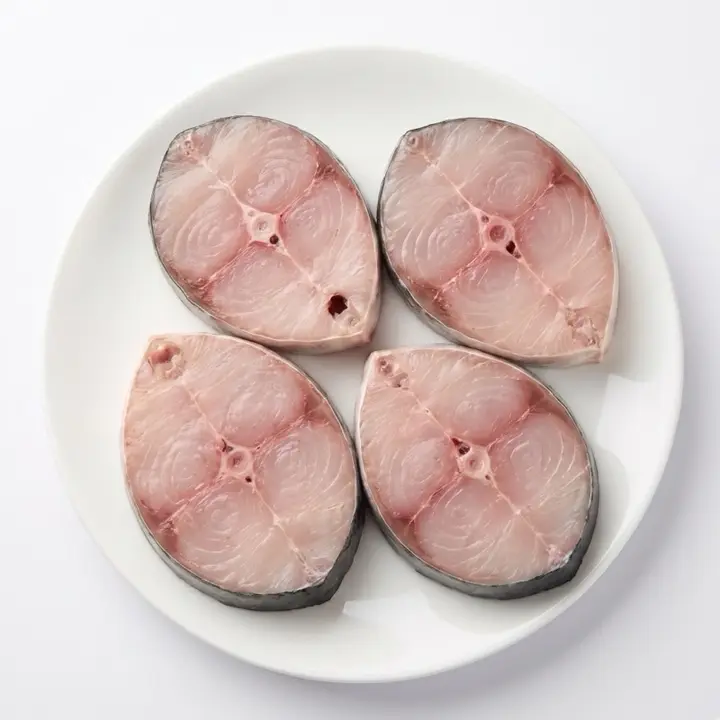
Fish in this guide: Surmai (Kingfish)Bangda (Mackerel)PomfretPrawns Today's prices →
Fish Oil vs Eating Fish, and Protein Powder vs Real Fish: What ICMR Says
For most healthy people, eating fish beats both the capsule and the scoop. ICMR-NIN advises against protein supplements for building muscle, and big trials of fish oil capsules found no clear heart benefit in people without heart disease.
- Protein: food first. ICMR-NIN Guideline 8 says avoid protein supplements to build muscle.
- Omega-3: about 200 g of marine fish a week (ICMR-NIN), or two fish meals a week (AHA).
- Fish oil capsules: a doctor's decision for specific conditions, not a daily habit for healthy people.
- One fish meal: 100 g of raw surmai gives about 22 g protein and 1.05 g EPA plus DHA (IFCT 2017).
This is general food information, not medical advice. Please ask your doctor or dietitian before changing your diet, especially if you are pregnant or have a medical condition. If your doctor has prescribed a supplement, keep following your doctor.
By Kunal Rawat, founder of Relifish. We read the full ICMR-NIN 2024 guidelines, not the news coverage. ICMR quotes carry their printed page numbers, and every trial is linked in the Sources. Last checked 22 November 2026.
Picture a 26-year-old in Thane who has just joined a gym near Gokhale Road. On his kitchen shelf sit a tub of whey and a bottle of fish oil softgels. On the stove, his aai is making the Sunday pomfret curry with coconut and kokum. He eats two helpings, then mixes a shake anyway, because the gym told him to.
His aai’s curry is doing more of the work than he thinks. This guide puts the two habits side by side. We use the exact words of India’s dietary guidelines, the big trials on fish oil, and the Indian food tables for fish you can buy in Thane.
What does ICMR say about protein powder and fish oil?
ICMR-NIN tells healthy Indians to avoid protein supplements for building muscle. It calls protein powders “unnecessary for normal healthy life”. For omega-3 (the healthy fats EPA and DHA), it advises about 200 g of marine fish a week. It says nothing about fish oil capsules.
The source is the Dietary Guidelines for Indians 2024, from the Indian Council of Medical Research and the National Institute of Nutrition (ICMR-NIN). Two guidelines matter here.
On protein (Guideline 8, pages 59 to 61). Its title says to get good protein from “appropriate combination of foods and avoid protein supplements to build muscle mass”. The key lines:
- Page 59: “Taking protein supplements on top of normal meal (balanced diet) intake is not going to build more muscle.”
- Page 60: “Most athletes can get the recommended amount of protein through food alone, without the use of supplements.”
- Page 61: “Protein powders are unnecessary for normal healthy life.”
- Page 61: “Non-vegetarians can meet their quality protein needs by taking recommended level of fish/poultry/meat/egg.”
Page 59 also warns that protein powders “may also contain added sugars, non-caloric sweeteners and additives such as artificial flavoring.” It adds that whey is rich in BCAAs (branched chain amino acids), which recent evidence suggests “may increase the risk of certain non-communicable diseases”.
How much protein do you need? Page 58 sets the adult RDA at 0.83 g per kg of body weight a day. That is 54 g a day for a 65 kg adult. Page 57 notes that an adult’s daily diet “often provides 60g to 70g of protein a day, which is higher than what we require.”
On omega-3 (Guideline 7, page 56). “Prefer marine fish such as salmon, mackerel, trout and tuna (~200gm/week)”. Mackerel is our bangda.
Three things ICMR does and does not say
- No brand list. The guidelines name no approved or unsafe protein powder brands. If a reel says ICMR has named brands, it is not quoting the guidelines.
- No view on fish oil. We searched the full text. The phrase “fish oil” does not appear.
- A kidney caution. Page 60 says kidney damage from high protein intake “may occur in those who already have some renal disease”. It also links long-term, large protein supplement use with “potential dangers, such as bone mineral loss”. If you have kidney disease, diabetes or high blood pressure, ask your doctor first.
Can you build muscle without protein powder?
Yes. Training builds the muscle; food supplies the protein. ICMR-NIN says intakes above about 1.6 g per kg a day add no further gains from resistance training (pages 59 to 60). For a 70 kg person, that ceiling is about 112 g a day, by our arithmetic. Our high protein fish diet plan for the gym shows how to reach it with meals.
Is fish better than whey protein?
For most healthy adults, yes. Both are complete proteins. But a piece of surmai also brings omega-3, vitamin B12, vitamin D and selenium, and it replaces part of a meal instead of adding to it.
| One scoop of protein powder | 100 g raw fish (IFCT 2017) | |
|---|---|---|
| Protein | Varies; check the label | Surmai 22.3 g, bangda 21.5 g, pomfret 19.0 g, tiger prawns 14.3 g |
| Omega-3 (EPA plus DHA) | None unless added | Surmai 1.05 g, pomfret 0.59 g, bangda 0.33 g, prawns 0.12 g |
| Other nutrients | Whatever the maker adds | B12, vitamin D and selenium (US FDA) |
| Added ingredients | May have sugars, sweeteners, flavouring (ICMR-NIN, p. 59) | Whatever you cook it with: oil, coconut, kokum, spices |
| Label accuracy | 25 of 36 Indian products tested had less protein than labelled (2024 study) | You can weigh your fish on a kitchen scale |
That last row needs a word. In 2024 the Citizens Protein Project, published in the journal Medicine, tested 36 protein supplements sold in India. 25 of them (69.4%) had less protein than the label claimed. 5 (13.9%) had aflatoxins, which are mould toxins. 3 (8.3%) had pesticide traces and 5 (13.9%) had arsenic. Some contained herbal extracts the authors linked to liver injury.
It was one self-funded study, and we name no brands. But it is a fair reason to ask what is in your scoop.
A fish meal also sits on a plate with rice or bhakri and a vegetable. That whole plate is what ICMR-NIN calls a balanced diet. See our fish protein and nutrition guide and fish vs chicken protein for more.
Fish oil vs eating fish: is a capsule as good as the fish?
For healthy adults, eating fish is the better bet. Your body absorbs omega-3 from both. But big trials of capsules found no clear heart benefit in people without heart disease, while advice from ICMR-NIN, the AHA (American Heart Association) and FAO/WHO is about eating fish.
A dietitian writing in The Conversation describes a study where EPA and DHA levels in the body rose in a similar way from fish or from fish oil, at equal doses. Fish also brings protein, vitamin D, iodine and selenium that a capsule does not.
The real question is whether capsules help healthy people. Here is what the main evidence says.
| Study | Who | What it found |
|---|---|---|
| AHA advisory, 2017 | Review of trials | No recommendation for capsules to prevent heart disease in the general public. “Reasonable” for people who already have heart disease, under medical care |
| VITAL trial, 2019 | 25,871 US adults, 1 g a day | No significant drop in major heart events (hazard ratio 0.92, 95% CI 0.80 to 1.06). No effect on cancer |
| UK Biobank, BMJ Medicine 2024 | 415,737 adults, about 12 years | In people without heart disease, regular fish oil use was linked with more atrial fibrillation (hazard ratio 1.13) and stroke (1.05) |
The UK Biobank study is observational. It shows a link, not a cause, and doses were not recorded.
The food evidence reads differently. A 2010 FAO/WHO expert report found that eating fish, especially oily fish, lowers the risk of death from heart disease in adults. The AHA’s 2018 advisory found that 1 to 2 seafood meals a week may lower the risk of heart failure, heart disease and stroke, especially when seafood replaces less healthy food.
So the honest summary is not “fish oil is bad”. For healthy people, the case for capsules is weak and mixed, and health bodies advise eating fish. Our omega-3 and heart health guide has the full table for Indian fish, and fish oil capsules vs fish goes deeper on capsules.
What are the side effects of fish oil capsules?
Usually mild, says the US National Center for Complementary and Integrative Health (NCCIH). They include a fishy taste, bad breath, headache, heartburn, nausea and loose motions. The atrial fibrillation link above is the more serious open question. If you take blood thinners or any regular medicine, ask your doctor before starting capsules.
How much fish equals a fish oil capsule?
Start with the EPA plus DHA figure on your capsule label. If it says 300 mg, 100 g of raw surmai matches about three and a half capsules, and 100 g of pomfret about two, by our calculation.
| Fish (100 g raw, IFCT 2017) | EPA plus DHA | 200 g a week gives (our calculation) |
|---|---|---|
| Surmai (kingfish, सुरमई) | 1.05 g | 2.1 g |
| Halwa (black pomfret, हलवा) | 0.81 g | 1.6 g |
| Tarli (oil sardine, तारली) | 0.61 g | 1.2 g |
| Pomfret (paplet, पापलेट) | 0.59 g | 1.2 g |
| Bangda (Indian mackerel, बांगडा) | 0.33 g | 0.66 g |
Fish values change with size, season and catch. Capsule labels vary by product. Treat these as planning numbers.
When does a supplement make sense?
When a doctor or dietitian says so, for a clear reason. Food first does not mean food only.
- A prescription. The AHA’s 2019 advisory found that prescription omega-3 at 4 g a day lowers very high triglycerides (a blood fat) by 30% or more. That is a monitored medical treatment, not a food habit. Do not stop a prescribed supplement because of an article.
- No fish, eggs or dairy. Your sources of omega-3 and B12 are limited. A dietitian can tell you what you need. See our vitamin B12 foods guide.
- A diagnosed deficiency. If a blood test shows low vitamin D or B12, your doctor may prescribe a dose food cannot reach quickly.
- Clinical needs. Older adults with poor appetite, people recovering from illness and people with kidney disease have protein needs set by a doctor, not a gym trainer.
- Pregnancy and breastfeeding. Mercury matters more here. See our low-mercury fish guide.
How do you get the same from real meals?
Four fish meals a week cover both jobs a scoop and a capsule are bought for. The plan below gives about 116 g of protein and 3.2 g of EPA plus DHA across the week for one adult. Values are per 150 g raw portion from IFCT 2017; totals are our calculation.
| Day | Meal | Protein | EPA plus DHA |
|---|---|---|---|
| Monday | Bangda fry with rice and solkadhi | 32.3 g | 0.50 g |
| Wednesday | Kolambi curry with bhakri | 21.4 g | 0.18 g |
| Friday | Surmai fry on the tawa, with chapati and salad | 33.4 g | 1.58 g |
| Sunday | Malvani pomfret curry with rice | 28.5 g | 0.89 g |
Surmai on Friday and pomfret on Sunday alone give 300 g of marine fish and about 2.5 g of EPA plus DHA. That clears ICMR-NIN’s 200 g a week and matches the AHA’s two fish meals. Bangda and prawns add protein and variety. The prawn figure uses IFCT’s tiger prawns; sea prawns differ a little.
Ask for the right cut. Surmai in 1 cm steaks for the tawa. Bangda gutted, with slits on both sides. Pomfret in thick slices for curry. Prawns peeled and deveined. Verified sellers on Relifish clean and cut to order.
Check freshness. Look for bright, clear eyes, red gills and firm flesh that springs back. Prawns should smell of the sea, not of ammonia.
Keep it light. Shallow fry on a tawa with a teaspoon or two of oil instead of deep frying. Keep curries coconut-based with kokum rather than cream. New to ordering? Our first order guide walks you through it.
Plate vs pill calculator
Enter your weight and how often you eat fish to see how your plate compares with a scoop or capsule.
The calculator uses the same IFCT 2017 values. It is an estimate for planning meals, not medical advice. It does not suggest stopping anything your doctor has prescribed.
The bottom line for the gym-goer in Thane
Keep training, because protein only builds muscle with resistance exercise. Eat the fish curry. Add a bangda fry or surmai tawa fry midweek. Spend the shake money on food you would eat anyway. If a doctor says you need a supplement, take it on their advice, not a reel’s.
What to do next: check today’s fish prices in Thane, then order surmai, bangda or pomfret from verified sellers with a 2-hour delivery slot in Thane and nearby Mulund and Bhandup. Questions about an order: call +91 91522 07607.
You might also like: best fish for athletes and fish vs eggs vs paneer protein.
Sources
- ICMR-National Institute of Nutrition. Dietary Guidelines for Indians 2024. Guideline 7, pages 55 to 56; Guideline 8, pages 57 to 61. PDF at nin.res.in. Booklet: nin.res.in.
- Longvah T, Ananthan R, Bhaskarachary K, Venkaiah K. Indian Food Composition Tables 2017 (IFCT 2017). ICMR-NIN, Hyderabad. PDF at nin.res.in. Protein (Table 1) and EPA, DHA (Table 7) for surmai, bangda, pomfret, halwa, sardine, tiger prawns.
- Citizens Protein Project: analysis of 36 protein supplements sold in India. Medicine (Baltimore). 2024;103(14). PMC10994440 and PubMed 38579036.
- Siscovick DS, Barringer TA, Fretts AM, et al. Omega-3 Polyunsaturated Fatty Acid (Fish Oil) Supplementation and the Prevention of Clinical Cardiovascular Disease: A Science Advisory From the American Heart Association. Circulation. 2017;135:e867 to e884. ACC summary.
- Manson JE, Cook NR, Lee IM, et al. Marine n-3 Fatty Acids and Prevention of Cardiovascular Disease and Cancer (VITAL). New England Journal of Medicine. 2019;380:23 to 32. doi:10.1056/NEJMoa1811403. Summary: NIHR Evidence.
- Chen G, Qian ZM, Zhang J, et al. Regular use of fish oil supplements and course of cardiovascular diseases: prospective cohort study. BMJ Medicine. 2024. DOAJ record.
- Rimm EB, Appel LJ, Chiuve SE, et al. Seafood Long-Chain n-3 Polyunsaturated Fatty Acids and Cardiovascular Disease: A Science Advisory From the American Heart Association. Circulation. 2018;138(1):e35 to e47. doi:10.1161/CIR.0000000000000574.
- Skulas-Ray AC, Wilson PWF, Harris WS, et al. Omega-3 Fatty Acids for the Management of Hypertriglyceridemia: A Science Advisory From the American Heart Association. Circulation. 2019;140(12):e673 to e691. doi:10.1161/CIR.0000000000000709.
- Mantzioris E. Are fish oil supplements as healthy as we think, and is eating fish better? The Conversation, republished by Down To Earth. downtoearth.org.in.
- FAO and WHO. Report of the Joint FAO/WHO Expert Consultation on the Risks and Benefits of Fish Consumption. 2010. fao.org.
- US Food and Drug Administration. Advice about Eating Fish. Nutrients in fish: protein, vitamin B12, vitamin D, selenium.
- US National Center for Complementary and Integrative Health. Omega-3 Supplements: What You Need To Know (updated November 2024). Side effects.
Frequently asked questions
Is eating fish better than taking fish oil?
For most healthy adults, yes. Eating fish gives you EPA and DHA along with protein, vitamin B12, vitamin D and selenium in one meal. The AHA's 2017 advisory made no recommendation for fish oil capsules to prevent heart disease in the general population, and the VITAL trial found no significant drop in major heart events with 1 g a day. Diet advice from ICMR-NIN and the AHA is about eating fish.
Should I take fish oil if I already eat fish?
If you are healthy and already eat oily sea fish such as surmai, bangda or pomfret about twice a week, most guidance does not ask you to add capsules. ICMR-NIN suggests about 200 g of marine fish a week for long-chain omega-3. If your doctor has prescribed omega-3 for a condition such as very high triglycerides, keep following your doctor's advice.
How much fish equals one fish oil capsule?
Capsules differ, so read the EPA and DHA figure on your label. Then compare it with IFCT 2017 values: 100 g of raw surmai has about 1.05 g (1,050 mg) of EPA plus DHA, pomfret about 0.59 g and bangda about 0.33 g. If your capsule says 300 mg EPA plus DHA, 100 g of surmai carries roughly what three and a half such capsules do, by our calculation.
Did ICMR say not to take protein powder?
ICMR-NIN's Dietary Guidelines for Indians 2024 tell healthy people to avoid protein supplements for building muscle. Guideline 8 says to get good protein from food combinations and to avoid protein supplements to build muscle mass, and page 61 states that protein powders are unnecessary for normal healthy life. It is guidance for healthy people, not a ban, and it does not cover medical nutrition prescribed by a doctor.
Is protein powder bad for your kidneys?
ICMR-NIN writes that kidney damage or worsening kidney function with high protein intake may occur in people who already have some kidney disease, and that prolonged intake of large amounts of protein as a supplement is linked with potential dangers such as bone mineral loss. If you have kidney disease, diabetes or high blood pressure, talk to your doctor before using any protein supplement.
Did ICMR publish a list of safe whey protein brands?
No. The Dietary Guidelines for Indians 2024 contain no list of approved or unsafe protein powder brands. Posts and videos claiming an ICMR whey brand list are not quoting the guidelines. What the document does say is general: protein powders are unnecessary for normal healthy life, and non-vegetarians can meet their protein needs from fish, poultry, meat and eggs.
How we write and check these guides: editorial standards
Share this article: