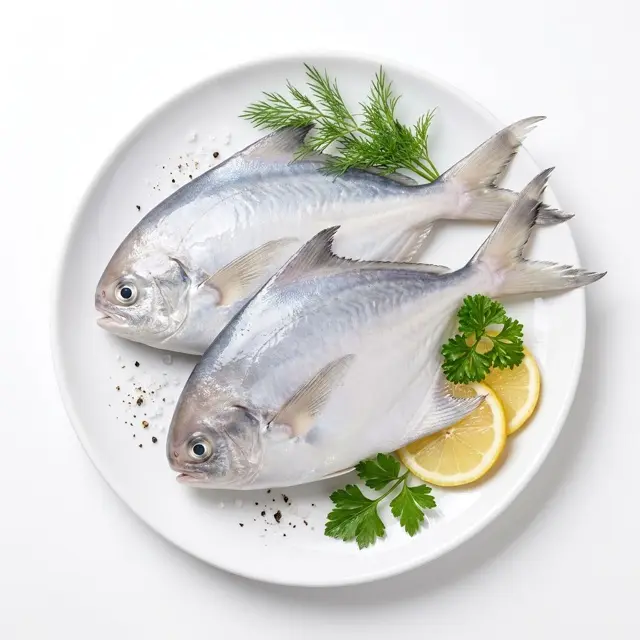
Fish in this guide: PomfretHalwa (Black Pomfret)Surmai (Kingfish) Today's prices →
Malvani Pomfret Curry Recipe (Paplet Curry with Coconut and Kokum)
Malvani pomfret curry is thick pomfret pieces simmered in a fried coconut and Malvani masala gravy, soured with kokum and scented with tirphal. It serves 4 in about 45 minutes, and the secret is to simmer the fish gently for 6 to 8 minutes without stirring.
- Buy 2 medium silver pomfret (250 to 300 g each), cut into 3 thick pieces each, bone in.
- Grind 100 g fresh coconut with roasted onion, garlic and 2.5 tbsp Malvani masala.
- Fry the paste until oil shows at the edges, then add hot water, 6 to 8 kokum petals and 4 to 5 tirphal.
- Slide the fish in and simmer 6 to 8 minutes. Swirl the pan; never stir with a spoon.
In a Malvani home, Sunday lunch has a sound and a smell. The sound is the mixer grinding coconut with onion that has just gone brown. The smell is coconut oil, red masala and the woody hit of tirphal as the gravy simmers.
Then the paplet goes in, the pan gets a gentle swirl, and someone puts the rice on. What reaches the table is a pourable orange gravy, tangy with kokum, around soft pomfret pieces that are still whole. This is that curry, written down with exact grams so it turns out the same every Sunday.
Why does this Malvani pomfret curry recipe work?
Many quick pomfret curries are tomato based and thin. The Malvani version gets its depth from four things, and each one is measured here.
- Roasted onion in the vatan. Browning the onion before grinding (bhajlela kanda) gives a sweet, toasty base that raw onion cannot.
- The paste is fried until oil shows. Three to four minutes of stirring removes the raw coconut taste. It also stops the gravy splitting later.
- Kokum for sourness, tirphal for aroma. Kokum gives a soft, fruity tang. Tirphal adds a citrusy, woody note that sets this curry apart.
- The fish goes in last and is never stirred. Thick pieces, a wide pan and a gentle simmer keep every piece whole.
What are kokum and tirphal?
Kokum (amsul) is the sun-dried rind of a fruit that grows along the Konkan coast. Soaked in warm water, it gives a gentle sourness and turns the gravy a dusky pink-orange. Strength varies between batches, so start with 6 petals and taste. If it gets too sharp, lift the petals out.
Tirphal (teppal) is the dried, split berry of a Konkan tree from the same family as Sichuan pepper. It smells woody and citrusy and leaves a light tingle on the tongue. Crush 4 to 5 shells lightly and throw away the black seeds, which are bitter.
More than 5 shells makes the curry bitter and numbing. Konkan provision stores and spice shops sell it. Without it the curry still works; it just tastes less Malvani. Our tirphal guide explains how to buy and store it.
No Malvani masala at home? Dry roast these on low heat for 2 minutes until fragrant:
- 4 Byadgi chillies and 1 tsp coriander seeds
- 1/4 tsp cumin and 4 black peppercorns
- 2 cloves and a 1 cm piece of cinnamon
Grind them with 1 tsp Kashmiri chilli powder. This replaces the 2.5 tbsp of masala in the recipe.
Which pomfret is best for curry?
Three fish are sold as pomfret at a Thane fish counter. All three work in this gravy, but they cook differently.
| Fish | Texture in curry | Size to buy | Simmer time |
|---|---|---|---|
| Silver pomfret (paplet) | Softest, most delicate, the classic choice | Medium, 250 to 300 g each | 6 to 8 minutes |
| Khapri pomfret | Thicker and firmer, holds shape better | 300 g and up | 7 to 9 minutes |
| Black pomfret (halwa) | Firmest, stronger taste, pieces never break | 500 g and up, cut | 8 to 10 minutes |
For a family of 4, two medium silver pomfret give 6 thick pieces, about 500 g after cutting. That is one or two pieces each with rice.
What to ask your seller
Ask for 2 medium silver pomfret, scaled, fins trimmed and gutted. Then ask for each fish to be cut across into 3 thick pieces (about 2.5 cm), bone in. Keep the head for the curry if you like it; many Malvani families do.
How to check it is fresh: bright silver skin with no yellow patches, clear bulging eyes, red gills, and firm flesh that springs back when pressed. If you would rather clean it yourself, our guide on how to clean pomfret covers scaling, gills and the curry cut. You can also read about white, black and silver pomfret in more detail.
How do you keep pomfret whole in curry?
Pomfret is soft. Most broken curries come down to three habits: thin pieces, a crowded pan and a spoon.
- Cut thick. About 2.5 cm, with the bone in. The bone holds each piece together.
- Use a wide, shallow pan. All 6 pieces should sit in one layer.
- Cook the gravy first. Slide the fish in from the side only once the gravy is ready. Spoon gravy over the top.
- Move the pan, not the fish. Hold both handles and swirl gently.
- Keep a lazy simmer. Partly cover, and switch off as soon as the flesh near the bone turns opaque. The 10 minute rest finishes the cooking.
What if the curry goes wrong?
| Problem | Why it happens | Fix |
|---|---|---|
| Raw coconut taste | Paste not fried long enough | Next time, fry until oil shows at the edges |
| Gravy split or oily | It boiled hard after the coconut went in | Lower the heat and whisk in 2 tbsp hot water |
| Too sour | Kokum sat in too long | Lift it out and add a small pinch of jaggery |
| Bitter | Too much tirphal, or seeds left in | A little extra coconut paste softens it |
| Fish breaking | Pieces too thin, or stirred | See the section above |
| Too thick after resting | Gravy reduced | Add hot water a splash at a time and simmer |
Variations
- With coconut milk: replace 100 ml of the water with thick coconut milk once the fish is cooked. Simmer only 1 minute, or it splits.
- Without coconut: fry 1 onion and 1 tomato with 2 tbsp Malvani masala, then add water, kokum and fish. It is thinner and sharper.
- Hirva (green) paplet curry: grind the coconut with 30 g coriander, 3 green chillies, garlic and ginger instead of red masala.
- Same gravy, other fish: surmai steaks need 7 to 9 minutes, bangda 6 to 8 and prawns 4 to 5. Our Malvani fish curry recipe uses surmai or bangda.
What to serve with pomfret curry
Serve it with steamed ukdya tandlacha bhaat (parboiled red rice) or plain rice. A soft tandlachi bhakri mops up the gravy.
Use a few extra kokum petals to make a glass of solkadhi on the side. For a full Malvani thali, add a crisp fry such as our surmai fry recipe or pomfret tawa fry, with sliced onion and lemon.
Storage and make ahead: the gravy, cooked to the kokum stage without fish, keeps 2 days in the fridge. Reheat it and add the fish fresh. The finished curry keeps 1 day; reheat gently until piping hot without a hard boil. Do not freeze it, as the pomfret turns soft and the gravy splits.
How many calories are in pomfret curry?
One serving (curry only, without rice) is about 290 kcal, 20 g protein, 20 g fat and 8 g carbohydrate. It also has about 0.6 g EPA plus DHA (omega-3 fats). These are approximate figures.
They are based on about 400 g edible pomfret from 500 g cut pieces. The Indian Food Composition Tables 2017 (ICMR-NIN) list raw pomfret at 19.02 g protein, 5.12 g fat and 0.59 g EPA plus DHA per 100 g. Coconut, about 35 ml oil, onion and masala use standard values.
Coconut and oil supply most of the fat. The no-coconut version comes to roughly 200 kcal. For more on omega-3 in Indian fish, read our omega-3 and heart health guide. Pomfret is also a common first fish for children; see best fish for kids.
What to do next
Ask for 2 medium silver pomfret, cleaned and cut into 3 thick pieces each, and order from verified sellers in Thane and Mulund. Check today’s fish prices in Thane and the pomfret page before you plan the menu. For help with an order, call +91 91522 07607.
You might also like
- Why fish curry doesn’t taste the same anymore
- Malvani crab masala recipe
- Kolambi curry, Maharashtrian prawn curry
Malvani Pomfret Curry (Paplet Curry with Coconut, Kokum and Tirphal)
Ingredients
Method
- Marinate the fish. Pat the pomfret pieces dry and rub with 1/2 tsp salt and 1/4 tsp turmeric. Set aside. Skip lemon here, because the kokum brings the sourness later.
- Roast onion for the vatan. Heat 1 tsp oil in a small pan. Fry the sliced onion on medium until brown at the edges. Add the garlic, ginger and coriander seeds for the last minute, switch off the heat and stir in the coconut just to warm it. Do not brown the coconut.
- Grind the vatan. Cool slightly, then grind with the Malvani masala, 1/2 tsp turmeric and about 200 ml water to a very smooth, thick paste.
- Start the curry. Heat 2 tbsp oil in a wide, shallow pan that holds the fish in one layer. Fry the chopped onion until soft and golden.
- Fry the paste. Add the vatan and cook on medium low, stirring, until it thickens, smells toasty and shows oil at the edges. This removes the raw coconut taste.
- Build the gravy. Pour in the hot water, add the tirphal and salt and bring to a gentle boil. Simmer 3 minutes, then add the kokum with its soaking water and simmer 2 minutes more.
- Add the fish. Slide the pomfret pieces in, in a single layer, and spoon gravy over them. Simmer gently, partly covered, until the flesh is opaque and pulls away from the bone. Do not stir with a spoon; swirl the pan by its handles instead.
- Finish. Taste for salt and sourness. If the kokum is turning sharp, lift the petals out. Scatter the coriander and switch off the heat.
- Rest. Optional. Cover and rest so the fish soaks up the gravy. Add a splash of hot water if it thickens too much, then serve warm.
Approx. per serving: 290 kcal · protein 20 g · fat 20 g · carbs 8 g
Frequently asked questions
Which pomfret is best for curry?
Medium silver pomfret of 250 to 300 g each gives the most delicate, classic Malvani curry. Khapri pomfret is larger and firmer, so it holds its shape even better in gravy. Black pomfret, called halwa, is firmer still and needs 8 to 10 minutes of simmering. All three work; choose silver for softness and halwa if you want pieces that never break.
What is kokum and can I use tamarind instead?
Kokum is the dried rind of a Konkan fruit that gives a gentle, fruity sourness and a dusky pink colour. It is the traditional souring agent in Malvani curry. You can use 1 tsp tamarind pulp instead, but tamarind is sharper and darker and changes the taste. Add it in small amounts and taste before adding more.
How long should pomfret be cooked in curry?
Simmer 2.5 cm thick pieces for 6 to 8 minutes at a gentle bubble, partly covered. The fish is done when the flesh turns opaque white and starts to pull away from the central bone. Thinner pieces need 4 to 5 minutes. Black pomfret needs 8 to 10. A short rest off the heat finishes the cooking without breaking the fish.
How do I stop pomfret breaking in curry?
Ask for thick pieces, about 2.5 cm, cut across the fish with the bone in. Use a wide pan so the pieces sit in one layer. Slide them into gravy that is already cooked, spoon gravy over the top and never stir with a spoon. Swirl the pan by its handles instead, and keep the gravy at a gentle simmer, not a rolling boil.
Can I make pomfret curry without coconut?
Yes. Fry 1 chopped onion and 1 tomato in oil until soft, add 2 tbsp Malvani masala and stir for a minute, then add hot water, kokum and salt. Simmer 5 minutes and add the fish as usual. The curry is thinner, sharper and lighter, at roughly 200 kcal a serving, but it loses the rich body of the coconut version.
How many calories are in pomfret curry?
One serving of this Malvani pomfret curry, without rice, is about 290 kcal with 20 g protein, 20 g fat and 8 g carbohydrate. That is an approximate figure using IFCT 2017 values for pomfret plus standard values for coconut, oil and onion. Most of the fat comes from the coconut and oil, not the fish.
How we write and check these guides: editorial standards
Share this article: