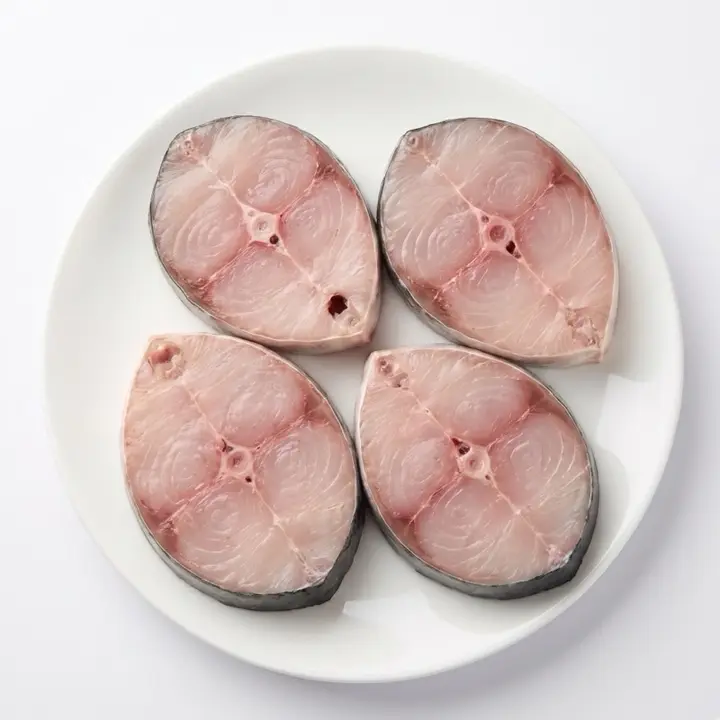
Fish in this guide: Surmai (Kingfish) Today's prices →
Surmai Fry Recipe (Surmai Rava Fry and Tawa Fry, Maharashtrian Style)
This surmai fry recipe gives crisp, golden steaks with a sandy rava crust and moist, flaky flesh inside. Marinate 1 cm surmai steaks, spread on a thin chilli masala, press on coarse rava and fry on a hot tawa for 3 to 4 minutes per side; skip the rava for a tawa fry.
- Serves 4 in 55 minutes, using 500 g surmai: 8 middle-cut steaks, 1 cm thick.
- Marinate 20 minutes in salt, turmeric, lemon and ginger-garlic, then spread on a thin masala paste.
- Press on 60 g coarse rava mixed with 20 g rice flour, and rest 10 minutes.
- Fry on a cast iron tawa on medium heat, 3 to 4 minutes per side, flipping once.
At a Thane fish market around 7 in the morning, surmai is the fish people point at first. The seller slices it into neat round steaks with a heavy knife. Each one shows a dark red line along the bone.
By lunch, those steaks are on a smoking tawa in homes across Thane and Mulund. The rava crackles, the edges brown and a squeeze of lemon hisses on top. Surmai fry next to varan bhaat is about as close to a Sunday ritual as a Maharashtrian kitchen gets.
The trouble at home is a rava crust that falls off, burns or goes soft. This recipe fixes all three with the right cut, the right rava and a few minutes of patience.
Why does this surmai fry recipe work?
- The right cut. Middle-cut steaks, 1 cm thick, cook through in the 7 to 8 minutes the crust needs to brown. Thinner steaks dry out; thicker ones need a lid.
- Three layers, then a rest. Marinade, a thin masala paste, then rava pressed on firmly. The paste gives the rava something to grip. A 10 minute rest lets the grains soak up moisture and set.
- Coarse rava cut with rice flour. 60 g coarse rava with 20 g rice flour gives a crunchy, even crust that does not burn before the fish cooks.
- Steady heat and one flip. A cast iron tawa on medium, oil shimmering, one flip only.
What should you ask your fish seller?
Ask for middle-cut surmai steaks (darne), 1 cm thick, skin on, cleaned. From 500 g you get about 8 steaks, two per person.
The middle of the fish gives wide, even steaks with one central bone. The tail cut is narrower and dries out faster, so save it for curry.
How to check surmai is fresh:
- Firm, glossy flesh that springs back when pressed
- No ammonia smell
- A bright red blood line along the steak, not a brown one
Verified sellers on Relifish cut surmai to the thickness you ask for. See what is available on the surmai page, and read surmai in English for its other names.
Which rava is best for fish fry?
Use coarse rava (bombay rava or jada rava), mixed with rice flour at about three parts rava to one part rice flour. Coarse rava gives the classic crunchy, sandy crust.
Rice flour fills the gaps between the grains, so the coating holds together and browns evenly. Fine rava gives a smoother, softer crust. It burns faster on a hot tawa and goes limp sooner.
Surmai rava fry vs tawa fry: what is the difference?
| Rava fry | Tawa fry | |
|---|---|---|
| Coating | Masala paste plus coarse rava and rice flour | Masala paste plus a light dusting of rice flour |
| Texture | Crunchy golden crust, moist inside | Soft, charred red masala, juicier surface |
| Oil | About 4 tbsp across 2 batches | About 2 tbsp per batch |
| Time per side | 3 to 4 minutes | About 3 minutes |
| Choose it when | You want a crisp side for a fish thali | You want a quicker, lighter fry |
For a surmai tawa fry, follow the recipe card but skip the rava. After the masala paste, dust the steaks with about 1 tbsp rice flour in total. Fry 3 minutes per side with 2 tbsp oil.
How do you know when surmai fry is done?
Fry 1 cm steaks for 3 to 4 minutes per side, 7 to 8 minutes in total. The fish is done when the flesh near the bone turns opaque and lifts away cleanly.
With a thermometer, aim for 63°C (145°F), the safe minimum temperature for fish used by US food safety agencies.
Tips for crisp surmai fry
- Coating falls off: the fish was wet, you skipped the paste, or you flipped too early. Leave each steak alone for the first 3 minutes.
- Sticks to the pan: the tawa was not hot enough, or there was too little oil. Wait for the oil to shimmer.
- Dry fish: the steaks were too thin or overcooked. Stick to 1 cm and check the bone at 7 minutes.
- Burnt rava: the heat was too high, or you used fine rava. Keep the flame at medium. Wipe the tawa between batches, as burnt grains make the next batch bitter.
- Thick steaks: cover with a lid for the last 2 minutes so the centre cooks through.
Storage: eat it hot, as the crust softens within about 30 minutes. Marinated steaks keep up to 6 hours in the fridge if you add the lemon only in the last 20 minutes. Leftover fried steaks keep 1 day; re-crisp on a dry tawa or in an air fryer at 180°C for 3 to 4 minutes.
Variations
Malvani surmai fry. Use kokum aagal in the marinade instead of lemon. Use 2.5 tsp Malvani masala as the only spice in the paste, for a tangier, deeper red fry.
Green masala fry. Replace the red paste with 30 g coriander, 3 green chillies, 6 garlic cloves and 1 cm ginger, ground together.
In an air fryer. After coating, spray both sides with oil, about 1 tbsp in total. Air fry at 200°C for 10 to 12 minutes, flipping and spraying again at 6 minutes. The crust is lighter and less even, so press the rava on firmly.
Same method, other fish. This works on whole slashed pomfret, rawas steaks or whole bangda. Adjust the time to the thickness. See our rawas fry and pomfret tawa fry.
What to serve with surmai fry
The classic pairing is varan bhaat with a squeeze of lemon. For a full fish thali, add solkadhi and a Malvani pomfret curry with rice. Tandlachi bhakri, sliced onion and green chutney also work. Or serve two steaks as a starter with prawns koliwada.
How many calories are in surmai fry?
One serving (two steaks, about 125 g raw surmai) is roughly 300 kcal, 30 g protein, 13 g fat and 16 g carbohydrate. It also gives about 1.3 g omega-3 fats (EPA plus DHA).
These figures use the Indian Food Composition Tables 2017 (ICMR-NIN), which list raw surmai at 22.28 g protein, 5.18 g fat and 1.05 g EPA plus DHA per 100 g. Rava, rice flour and about 30 ml absorbed oil use standard values. Skin and bone lower the edible weight a little, so treat this as approximate.
Surmai is one of the richer sources of omega-3 among the fish sold in Mumbai. Read more in our omega-3 fish guide and, if you train, the best fish for athletes.
This is general food information, not medical advice. Check with your doctor or dietitian before changing your diet, especially if you are pregnant or have a medical condition.
What to do next
Ask for middle-cut surmai steaks, 1 cm thick: verified sellers in Thane and Mulund cut them to order. Check today’s fish prices in Thane first. New to ordering? The Relifish ordering guide walks you through it.
You might also like
Surmai Fry (Maharashtrian Rava Fry)
Ingredients
Method
- Dry the steaks. Rinse the steaks, then pat both sides dry with a kitchen towel. Surface water is what makes rava slide off.
- Marinate. Rub the steaks with the salt, turmeric, lemon juice (or kokum agal) and ginger-garlic paste. Rest 20 minutes, covered. Not more than 30 minutes with lemon, or the surface turns mushy.
- Make the masala paste. Mix both chilli powders (or the Malvani masala), coriander powder, cumin, garam masala and coriander leaves with just enough water for a thick, spreadable paste.
- Coat with the paste. Spread a thin layer of paste on both sides of each steak, pushing it into the skin.
- Press on the rava and rest. Mix the coarse rava, rice flour, chilli and salt on a plate. Press each steak firmly into the mix on both sides and the edges, then shake off loose grains. Lay them on a plate and rest 10 minutes so the coating hydrates and sets.
- Heat the tawa. Heat a cast iron tawa or heavy pan on medium for about 3 minutes. Add 2 tbsp oil and spread it. It is ready when the oil shimmers and a pinch of rava sizzles at once, around 170 to 180 °C on the surface.
- Fry side one. Place 4 steaks with space between them and don't move them for 3 minutes. Drizzle ½ tsp oil around each steak. Flip when the underside is deep golden and releases easily; if it sticks, give it another 30 seconds.
- Fry side two and check doneness. Fry 3 to 4 minutes until golden. The flesh near the central bone should be opaque and lift away cleanly, or read 63 °C on a probe thermometer. Stand each steak on its edge for 20 seconds to crisp the skin.
- Drain and fry the second batch. Drain on a wire rack. Wipe the burnt rava off the tawa, add the remaining oil and fry the second batch the same way.
- Serve. Serve at once with lemon wedges and sliced onion, while the crust is still crisp.
Approx. per serving: 300 kcal · protein 30 g · fat 13 g · carbs 16 g
Frequently asked questions
Which rava is best for fish fry, fine or coarse?
Coarse rava, sold as bombay rava or jada rava, gives the classic crunchy, sandy crust on a fish fry. Mix it with about one part rice flour to three parts rava so it holds together and browns evenly. Fine rava makes a smoother, softer crust that burns faster on a hot tawa and goes limp within minutes of serving.
What is the difference between surmai rava fry and tawa fry?
Both start with the same marinade and masala. Rava fry adds a coat of coarse rava and rice flour, so you get a crunchy golden crust and a little more oil absorbed. Tawa fry skips the rava, uses just a light dusting of rice flour, and lets the red masala itself char on the pan. It is quicker, lighter and more masala-forward.
How long should surmai be fried on each side?
For 1 cm thick steaks on a medium-hot cast iron tawa, fry 3 to 4 minutes per side, about 7 to 8 minutes in total. The fish is done when the flesh near the bone turns opaque and lifts away cleanly. A probe thermometer should read 63 °C, the safe internal temperature for fish in US FDA guidance.
What is surmai called in English?
Surmai is called seer fish or kingfish in Indian English. The surmai sold in Mumbai and Thane is mostly Scomberomorus commerson, known internationally as the narrow-barred Spanish mackerel. In other Indian languages it goes by vanjaram in Tamil and neymeen in Malayalam. In Marathi homes it is simply surmai, prized for its firm, almost boneless steaks.
Is surmai high in mercury?
Surmai is a seer fish, the narrow-barred Spanish mackerel. Its closest match on the US FDA and EPA fish chart is Spanish mackerel, listed under Good Choices, with one serving a week advised. Do not confuse it with king mackerel, a different Atlantic species on the FDA's avoid list. If you are pregnant, see our low-mercury fish guide and ask your doctor.
How many calories are in surmai fry?
About 300 kcal per serving of two steaks, with 30 g protein, 13 g fat, 16 g carbohydrate and about 1.3 g omega-3 (EPA plus DHA). The estimate uses IFCT 2017 values for surmai, standard values for rava and rice flour, and about 30 ml oil absorbed across the batch. A tawa fry without rava has fewer carbohydrates and calories.
How we write and check these guides: editorial standards
Share this article: