Fish in this guide: PomfretSurmai (Kingfish)Bangda (Mackerel)PrawnsShark (Mushi) Today's prices →
Goan Fish Curry Recipe: Coconut, Red Chilli and Kokum
This Goan fish curry recipe grinds raw coconut with Kashmiri chillies, spices and tamarind into a smooth orange masala. You cook it briefly with onion, then simmer pomfret, kingfish or mackerel in it with kokum for 6 to 9 minutes. It serves 4 in about 45 minutes.
Goan fish curry is the daily lunch of Goa, so common that “fish curry rice” is almost one word there. In Konkani it is xitt kodi, rice and curry. The gravy is bright orange, smooth as silk, hot without being harsh and clearly sour from tamarind and kokum. Unlike the Malvani curry most Thane families know, nothing is roasted. Raw coconut and soaked chillies are ground together, and the curry tastes fresh and clean.
This recipe is for a home kitchen in Thane or Mumbai. It gives exact grams, a fish-by-fish timing table and what to ask your seller. So you can cook it with whatever is good at the market today.
Why this Goan fish curry recipe works
- Raw coconut, not roasted. Grinding fresh coconut as it is keeps the gravy bright and light. Roasting it would push the curry towards Malvani.
- Kashmiri chillies for colour. They give a deep red with gentle heat. Two Byadgi or one hot chilli adds kick without dulling the colour.
- Tamarind in the masala, kokum in the pot. Tamarind gives the main, sharp sourness. Kokum rounds it off with a soft, fruity tang.
- The onion stays pale. Soft, golden onion adds sweetness. Browned onion would darken the curry and change its taste.
- A short, gentle simmer. The masala cooks for only 3 to 4 minutes before the water goes in, and the fish is added last and never stirred.
Which fish to buy and the cut to ask for
Goan homes use whatever the boats bring in, but three fish are the classics. Their Goan Konkani names are useful if you follow Goan recipes.
| Fish | Goan name | Cut to ask for | Simmer time |
|---|---|---|---|
| Pomfret | paplet | 2 medium fish, 3 thick pieces each, bone in | 6 to 8 min |
| Surmai (kingfish) | isvon | 5 steaks, 2 cm thick, skin on | 7 to 9 min |
| Bangda (mackerel) | bangdo | 4 fish, gutted, 3 pieces each | 6 to 8 min |
| Prawns | sungta | Medium, peeled, deveined, tail on | 4 to 5 min |
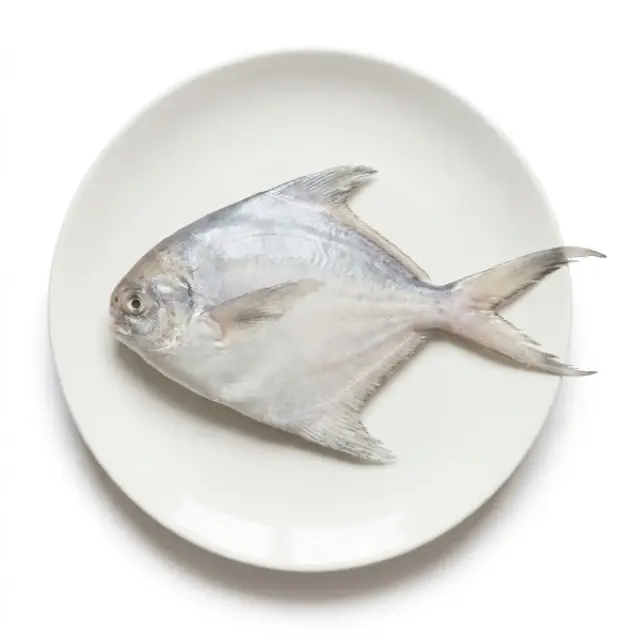
Pomfret gives the most delicate curry and is the restaurant favourite. Ask for 2 medium silver pomfret of 250 to 300 g, scaled, fins trimmed, gutted and cut across into 3 thick pieces each. Our guide on how to clean pomfret shows the curry cut step by step.
Surmai is the Sunday fish in Goa. Steaks from the middle of the fish hold their shape best. Bangda is the everyday choice. It is oilier and stronger, and the tamarind balances it well.
Check which verified sellers have each fish today on the fish pages, and see today’s fish prices in Thane before you plan the menu. Whatever you buy, look for bright eyes, red gills and firm flesh that springs back.
How to get the colour and texture right
The look of a good Goan fish curry is half the pleasure: glossy, smooth and a clear orange red. Four things decide it.
- Soak the chillies. Fifteen minutes in hot water softens the skins so they grind fine. Unsoaked chillies leave red flecks and a grainy gravy.
- Grind longer than you think. Run the mixer 3 to 4 minutes, scraping down twice. Rub a little paste between your fingers. It should feel smooth.
- Do not brown anything. Keep the onion pale gold and cook the masala on medium. Browning turns the colour brick and the taste heavy.
- Keep the coconut in proportion. About 120 g of coconut to 8 chillies gives a strong colour. More coconut makes the curry paler and sweeter.
How thick should it be? Goan fish curry is meant to be poured over rice. It should be a little thicker than single cream and should run off a spoon in a steady stream. If it is too thick after resting, add hot water a splash at a time.
How to tell when the fish is done
The fish is cooked when the flesh turns opaque all the way to the bone and flakes when you press it with a spoon. The US FDA advises cooking fish to an internal temperature of 145°F (63°C). In a gently simmering curry that usually happens a minute or two before the times above end. Switch off then, cover and let the curry rest for 10 minutes. The fish finishes cooking and soaks up the gravy.
Troubleshooting
- Gravy is grainy: the chillies were not soaked or the masala was not ground long enough. Grind again with a little water.
- Too sour: cut the tamarind to 10 g next time, or leave out the kokum. For now, add a small pinch of jaggery.
- Not sour enough: add 2 or 3 kokum petals and simmer 2 minutes, or a squeeze of tamarind pulp.
- Curry split or oily: it boiled hard after the coconut went in. Lower the heat and whisk in 2 tbsp hot water.
- Fish broke: the pieces were thin, the pan was crowded, or it was stirred. Swirl the pan instead.
- Strong fishy smell with bangda: the black belly lining was left in. Scrape it out and rinse twice before salting.
Variations
- Goan prawn curry: use 400 g medium prawns, peeled and deveined, and simmer only 4 to 5 minutes. Some homes add a few pieces of raw mango in season.
- With drumsticks or raw mango: add 2 drumsticks, cut into 7 cm pieces, with the water. Simmer 8 minutes before the fish goes in. Raw mango slices replace the kokum.
- Coconut milk version: grind the spices and tamarind with only 100 ml water. Use 300 ml thin coconut milk for the gravy. Stir in 100 ml thick milk at the end and heat 1 minute without boiling.
- Ambot tik: Goa’s sour and fiery curry, usually made without coconut and often with shark. It is a different dish, with more chilli, vinegar or tamarind and a thinner gravy.
What to serve with it
Serve it the Goan way. Pile up boiled ukda rice (parboiled red rice), add a fried fish on the side and a simple vegetable. For the fried fish, try our bangda fry or pomfret tawa fry, both quick on a tawa while the curry rests. Plain white rice works well too.
Storage: the curry tastes even better the next day. It keeps 1 day in the fridge in a covered container. Reheat gently until piping hot without a hard boil. The gravy without fish keeps 2 days, so you can make it ahead and cook the fish fresh. Do not freeze it, because the coconut gravy splits. To keep raw fish fresh until you cook, see how to store fish at home.
Nutrition notes
We do not give a calorie panel for this curry. The coconut, oil and fish change it too much. For the fish itself, India’s food tables give clear figures, per 100 g raw, from IFCT 2017 (ICMR-NIN):
| Fish | Protein | Omega-3 (EPA plus DHA) |
|---|---|---|
| Pomfret | 19.02 g | 0.59 g |
| Surmai | 22.28 g | 1.05 g |
| Bangda | 21.51 g | 0.33 g |
Most of the fat in the curry comes from the coconut and oil, not the fish. For more, read pomfret nutrition and benefits and our omega-3 fish guide. If you are pregnant, check our guide to low-mercury fish in pregnancy first.
This is general food information, not medical advice. Ask your doctor about your own diet.
What to do next
Ready to cook? Ask for pomfret in 3 thick pieces, surmai steaks or bangda cut into 3, and order from verified sellers in Thane and Mulund. Choose how it is cleaned and cut, pick a 2-hour delivery slot and check today’s rate first. The seller delivers across Thane and nearby Mulund and Bhandup. For help with an order, call +91 91522 07607.
Sources
- Indian Food Composition Tables 2017, ICMR-NIN: protein, fat and EPA plus DHA for raw pomfret, surmai and bangda.
- US FDA, Selecting and Serving Fresh and Frozen Seafood Safely: cook fish to 145°F (63°C).
Related reading
- Solkadhi Recipe: Pink Kokum Coconut Drink, Malvani Style
- How to Clean Prawns at Home: Peel and Devein Guide
- Malvani fish curry recipe
- Malvani pomfret curry recipe
- Kolambi curry: Maharashtrian prawn curry
Goan Fish Curry (Coconut, Red Chilli and Kokum)
Ingredients
Method
- Salt the fish. Rinse the fish pieces and pat dry. Rub with 1 tsp salt and 1/4 tsp turmeric and keep aside for 15 minutes while you grind the masala.
- Grind the masala. Drain the soaked chillies. Grind them with the coconut, coriander seeds, cumin, peppercorns, turmeric, garlic, ginger and tamarind, adding about 200 ml water a little at a time, to a very smooth, bright orange paste. This takes 3 to 4 minutes in a mixer.
- Soften the onion. Heat the coconut oil in a wide, shallow pan on medium. Add the onion and green chillies and cook 3 to 4 minutes until the onion is soft and pale gold, not brown.
- Cook the masala. Add the ground masala and stir on medium for 3 to 4 minutes, until it thickens, smells cooked and a little oil shows at the edges. Do not let it catch at the bottom.
- Make the gravy. Rinse the mixer jar with 300 ml water and pour it in. Add the salt and kokum and bring to a gentle boil. Simmer 5 minutes. The gravy should be pourable, a little thicker than single cream.
- Cook the fish. Slide in the fish in one layer and spoon gravy over it. Simmer uncovered on low: pomfret and bangda 6 to 8 minutes, surmai 7 to 9 minutes. Swirl the pan instead of stirring.
- Rest. Switch off when the flesh at the bone turns opaque. Cover and rest 10 minutes so the fish soaks up the gravy. Serve with rice.
Frequently asked questions
Which fish is best for Goan fish curry?
Pomfret, kingfish and mackerel are the classics. In Goa, kingfish (surmai, called isvon in Konkani) is the favourite for Sunday curry because the steaks are firm and almost boneless. Pomfret gives a softer, delicate curry. Mackerel (bangdo) is the everyday fish and tastes stronger. Prawns also work well, and need only 4 to 5 minutes in the gravy.
Is Goan fish curry made with kokum or tamarind?
Most Goan homes use tamarind in the ground masala, and many also drop in a few kokum petals while the gravy simmers. Tamarind gives a sharper, deeper sourness. Kokum adds a softer, fruity tang and a pink tint. This recipe uses both. If you only have one, use 1 tbsp tamarind pulp, or 8 kokum petals added to the gravy.
Why is my Goan fish curry not red?
The colour comes from Kashmiri chillies, which are deep red but mild. Hot chillies like Guntur give heat but a duller colour. Use 8 Kashmiri chillies soaked in hot water, grind very fine, and do not brown the onion or the masala, because browning turns the gravy dull. Too much coconut also makes the curry paler.
What is the difference between Goan and Malvani fish curry?
Goan fish curry grinds raw coconut with whole dried red chillies, coriander and tamarind, so the gravy is bright orange, smooth and tangy. Malvani fish curry roasts the coconut and onion first and uses a ready Malvani masala with warm spices, so it is darker, spicier and more aromatic. Both go best with plain rice.
Can I use coconut milk instead of grated coconut?
Yes. Grind the chillies, spices, garlic, ginger and tamarind with 100 ml water. Cook this paste with the onion, then add 300 ml thin coconut milk and the fish. Stir in 100 ml thick coconut milk only after the fish is cooked, and heat for 1 minute without boiling, or it can split. The curry is smoother and richer this way.
How we write and check these guides: editorial standards
Share this article: