Fish in this guide: Surmai (Kingfish)Bangda (Mackerel)PomfretPrawnsRawas (Indian Salmon) Today's prices →
Malvani Fish Curry Recipe: Surmai or Bangda Kalvan
This Malvani fish curry is the Konkan coast kalvan. Roast fresh coconut and onion until brown, grind them with garlic and Malvani masala, and fry the paste. Then simmer surmai steaks or bangda pieces in it with kokum. Surmai needs 7 to 9 minutes and bangda 6 to 8. It serves 4 in about 50 minutes.
Key points:
- Use surmai (kingfish) steaks for a mild curry, or bangda (Indian mackerel) for a stronger everyday one.
- 500 g surmai steaks or 4 medium bangda serve a family of 4 with rice.
- Roast the coconut and onion brown; that is what makes it Malvani.
- Never stir the fish. Swirl the pan, and rest the curry 10 minutes.
In Malvan, fish curry means one thing: kalvan. It sits next to rice every day of the week. On weekdays it is bangda, bought in the morning and in the pan by noon. On Sundays it is surmai, cut into thick steaks.
The gravy is the same. It is orange brown and thick enough to cling to rice. It is hot from the masala, nutty from roasted coconut and soured with kokum.
This recipe is written for a home kitchen in Thane or Mumbai. It gives exact grams, the cut to ask for and a table of simmer times, so you can use whatever fish looks good today. You can also read this Malvani fish curry recipe in Marathi.
Why this Malvani fish curry works
- The coconut and onion are roasted, not raw. Browning them before grinding gives the deep, toasty base that sets Malvani curry apart from Goan or Mangalorean curries.
- Malvani masala does the heavy lifting. It is a ready blend of dried red chillies with coriander, pepper, cloves, cinnamon and other warm spices. One spoon carries both heat and aroma.
- The paste is fried until oil shows. Four to five minutes on medium cooks out the raw masala and stops the gravy splitting later.
- Kokum goes in at the end. Added in the last 2 minutes, it gives a soft, fruity sourness. Boiled too long, it turns harsh.
- The fish is never stirred. Thick pieces, one layer and a swirl of the pan keep every piece whole.
Surmai or bangda: which to buy and the cut to ask for
Both fish make an excellent Malvani fish curry, but they give different results.
| Surmai (kingfish) | Bangda (Indian mackerel) | |
|---|---|---|
| Taste | Mild, meaty, clean | Stronger, richer, more “fishy” |
| Bones | One central bone per steak | Central spine, a few fine belly bones |
| Best for | Guests, children, Sunday lunch | Everyday kalvan, masala lovers |
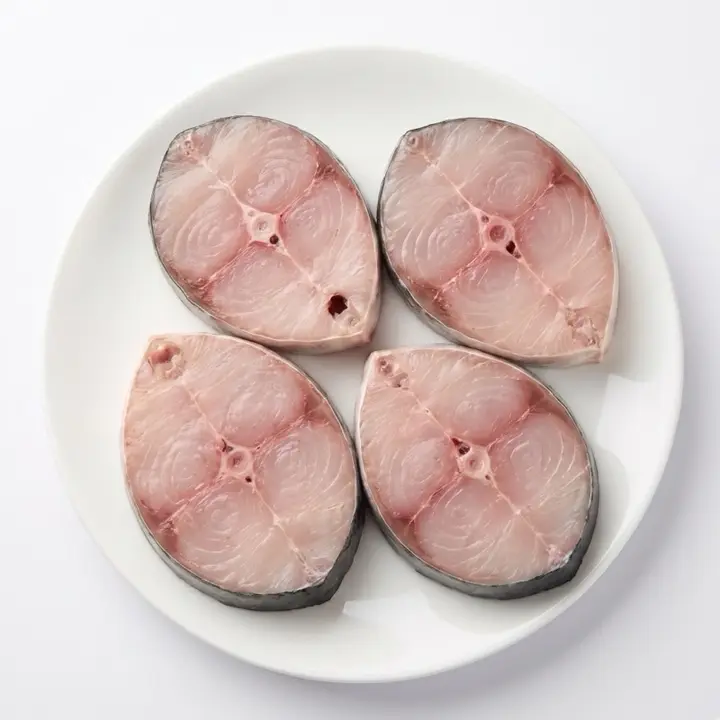
| Cut to ask for | Steaks 2 cm thick, skin on | Gutted, belly cleaned, 3 pieces per fish |
| Simmer time | 7 to 9 minutes | 6 to 8 minutes |
For surmai, ask for 500 g of steaks from the middle of the fish, 2 cm thick, skin on. Thinner steaks break in the gravy. The tail end is bonier and dries out.
For bangda, ask for 4 medium fish of 150 to 180 g, gutted, belly lining cleaned, head off, each cut into 3 pieces.
How to check freshness: look for bright eyes, red gills and firm, shiny skin that springs back when pressed. For the Marathi and English names of other fish, see fish names in English and Marathi.
Check which verified sellers have surmai and bangda today on the fish pages, then compare today’s fish prices in Thane.
Malvani masala, kokum and tirphal
Malvani masala is sold in most Thane and Mumbai grocery stores, and many Malvani families still grind their own each summer. Brands differ in heat. Start with 2 tbsp, taste the gravy, then add the last half spoon.
No Malvani masala at home? Dry roast 5 Byadgi chillies, 1 tsp coriander seeds, 1/4 tsp cumin, 5 black peppercorns, 3 cloves and a 1 cm piece of cinnamon. Keep the heat low for 2 minutes, until fragrant. Grind them with 1 tsp Kashmiri chilli powder and 1/4 tsp turmeric. That replaces the 2.5 tbsp in the gravy.
Kokum is the dried rind of a Konkan fruit. It gives a gentle sourness and a dusky pink tint. Strength varies by batch, so start with 6 petals and lift them out if the curry turns too sour.
Tirphal (teppal) is a dried berry with a woody, citrus smell and a light tingle. Crush 4 shells and throw away the black seeds, which are bitter. It is optional, but it is what makes the curry taste of Malvan.
Simmer times for other fish
The same gravy works with most fish from the morning market. Keep the gravy and the method the same and change only the cut and the time.
| Fish | Cut to ask for | Simmer time |
|---|---|---|
| Surmai | Steaks, 2 cm | 7 to 9 min |
| Bangda | 3 pieces per fish | 6 to 8 min |
| Pomfret | 3 thick pieces per fish, bone in | 6 to 8 min |
| Rawas | Steaks, 2.5 cm | 8 to 10 min |
| Prawns | Medium, peeled, deveined | 4 to 5 min |
For pomfret, we have a full Malvani pomfret curry recipe with tips on keeping the soft fish whole. For prawns, try the Koli kolambi curry, which uses raw (not roasted) coconut for a lighter gravy. Delicate fish like bombil fall apart in a simmering curry, so they are better fried.
How to tell when the fish is done
Do not go only by the clock. Fish is cooked when the flesh turns opaque all the way to the bone and flakes when you press it with a spoon. The US FDA advises cooking fish to an internal temperature of 145°F (63°C).
In a curry, that point often comes a minute or two before the times above end. Switch off then. The 10 minute rest under a lid finishes the cooking gently and lets the fish soak up the gravy.
Troubleshooting
- Gravy tastes of raw coconut: the coconut was not roasted to light brown, or the paste was not fried long enough. Fry until oil shows.
- Gravy is grainy: grind longer, with a little more water. A fine paste gives a smooth, glossy curry.
- Too sour: the kokum sat in too long. Lift it out and add a small pinch of jaggery.
- Bitter: too much tirphal, the seeds were left in, or the coconut burnt. Roast on medium, not high.
- Fish broke: the pieces were thin, or it was stirred. Swirl the pan instead.
- Bangda smells strong: the black belly lining was not cleaned. Scrape it out and rinse twice before marinating.
Variations
- Without coconut: fry 1 onion until brown, add 1 tomato and 2 tbsp Malvani masala, then water, kokum and fish. Sharper and lighter.
- With coconut milk: replace 100 ml of the water with thick coconut milk once the fish is cooked. Simmer 1 minute only.
- Ambat, tangier: add 6 more kokum petals, or 1 tsp tamarind with the water, for the sour style many Konkan homes like with bangda.
- Lower oil: fry the paste in 1.5 tbsp oil on a non-stick pan and add 2 tbsp water if it sticks. See our low-oil fish curry recipe for more ideas.
What to serve with it
Malvani fish curry is made for rice. Serve it with steamed ukda (parboiled) rice or plain white rice, and a tandlachi bhakri to wipe the plate. Add a glass of sol kadhi made from the rest of the kokum.
For a Sunday thali, add a crisp surmai fry or a bangda fry, with sliced onion and lemon. The curry tastes even better the next day, so many families make extra gravy and add fresh fish.
Storage: the finished curry keeps 1 day in the fridge. Reheat it gently until piping hot without a hard boil. The gravy alone keeps 2 days. For how to keep raw fish fresh until cooking, see how to store fish at home.
Nutrition notes
We do not give a calorie panel for this curry, because coconut, oil and fish size change it a lot. What we can give are the raw fish figures from India’s food tables, IFCT 2017 (ICMR-NIN):
| Per 100 g raw | Protein | Omega-3 (EPA plus DHA) |
|---|---|---|
| Surmai | 22.28 g | 1.05 g |
| Bangda | 21.51 g | 0.33 g |
IFCT also lists bangda at 1.53 g total fat. Most of the fat in the curry comes from the coconut and oil, not the fish. For more, read our surmai fish benefits guide.
If you are pregnant, read our guide to low-mercury fish in pregnancy before you choose. This is general food information, not medical advice; ask your doctor about your own diet.
Sources
- Indian Food Composition Tables 2017, ICMR-NIN: protein, fat and EPA plus DHA for raw surmai and bangda.
- US FDA, Selecting and Serving Fresh and Frozen Seafood Safely: cook fish to 145°F (63°C).
Related reading
- Solkadhi Recipe: Pink Kokum Coconut Drink, Malvani Style
- Surmai Fish in English: Kingfish or Seer Fish? (2026)
- Malvani pomfret curry recipe
- Goan fish curry recipe
- Why fish curry does not taste the same anymore
What to do next: check today’s fish prices in Thane, then ask for surmai steaks or bangda cut into 3 and order from verified sellers. Pick a 2-hour slot; the seller delivers across Thane, Mulund and Bhandup. For help, call +91 91522 07607.
Malvani Fish Curry (Surmai or Bangda Kalvan)
Ingredients
Method
- Marinate the fish. Rinse the surmai steaks or bangda pieces and pat dry. Rub with 1 tsp salt, the turmeric and 1 tsp Malvani masala. Rest 15 minutes while you make the gravy.
- Roast the onion and coconut. Heat 1 tsp oil in a pan on medium. Fry the sliced onion for 4 minutes until golden at the edges. Add the coconut and coriander seeds and roast, stirring, 5 to 6 minutes until the coconut is light brown and smells nutty. Cool 5 minutes.
- Grind the vatan. Grind the roasted onion and coconut with the garlic, ginger, 2.5 tbsp Malvani masala and 100 to 150 ml water to a very smooth paste. Rub a little between your fingers: it should not feel grainy.
- Fry the paste. Heat the remaining oil in a wide, shallow pan on medium. Add the paste and fry, stirring, 4 to 5 minutes until it darkens a shade and oil shows at the edges.
- Make the gravy. Pour in 400 ml hot water, add the salt and the crushed tirphal, and bring to a gentle boil. Simmer 4 minutes. The gravy should coat a spoon thinly; add a splash of water if it is thick.
- Cook the fish. Slide in the fish in a single layer and spoon gravy over the top. Simmer uncovered on low: surmai steaks 7 to 9 minutes, bangda pieces 6 to 8 minutes. Swirl the pan by its handles instead of stirring.
- Add kokum and rest. Add the kokum with its soaking water in the last 2 minutes. Taste and adjust salt. Switch off when the flesh at the bone is opaque, scatter coriander, cover and rest 10 minutes before serving.
Frequently asked questions
Which fish is best for Malvani fish curry?
Surmai and bangda are the two Malvani favourites. Surmai steaks are firm, mild and almost boneless, so they suit guests and children. Bangda is stronger and oilier and soaks up the masala, which is why it is the everyday kalvan in Malvan homes. Pomfret, rawas and prawns also work in the same gravy; only the simmer time changes.
What is the difference between Malvani and Goan fish curry?
Malvani fish curry roasts the coconut and onion before grinding and uses Malvani masala, a blend of dried chillies and warm whole spices, so it is darker, spicier and more aromatic. Goan fish curry grinds raw coconut with whole red chillies and tamarind, giving a brighter, smoother, tangier gravy. Both use kokum or tamarind for sourness.
Can I make Malvani fish curry without coconut?
Yes. Fry one sliced onion until brown, add one chopped tomato and 2 tbsp Malvani masala, cook until oil shows, then add 400 ml water, kokum and the fish. It is thinner and sharper than the coconut kalvan, and lighter on fat. Many families make this quicker version on busy weekdays and keep the coconut kalvan for Sunday.
How do I stop the fish breaking in the curry?
Buy thick pieces, about 2 cm for surmai and 3 pieces per bangda with the bone in. Make sure the gravy is fully cooked before the fish goes in, use a wide pan so the pieces sit in one layer, and swirl the pan instead of stirring. Keep it at a gentle simmer and let the curry rest 10 minutes off the heat.
Can I use tamarind instead of kokum?
Yes. Use 1 tbsp thick tamarind pulp in place of 6 kokum petals and add it with the water, not at the end. Tamarind is sharper and darker, so the curry loses some of its dusky pink colour. Kokum is the Malvani choice because its sourness is softer and fruitier. Lemon juice, stirred in after cooking, is the last resort.
How long does Malvani fish curry keep?
The finished curry keeps 1 day in the fridge in a covered steel or glass container. Reheat gently until piping hot without a hard boil. The gravy alone, cooked up to the kokum stage without fish, keeps 2 days, so you can make it ahead and add fresh fish on the day. Do not freeze it, because the coconut gravy splits.
How we write and check these guides: editorial standards
Share this article: