Fish in this guide: Bangda (Mackerel)Surmai (Kingfish)Rawas (Indian Salmon)Pomfret Today's prices →
Low Oil Fish Curry: Konkani Kokum Curry in 2 tsp Oil
This low oil fish curry uses just 2 teaspoons of oil for 4 people. Bangda simmers in a tangy kokum gravy with a little dry-roasted coconut, and each serving comes to about 185 kcal with 27 g protein.
Most Konkan homes already know how to cook light. A weekday ambat or kalvan was never meant to swim in oil. The tang comes from kokum, the body from a little coconut and the flavour from the fish itself. Heavy oil and a big bowl of coconut are what we add for guests.
This recipe goes back to that everyday style. It suits anyone watching their oil, from a parent cooking for the family to someone told to cut down on fat.
This is general food information, not medical advice. If you have a heart condition, diabetes or high cholesterol, ask your doctor or dietitian how much oil and fish suits you.
How much oil is “low oil”?
India’s national dietary guidelines give a clear number. ICMR-NIN’s Dietary Guidelines for Indians 2024 set a limit on visible fat (cooking oil, ghee and butter). It is 20 to 50 g a day per person, or 4 to 10 teaspoons, depending on how active you are.
| Who | Visible fat a day (ICMR-NIN) |
|---|---|
| Sedentary adult woman | 20 g |
| Sedentary adult man | 30 g |
| Moderately active woman / man | up to 30 g / 40 g |
| Heavily active woman / man | up to 40 g / 50 g |
The same guidelines say a 2,000 kcal diet needs no more than 27 to 30 g of visible fat. They also warn against reheating cooking oil again and again.
This curry uses 10 g of oil in the whole pot. Split four ways, that is 2.5 g each, about half a teaspoon. It leaves most of your day’s allowance for breakfast, dinner and the tadka on your dal.
Why this recipe works with so little oil
- Steam does the work oil usually does. The onion cooks covered on low heat. Its own water softens it, and a spoon of water stops sticking.
- Coconut is dry roasted, not fried. Two minutes in a dry pan gives the nutty smell you would get from frying it in oil.
- The fish is not fried first. Many curries start with a quick fry of the fish. Skipping it saves a tablespoon or more of oil.
- Kokum carries the flavour. Its sourness makes the gravy taste full, so you miss the oil less.
- The curry rests. Ten minutes off the heat lets the fish soak up the gravy.
Ingredients for a low oil fish curry (serves 4)
| Ingredient | Amount | Note |
|---|---|---|
| Bangda (बांगडा, Indian mackerel) | 500 g cleaned | each fish cut into 3 |
| Fresh grated coconut | 30 g (3 tbsp) | full coconut curries use 100 g or more |
| Kokum petals (आमसूल) | 8 | soaked in 100 ml warm water |
| Kashmiri chilli powder | 1.5 tbsp | or 1 tbsp Malvani masala |
| Coriander powder | 1 tsp | |
| Garlic and ginger | 5 cloves, 1 inch | ground with the coconut |
| Oil | 2 tsp (about 10 g) | groundnut or coconut |
| Onion | 100 g | finely chopped |
| Turmeric, salt, curry leaves, coriander | to taste |
Ask your seller to clean the bangda, remove the head and cut each fish into 3 curry pieces. On Relifish you can choose the cut when you order.
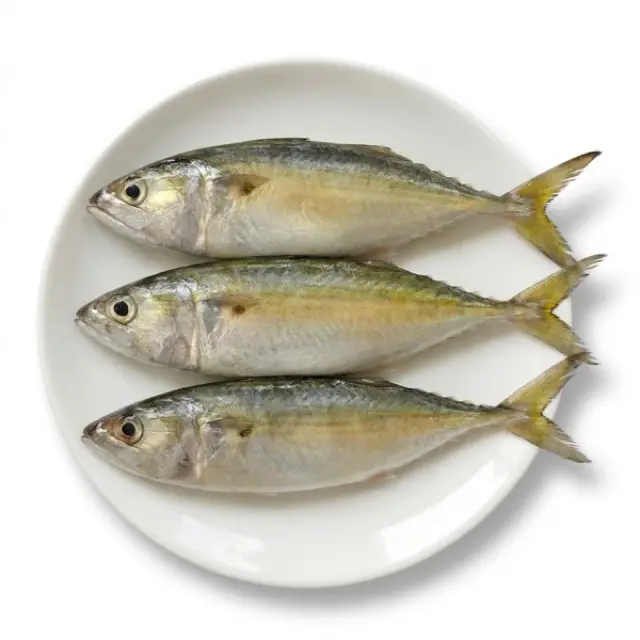
How to pick fresh bangda: the eyes should be clear and bulging, the gills bright red, and the body firm, shiny and silver-blue. Bangda is an oily fish and spoils fast, so cook it the day you buy it. Our bangda guide has more tips.
How to make low oil fish curry, step by step
- Soak the kokum. Put 8 petals in 100 ml warm water for 15 minutes. Squeeze them and keep the water.
- Salt the fish. Rub the pieces with 1/2 tsp turmeric and 1/2 tsp salt. Rest 10 minutes.
- Make the masala. Dry roast the coconut for 2 minutes until it smells nutty. Grind it with the chilli, coriander powder, garlic, ginger and 100 ml water until smooth.
- Cook the onion without extra oil. Heat 2 tsp oil, add curry leaves, then the onion and a pinch of salt. Cover and cook on low for 5 minutes. Add a spoon of water if it catches.
- Cook the paste. Add the masala and stir for 4 to 5 minutes. It is ready when it thickens and the raw garlic smell is gone.
- Make the gravy. Pour in 300 ml water, bring to a boil, then add the kokum water, petals and salt. Simmer 3 minutes.
- Add the fish. Lay the pieces in one layer. Swirl the kadai instead of stirring. Simmer with the lid half on for 6 to 8 minutes.
- Check and rest. The fish is done when the flesh is opaque and separates easily from the bone. Add coriander, cover and rest 10 minutes.
Common mistakes: stirring breaks the fish, so swirl the pan. Boiling hard makes the flesh dry, so keep it at a gentle simmer. Too much kokum turns the gravy dark and bitter, so start with 8 petals and add more next time if you like it sharper.
Which fish to use
Any firm fish that holds its shape works. The fish you choose changes the calories more than you might expect, because some fish carry more natural fat. Values below are per 100 g raw from IFCT 2017 (ICMR-NIN). The last column is our calculation for one serving of this curry with 500 g of that fish.
| Fish (Marathi name) | kcal per 100 g raw | Protein per 100 g | Curry per serving |
|---|---|---|---|
| Prawns (कोळंबी, kolambi) | 65 | 14.25 g | about 140 kcal |
| Rawas (रावस, Indian salmon) | 73 | 17.9 g | about 150 kcal |
| Bangda (बांगडा) | 101 | 21.51 g | about 185 kcal |
| Pomfret (पापलेट, paplet) | 123 | 19.02 g | about 212 kcal |
| Surmai (सुरमई, kingfish) | 136 | 22.28 g | about 229 kcal |
Prawns cook in 4 to 5 minutes, so add them last. Surmai and rawas steaks need 7 to 8 minutes. Check today’s fish prices before you decide, since rates change every morning.
How we worked out 185 kcal a serving
We used raw weights and published per-100 g values, then divided by 4. Spices, garlic, ginger and kokum add only a few calories, so we left them out.
| Ingredient | Amount | kcal | Protein | Fat |
|---|---|---|---|---|
| Bangda (IFCT 2017) | 500 g | 505 | 107.6 g | 7.7 g |
| Fresh coconut (USDA) | 30 g | 106 | 1.0 g | 10.1 g |
| Oil (USDA) | 10 g | 88 | 0 g | 10.0 g |
| Onion (USDA) | 100 g | 40 | 1.1 g | 0.1 g |
| Whole pot | 739 | 109.7 g | 27.8 g | |
| Per serving (÷ 4) | about 185 | about 27 g | about 7 g |
The number is a little high, because it counts all 500 g of fish. The bones you leave on the plate are not eaten. For comparison, the same curry made with 100 g coconut and 2 tbsp (about 30 g) oil works out to roughly 290 kcal a serving. For the method behind these numbers, see calories in fish curry.
How much to serve, and with what
One serving is about 125 g of raw fish with its gravy. That is close to the US FDA’s adult seafood serving of 4 ounces (about 113 g). ICMR-NIN also suggests about 200 g of marine fish a week, so two meals of this curry cover it.
- With rice bhakri (तांदळाची भाकरी). One bhakri made with 40 g rice flour adds about 146 kcal (USDA rice flour, 366 kcal per 100 g).
- With steamed rice. 150 g cooked rice adds about 195 kcal (USDA, 130 kcal per 100 g).
- With jowar bhakri. Same idea. Keep it to one or two, and fill the rest of the plate with a dry bhaji.
- On the side. Onion and cucumber koshimbir, and a dry vegetable such as cabbage or french beans with very little oil.
Kokum fish curry tastes better after a few hours. Cool it quickly, refrigerate in a closed steel or glass box and eat within a day. Reheat gently till it bubbles; do not boil hard or the fish breaks.
Variations
- No coconut: grind the spices with 1 small tomato instead. Lighter and sharper.
- Green version: grind 30 g coriander, 3 green chillies and the garlic with the coconut, and skip the red chilli.
- Tirphal: add 4 to 5 lightly crushed tirphal with the kokum for the Malvani aroma.
- Richer weekend version: our Malvani pomfret curry or kolambi curry use more coconut, for days when you want it.
For more ways to keep fish light, see best fish for weight loss and omega-3 fish for heart health.
Order bangda, rawas or surmai cleaned and cut for curry from verified sellers in Thane and nearby Mulund. Pick same-day or pre-order and a 2-hour delivery slot.
What to do next: see today’s bangda from verified sellers, ask for it cut into 3 curry pieces, and cook this curry tonight.
Related reading
Sources
- ICMR-National Institute of Nutrition. Dietary Guidelines for Indians 2024. PDF at nin.res.in. Page 54: visible fat limited to 20 to 50 g (4 to 10 teaspoons) a day; 20 g for sedentary women and 30 g for sedentary men; 27 to 30 g for a 2,000 kcal diet; avoid repeated heating of oils. Marine fish about 200 g a week.
- Longvah T, Ananthan R, Bhaskarachary K, Venkaiah K. Indian Food Composition Tables 2017 (IFCT 2017). ICMR-NIN, Hyderabad. PDF at nin.res.in. Energy, protein and fat for mackerel, vanjaram, pomfret white, tiger prawns and Indian salmon.
- USDA FoodData Central (SR Legacy): coconut meat, raw (FDC 170169), peanut oil (FDC 171410), onions, raw (FDC 170000), rice flour, white (FDC 169714), white rice, cooked (FDC 168878).
- US FDA. Advice about Eating Fish. Adult serving of 4 ounces.
- US FDA. Selecting and Serving Fresh and Frozen Seafood Safely. Doneness: flesh separates easily with a fork.
Low Oil Kokum Fish Curry (Konkani Style)
Ingredients
Method
- Soak the kokum. Soak the kokum petals in 100 ml warm water for 15 minutes. Squeeze them into the water and keep both.
- Salt the fish. Rub the bangda pieces with turmeric and half a teaspoon of salt. Keep aside while you make the masala.
- Grind the masala. Dry roast the coconut on a pan without oil for 2 minutes, until it smells nutty. Grind it with the chilli powder, coriander powder, garlic, ginger and 100 ml water into a smooth paste.
- Soften the onion. Heat 2 tsp oil in a heavy kadai on medium. Add curry leaves, then the onion with a pinch of salt. Cover and cook on low for 5 minutes, adding a spoon of water if it sticks.
- Cook the masala. Add the ground paste and cook, stirring, for 4 to 5 minutes until it thickens and the raw garlic smell goes. Pour in 300 ml water and bring to a boil.
- Add kokum and salt. Add the kokum water with the petals and the remaining salt. Simmer for 3 minutes and taste. It should be tangy, mildly hot and thin.
- Simmer the fish. Slide the fish pieces in one layer. Do not stir with a spoon; swirl the kadai instead. Simmer with the lid half on for 6 to 8 minutes, until the flesh is opaque and lifts off the bone.
- Rest and serve. Turn off the heat, add coriander and rest the curry covered for 10 minutes so the fish soaks up the gravy. Serve with rice bhakri or steamed rice.
Approx. per serving: 185 kcal · protein 27 g · fat 7 g · carbs 4 g
Frequently asked questions
How do I make fish curry with less oil?
Use 2 teaspoons of oil for 4 people and let steam do the rest. Cook the onion covered on low heat, add spoons of water instead of more oil, and dry roast the coconut instead of frying it. Simmer the fish in the gravy rather than frying it first. A heavy kadai or non-stick pan helps the masala cook without sticking.
Which fish is best for a low oil curry?
Lean, firm fish that hold their shape work best. Rawas, bangda and surmai are good choices, and so are prawns. Per IFCT 2017, rawas has about 73 kcal and bangda 101 kcal per 100 g raw, so they keep the curry light. Surmai and pomfret carry more natural fat, which also makes the gravy taste richer with less oil.
How many calories are in this low oil fish curry?
About 185 kcal a serving when made with bangda, with about 27 g protein and 7 g fat. We calculated it from the raw weights: 500 g bangda, 30 g coconut, 10 g oil and 100 g onion, divided by 4. The same curry with 100 g coconut and 2 tablespoons of oil comes to roughly 290 kcal a serving.
How much cooking oil should one person use in a day?
ICMR-NIN's Dietary Guidelines for Indians 2024 suggest limiting visible fat, which includes cooking oil, to 20 to 50 g a day depending on activity. Sedentary women are advised about 20 g and sedentary men about 30 g. This curry uses about 2.5 g of oil per serving. This is general information, not medical advice.
Can I make this curry without coconut?
Yes. Skip the 30 g coconut and grind the spices with 1 small tomato instead. The gravy will be thinner and sharper, closer to a plain kokum ambat. Simmer it 2 minutes longer before the fish goes in so the raw tomato taste cooks out. Without coconut, each serving drops by roughly 26 kcal.
How we write and check these guides: editorial standards
Share this article: