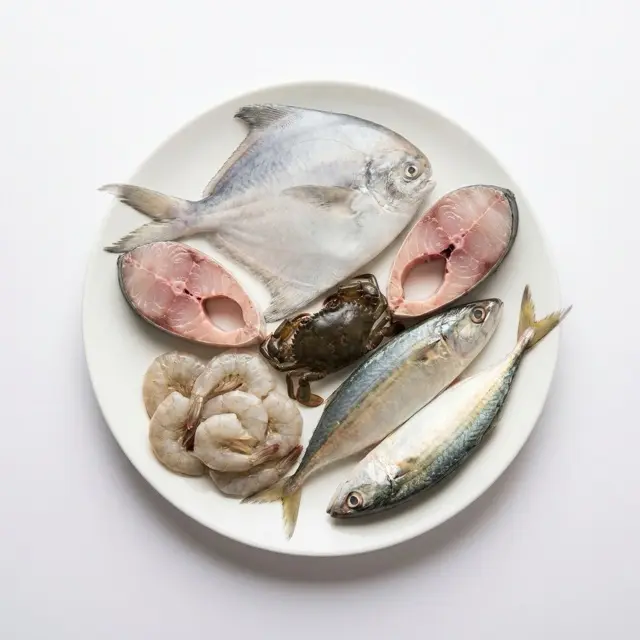
Fish in this guide: Surmai (Kingfish)Bangda (Mackerel)PomfretRawas (Indian Salmon)Prawns Today's prices →
Highest Protein Fish in India: Fish Protein by Goal
Surmai is the highest protein fish in India’s food tables: 100 g raw gives 22.28 g of protein. Bangda gives 21.51 g. That is about 40% of the 54 g a day ICMR-NIN suggests for a 65 kg adult. ICMR-NIN also suggests about 200 g of sea fish a week for omega-3 fats.
- Daily protein: 0.83 g per kg of body weight, about 54 g for a 65 kg adult (ICMR-NIN 2024).
- Highest protein per 100 g raw: surmai 22.28 g, bangda 21.51 g, rohu 19.71 g (IFCT 2017).
- Weekly fish: at least about 200 g of sea fish, which is two fish meals.
- Protein powder: ICMR-NIN calls it unnecessary for normal healthy life.
This is general food information, not medical advice. Check with your doctor or dietitian before changing your diet, especially if you are pregnant or have a medical condition.
By Kunal Rawat, founder of Relifish, the Thane marketplace where verified sellers list fish for home delivery. Every number below is checked against the ICMR-NIN Dietary Guidelines for Indians 2024 and IFCT 2017, with page numbers or table codes in the Sources. Last checked 22 November 2026.
Picture a Sunday morning in a Thane flat. The son has just joined a gym and wants a big tub of whey. His mother points at the surmai steaks marinating for lunch. Isn’t that protein too? She is right, and the answer is simpler than the supplement shelf suggests.
Most Indians eat fish less often than they could. In the National Family Health Survey (NFHS-5), only 6.8% of men and 5.1% of women said they ate fish daily. Weekly, it was 39.0% of men and 30.6% of women, according to a 2025 analysis in the British Journal of Nutrition. This guide puts the official Indian numbers in one place, so you can work out how much fish your family needs.
How much protein do you need a day?
A healthy Indian adult needs about 0.83 g of protein per kg of body weight a day. That is roughly 54 g for a 65 kg person, man or woman, however active you are.
ICMR-NIN’s Dietary Guidelines for Indians 2024 (page 58) say: “The recommended dietary allowance (RDA) for protein intake is 0.83g protein/kg/day for healthy men and women.” For a 65 kg person, that is 54 g a day “regardless of physical activity or gender.”
| Body weight | Protein a day (0.83 g per kg) | Surmai that gives a third of it |
|---|---|---|
| 50 kg | about 41.5 g | about 62 g raw |
| 65 kg | about 54 g | about 81 g raw |
| 80 kg | about 66.4 g | about 99 g raw |
The last column is our arithmetic from the IFCT 2017 surmai value.
Extra protein in pregnancy and breastfeeding
The guidelines add 8 g of protein a day in the second trimester and 18 g in the third (page 15). In the first six months of breastfeeding, the extra need is 13.6 g a day. In the next six months it is 10.6 g (page 16).
Why the kind of protein matters
Here is the surprise. ICMR-NIN says an adult’s daily diet “often provides 60g to 70g of protein a day, which is higher than what we require” (page 57). The real gap is the essential amino acids (the protein building blocks your body cannot make).
Animal proteins, including fish, “contain all twenty amino acids, including nine EAA” (page 59). They are also more easily digested and absorbed (page 60). So fish is less about piling on grams. It is about complete protein your body uses well.
Fish protein calculator: how much fish covers your day?
Enter your weight and life stage to see your daily protein need. It also shows roughly how much of each fish covers a third of it at one meal.
Numbers are averages for raw fish from ICMR-NIN 2024 and IFCT 2017. If you train hard, note this: ICMR-NIN says intakes above about 1.6 g per kg a day “do not contribute any further” to muscle gains (page 60).
Which fish has the most protein per 100 g?
These values are from the Indian Food Composition Tables 2017 (IFCT 2017), published by ICMR-NIN. They are per 100 g of raw edible fish. The last column shows how much of a 65 kg adult’s 54 g a day that 100 g covers.
| Fish (Marathi name) | Protein (g) | Fat (g) | EPA + DHA (g) | Share of 54 g |
|---|---|---|---|---|
| Surmai (सुरमई, kingfish) | 22.28 | 5.18 | 1.05 | 41% |
| Bangda (बांगडा, Indian mackerel) | 21.51 | 1.53 | 0.33 | 40% |
| Rohu (रोहू, freshwater) | 19.71 | 2.39 | 0.07 | 37% |
| Pomfret (पापलेट, white) | 19.02 | 5.12 | 0.59 | 35% |
| Halwa (हलवा, black pomfret) | 18.91 | 4.83 | 0.81 | 35% |
| Tarli (तारली, oil sardine) | 17.91 | 8.99 | 0.61 | 33% |
| Rawas (रावस, Indian salmon) | 17.9 | 0.1 | n.a. | 33% |
| Prawns (कोळंबी, tiger) | 14.25 | 0.74 | 0.12 | 26% |
Rawas is not in IFCT 2017. Its row comes from the Philippine Food Composition Table for the same species (Eleutheronema tetradactylum), which does not report EPA or DHA. Any single fish varies with size, season and catch area.
What is the best fish for protein in India?
- Most protein: surmai, bangda and rohu.
- Protein plus omega-3: surmai stands out, with halwa, tarli and pomfret next.
- Leanest protein: rawas and prawns carry the least fat.
- Most nutritious overall: no fish wins on everything. In this table, surmai has both the highest protein and the highest EPA plus DHA.
For the full comparison with chicken, eggs, paneer and dal, see fish vs chicken protein per 100 g. Our omega-3 guide has the complete EPA and DHA ranking.
How much fish should you eat per week?
ICMR-NIN gives two numbers for two questions.
- For omega-3: “Prefer marine fish such as salmon, mackerel, trout and tuna (~200gm/week)” (page 56). Bangda is an Indian mackerel. Surmai, halwa and pomfret are sea fish with good omega-3 too.
- For protein: non-vegetarians can get high-quality protein from “700g to 900g/week of fish, poultry or lean meat” (pages 58 to 59).
So about 200 g of sea fish a week is the floor. That is two fish meals of about 100 g each. Fish can fill as much of the 700 to 900 g flesh-food total as your family likes. By our arithmetic, that is 100 to 130 g a day if fish is your only flesh food.
What does a serving look like?
The American Heart Association suggests two servings of non-fried fish a week, each about 3.5 ounces (roughly 100 g). The US FDA counts one adult serving as 4 ounces (about 113 g). It advises adults to eat at least 8 ounces (about 225 g) of seafood a week. Both match ICMR-NIN’s ~200 g.
At home, 100 g of raw fish is roughly one medium surmai steak, or one small bangda once cleaned. For a family of four, about 500 g of cleaned fish makes one meal.
Is it OK to eat fish every day?
For most healthy adults, yes. Keep the week’s total within the 700 to 900 g range and rotate species. Rotating keeps exposure to any one contaminant low, which matters most for mercury.
Which fish should you limit because of mercury?
Limit shark, and rotate everything else. The US FDA puts sardine, shrimp and Atlantic and chub mackerel on its lowest-mercury “Best Choices” list. Shark, king mackerel and swordfish are on its “Choices to Avoid” list. So skip baby shark (mushi) if you are pregnant or feeding young children.
The FDA lists Spanish mackerel as a “Good Choice”. Surmai is a related Indian Ocean species the chart does not name. Treat it as one fish among several, not a daily habit, especially in pregnancy.
Which fish is best for your goal?
For most goals the answer is the same two fish meals a week. What changes is the fish and the portion.
| Goal | Good picks | Key point | Full guide |
|---|---|---|---|
| Kids | Pomfret, surmai steaks | Small, deboned portions | Best fish for kids |
| Pregnancy | Bangda, pomfret, prawns | Low-mercury fish only | Low-mercury fish |
| Diabetes | Any plain fish | Grill or curry, not breaded | Fish for diabetes |
| Heart health | Surmai, halwa, pomfret | Oily sea fish twice a week | Omega-3 fish |
| Gym and muscle | Surmai, bangda | Over 21 g protein per 100 g | Fish for athletes |
| Weight loss | Rawas, prawns | Least fat per 100 g | Fish for weight loss |
Kids
ICMR-NIN says nutrient-dense foods such as nuts, oilseeds and marine fish “must be consumed frequently” by children and teens. The FDA suggests two fish servings a week for children. A serving is about 1 ounce (28 g) at ages 1 to 3, 2 ounces (57 g) at 4 to 7, 3 ounces (85 g) at 8 to 10 and 4 ounces (113 g) from 11. Pomfret and surmai steaks are easy to debone for small plates.
Pregnancy and breastfeeding
ICMR-NIN’s pregnancy plate (page 16) lists “Marine fish, lean meat 80g/day or 250g to 300g twice a week”. It says a portion of dal can be swapped for fish, chicken, meat or egg. The FDA advises 8 to 12 ounces (about 225 to 340 g) a week from lower-mercury choices. Our pregnancy diet chart with Indian fish has a trimester-wise plan.
Diabetes
Plain fish adds protein with almost no carbohydrate. The American Diabetes Association suggests fatty fish at least twice a week, baked, grilled or broiled rather than breaded and fried. Fish suits a diabetic plate, but it is not a treatment.
Heart health
The FAO/WHO expert consultation on fish (2010) found that eating fish, especially oily fish, lowers the risk of dying from coronary heart disease in adults. The AHA’s two weekly servings and ICMR-NIN’s ~200 g point the same way.
Gym and muscle
ICMR-NIN says: “Most athletes can get the recommended amount of protein through appropriate selection of food items” (page 61). Above about 1.6 g per kg a day, extra protein adds no further muscle.
Weight loss
Lean fish gives a lot of protein for very little fat. Rawas has 0.1 g of fat per 100 g (Philippine FCT) and tiger prawns 0.74 g (IFCT 2017). The cooking method matters as much as the fish.
Adults over 60
ICMR-NIN notes that “elderly people require less energy but more micronutrients from vegetables, fruits, beans, nuts, eggs and fish”. Soft fish such as steamed pomfret or a light rawas curry work well when teeth or appetite are a concern.
Is fish better than chicken, eggs, dal or protein powder?
Fish, chicken and eggs all give complete protein. ICMR-NIN groups fish, poultry and lean meat together in its 700 to 900 g a week of flesh foods.
What sets sea fish apart is long-chain omega-3. ICMR-NIN names marine fish, other seafood and eggs as good natural sources (page 55). Chicken and dal do not give it.
Dal is a useful protein too. ICMR-NIN notes that replacing 30 g of pulses with 80 g of meat a day improves protein quality (page 60). Its pregnancy plate allows the same swap with fish (page 16). Protein powder, it says, is unnecessary for normal healthy life (page 61). For more, see real fish vs protein powder and fish oil.
How should you cook fish to keep its nutrition?
Cooking changes the weight of fish more than its protein. The bigger difference is what you add to it. The AHA’s advice is about non-fried fish. The ADA suggests baking, grilling or broiling over breading and frying, because a thick rava crust and a pool of oil add carbohydrate and calories.
- Curry: a tangy kokum bangda curry or a coconut Malvani pomfret curry keeps the fish moist with little oil.
- Tawa fry: a thin masala coat and a tablespoon of oil on an iron tawa gives a crisp edge without deep frying. See our pomfret tawa fry and bangda fry.
- Steamed or grilled: pomfret or rawas wrapped in green chutney and steamed is gentlest for kids and elders.
Myths about fish and protein
- “Everyone needs more protein.” ICMR-NIN says a typical adult diet already gives 60 to 70 g a day. The gap is usually the kind of protein, which is where fish helps.
- “More protein means more muscle.” ICMR-NIN puts the useful ceiling at about 1.6 g per kg a day for strength training.
- “All fish give the same omega-3.” IFCT 2017 shows surmai at 1.05 g EPA + DHA per 100 g against 0.07 g for rohu. Sea fish carry far more.
- “You need protein powder to build muscle.” ICMR-NIN: “Protein powders are unnecessary for normal healthy life” (page 61).
Where can you buy high-protein fish in Thane?
On Relifish, verified sellers in Thane and nearby Mulund list surmai, pomfret, bangda, rawas, halwa and prawns, along with bombil and jitada. You order same-day or pre-order, choose the cleaning and cut, and pick a 2-hour delivery slot.
- Surmai: ask for steaks about 1 to 1.5 cm thick. Each is roughly a 100 g portion.
- Pomfret and bangda: ask for them whole, cleaned and scored for tawa fry, or cut into curry pieces.
- Prawns: ask for them peeled and deveined to save time.
- Freshness: look for bright eyes, red gills and firm flesh that springs back.
- Season: sea fish gets scarce in the monsoon fishing ban (see our monsoon fish guide). November to February brings the widest choice; our winter fish guide lists what is in season.
New to ordering? The first order guide walks you through it, or call us on +91 91522 07607.
What to do next: check today’s fish prices in Thane, look at surmai for the most protein per 100 g, then order from verified sellers on Relifish.
Sources
- ICMR-National Institute of Nutrition. Dietary Guidelines for Indians 2024. Guideline 7 (page 56: ~200 g/week marine fish), Guideline 8 (page 57: typical intake 60 to 70 g; page 58: RDA 0.83 g/kg, 54 g for 65 kg; pages 58 to 59: 700 to 900 g/week flesh foods; pages 59 to 60: animal protein amino acids and digestibility; page 60: ~1.6 g/kg ceiling; page 61: athletes and protein powders), Guideline 2 (page 15: pregnancy protein; page 16: pregnancy plate and lactation), children, adolescents and elderly guidance. PDF at nin.res.in.
- ICMR-National Institute of Nutrition. Dietary Guidelines for Indians 2024, summary booklet (elderly guidance). PDF at nin.res.in.
- Longvah T, Ananthan R, Bhaskarachary K, Venkaiah K. Indian Food Composition Tables 2017 (IFCT 2017). ICMR-National Institute of Nutrition, Hyderabad. Table 1 (protein, fat) and Table 7 (EPA, DHA): Vanjaram P087, Mackerel P034, Rohu S006, Pomfret white P057, Pomfret black P055, Sardine P071, Tiger prawns orange Q008. PDF at nin.res.in.
- DOST-FNRI. Philippine Food Composition Table (PhilFCT): Threadfin, fourfinger (Eleutheronema tetradactylum), Food ID G143. Used for rawas.
- US Food and Drug Administration. Advice about Eating Fish. Adult, pregnancy and child servings; Best Choices and Choices to Avoid lists.
- American Heart Association. Fish and Omega-3 Fatty Acids (last reviewed 23 Aug 2024).
- Rimm EB, Appel LJ, Chiuve SE, et al. Seafood Long-Chain n-3 Polyunsaturated Fatty Acids and Cardiovascular Disease: A Science Advisory From the American Heart Association. Circulation. 2018;138(1):e35 to e47. doi:10.1161/CIR.0000000000000574.
- FAO and WHO. Report of the Joint FAO/WHO Expert Consultation on the Risks and Benefits of Fish Consumption (Rome, January 2010; published 2011). fao.org.
- Rai RK, et al. Fish consumption and its association with anaemia and metabolic disorder among Indian adults. British Journal of Nutrition. 2025;134(10):850 to 862. NFHS-5 data. cambridge.org.
- American Diabetes Association. What superstar foods are good for diabetes? Fatty fish at least twice a week; cooking advice.
Frequently asked questions
Which Indian fish has the highest protein?
Surmai has the most protein of the common Mumbai and Thane fish, at 22.28 g per 100 g raw, according to IFCT 2017. Bangda is next at 21.51 g, then rohu at 19.71 g. Pomfret (19.02 g) and halwa (18.91 g) are close behind. Prawns are lower at 14.25 g, but they are also very low in fat, so they suit lighter meals.
How much protein is in 100 g of fish?
Most Indian sea fish give 18 to 22 g of protein per 100 g raw, according to IFCT 2017. Surmai has 22.28 g, bangda 21.51 g, pomfret 19.02 g, halwa 18.91 g and tarli 17.91 g. Freshwater rohu has 19.71 g. Tiger prawns are lower at 14.25 g. Cooking drives off water, so a cooked 100 g piece came from a heavier raw piece.
How much protein is in 250 g of fish?
Multiply the IFCT 2017 value per 100 g by 2.5. A 250 g raw portion of surmai gives about 56 g of protein, bangda about 54 g, pomfret about 48 g and tiger prawns about 36 g. For a 65 kg adult, 250 g of surmai or bangda covers roughly a full day's protein allowance under ICMR-NIN's 0.83 g per kg rule.
How much protein is in half kg of fish?
It depends on the fish and how much of it you can eat. 500 g of cleaned, boneless surmai flesh gives about 111 g of protein (22.28 g per 100 g raw, IFCT 2017). A half kg whole fish loses its head, bones and gut when cleaned, so the edible part, and its protein, is lower. Weigh the cleaned pieces for a better estimate.
How much protein do I need per day according to ICMR?
ICMR-NIN's 2024 guidelines set the recommended dietary allowance at 0.83 g of protein per kg of body weight per day for healthy men and women. For a 65 kg adult that is about 54 g a day, regardless of physical activity or gender. Pregnancy adds 8 g a day in the second trimester and 18 g in the third.
Is it OK to eat fish every day?
For most healthy adults, yes, if the week's total stays within ICMR-NIN's 700 to 900 g of fish, poultry or lean meat and you rotate species. ICMR-NIN also suggests at least about 200 g of sea fish a week. Lean on lower-mercury fish such as bangda, tarli and prawns, and avoid shark. Pregnant women and young children should follow the US FDA's weekly limits.
How we write and check these guides: editorial standards
Share this article: