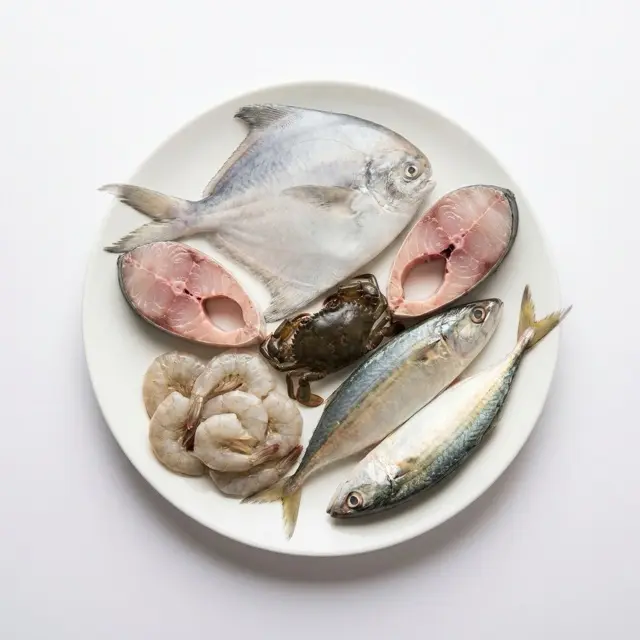
Fish in this guide: Bangda (Mackerel)Surmai (Kingfish)RohuPomfretPrawns Today's prices →
Fish vs Egg vs Paneer Protein: Which Gives You More?
In the fish vs egg vs paneer protein question, sea fish wins per 100 g and wins clearly per calorie. Paneer comes second on grams, and egg is third.
India’s own food tables (IFCT 2017, ICMR-NIN) give bangda 21.51 g protein per 100 g. Paneer has 18.86 g and a whole raw egg 13.28 g. All three are good-quality protein. What really separates them is the fat and calories that come along.
Quick answer
- Most protein per 100 g: surmai and bangda (about 21 to 22 g), then paneer (about 19 g), then egg (about 13 g).
- Most protein per calorie: prawns, bangda and rohu, by a wide margin.
- Most fat: paneer, with more fat than protein.
- Most calcium: paneer.
- All three are complete protein, so a mixed family can rotate them through the week.
Many Thane and Mumbai homes cook all three. One person eats fish, another eats only eggs, and Nani eats paneer on the days the kitchen is vegetarian. This guide puts them side by side so you can plan meals for everyone at the same table.
Every number comes from a source listed under Sources. Values are per 100 g raw edible portion unless stated. We have kept prices out, because fish prices change daily.
This is general food information, not medical advice. If you have a kidney, heart or other health condition, ask your doctor before changing how much protein you eat.
Per 100 g: fish, egg and paneer side by side
| Food (raw) | Energy (kcal) | Protein (g) | Fat (g) | Source |
|---|---|---|---|---|
| Surmai (सुरमई, kingfish) | 136 | 22.28 | 5.18 | IFCT 2017 |
| Bangda (बांगडा, Indian mackerel) | 101 | 21.51 | 1.53 | IFCT 2017 |
| Rohu (रोहू) | 102 | 19.71 | 2.39 | IFCT 2017 |
| Paplet (पापलेट, white pomfret) | 123 | 19.02 | 5.12 | IFCT 2017 |
| Kolambi (कोळंबी, tiger prawns) | 65 | 14.25 | 0.74 | IFCT 2017 |
| Paneer | 306 | 18.86 | 24.78 | IFCT 2017 |
| Egg, hen, whole, raw | 135 | 13.28 | 9.15 | IFCT 2017 |
| Egg, hen, whole, boiled | 148 | 13.43 | 10.54 | IFCT 2017 |
| Toor dal, dry, uncooked | 331 | 21.70 | 1.56 | IFCT 2017 |
How to read this table
- IFCT gives energy in kilojoules. We converted to kcal with IFCT’s factor (1 kcal = 4.18 kJ) and rounded.
- The egg rows are per 100 g of egg without the shell. USDA counts one large egg as 50 g, so 100 g is about two large eggs.
- Dal is shown dry. It soaks up water when cooked, so a bowl of cooked dal has far less protein per 100 g.
- Fish values are averages. Size, season and catch area change them a little.
Two things stand out. First, paneer has good protein but more fat than protein. Second, egg has less protein per 100 g than you might expect, because an egg is mostly water.
Protein per calorie: the fairer comparison
If you are watching weight, protein per 100 kcal tells you more than protein per 100 g. We divided protein by calories from the table above.
| Food (raw) | Protein per 100 kcal (g) |
|---|---|
| Kolambi (tiger prawns) | 21.9 |
| Bangda | 21.3 |
| Rohu | 19.3 |
| Surmai | 16.4 |
| Paplet | 15.5 |
| Egg, whole, raw | 9.8 |
| Toor dal, dry | 6.6 |
| Paneer | 6.2 |
Fish gives about 1.5 to 3.5 times more protein per calorie than egg or paneer. That is the single biggest difference between these foods.
How much of each gives you 20 g of protein?
Here is the same idea as a portion. Numbers are calculated from IFCT 2017 values.
| To get 20 g protein | Raw weight | Energy (kcal) | Fat (g) |
|---|---|---|---|
| Bangda | 93 g | 94 | 1.4 |
| Surmai | 90 g | 122 | 4.6 |
| Rohu | 101 g | 104 | 2.4 |
| Kolambi | 140 g | 91 | 1.0 |
| Egg, whole (about 3 large) | 151 g | 203 | 13.8 |
| Paneer | 106 g | 324 | 26.3 |
So a 100 g piece of bangda and a 106 g block of paneer give the same protein. The paneer brings more than three times the calories. This is before any oil, ghee or cream goes into the pan.
None of this makes paneer or eggs “bad”. It simply tells you where the calories come from, so you can plan.
Protein quality: are all three complete?
Yes. ICMR-NIN’s Dietary Guidelines for Indians (2024) say animal foods like milk, meat, fish and eggs give high-quality protein. It is bioavailable and provides all the essential amino acids in the right proportions. Paneer is made from milk, so it sits in this group too.
Plant proteins are different. The same guidelines say cereals are low in lysine and pulses are low in methionine and cysteine. Eaten together, they cover each other’s gaps.
For vegetarian days, ICMR-NIN suggests:
- Cereals and pulses in a 3:1 ratio by raw weight. Think dal-rice, rajma-chawal or idli-sambar.
- 250 ml of milk a day, which further raises essential amino acid intake.
- A variety of foods, since diverse diets meet protein needs more easily.
For non-vegetarians, ICMR-NIN says 700 g to 900 g a week of fish, poultry or lean meat, or eggs, provides high-quality protein. The adult protein requirement (RDA) is 0.83 g per kg of body weight a day. For a 65 kg adult, that is 54 g a day.
What else comes with the protein?
Protein is only part of the story. Each food brings its own extras.
| Nutrient | Fish | Egg | Paneer |
|---|---|---|---|
| Omega-3 (EPA + DHA) | Surmai 1.05 g, bangda 0.33 g per 100 g (IFCT) | 0.058 g per 100 g (USDA) | Not a source named by ICMR-NIN |
| Vitamin B12 | 2.6 µg in 3 oz cooked salmon (NIH) | 0.5 µg per large egg (NIH) | Present in dairy (NIH) |
| Calcium | Low in fillets; bombil and crab are higher | 56 mg per 100 g (USDA) | 476 mg per 100 g (IFCT) |
| Fat | 1.53 to 5.18 g per 100 g | 9.15 g per 100 g | 24.78 g per 100 g |
Omega-3. ICMR-NIN names marine fish, other seafood and eggs as natural sources of long-chain omega-3 fats. Sea fish like surmai give far more than eggs. See our omega-3 fish guide.
Vitamin B12. NIH says B12 occurs naturally only in animal foods, including fish, eggs and dairy. Plant foods have none unless fortified. This matters for vegetarians. Our vitamin B12 from fish guide has the full chart.
Calcium. This is where paneer shines. IFCT lists 476 mg calcium per 100 g of paneer. Most fish fillets have very little, though crab and small soft-boned fish are exceptions.
Cholesterol. USDA lists a whole raw egg at 372 mg cholesterol per 100 g. The American Heart Association’s 2019 advisory says guidance should focus on healthy eating patterns rather than a single cholesterol number. If you have high cholesterol, ask your doctor how many eggs suit you.
How to use all three in one family kitchen
You do not have to pick one. A mixed Indian home can rotate them across the week.
A sample week for a mixed family
| Day | Fish eaters | Egg eaters | Vegetarian |
|---|---|---|---|
| Monday | Bangda curry, rice | Egg curry, rice | Rajma-chawal, curd |
| Tuesday | Dal, roti, sabzi | Boiled eggs with poha | Paneer bhurji, roti |
| Wednesday | Rohu or paplet curry | Egg bhurji, roti | Chana, rice, buttermilk |
| Thursday | Dal-rice, curd | Dal-rice, curd | Dal-rice, curd |
| Friday | Kolambi curry, rice | Omelette, roti | Moong dal chilla, curd |
| Saturday | Surmai tawa fry, dal | Egg pulao | Palak paneer, roti |
| Sunday | Family choice | Family choice | Family choice |
Practical tips
- One masala, three pots. Make one onion-tomato-coconut base. Split it three ways for fish curry, egg curry and paneer.
- Cook fish last. Fish needs only a few minutes in the gravy. Add it at the end.
- Go easy on oil with paneer. Grilled or bhurji-style paneer is lighter than paneer in a butter-cream gravy.
- Keep separate utensils for fish if a family member is strictly vegetarian.
- Pair paneer and eggs with dal. It lifts protein quality on vegetarian days.
For recipes, try our kolambi curry or surmai fry. If chicken is also on your table, see fish vs chicken protein per 100 g.
Which should you choose?
- For the most protein with the fewest calories: bangda, rohu or kolambi.
- For protein plus omega-3: surmai, bangda or paplet.
- For calcium on vegetarian days: paneer and curd.
- For a quick, low-effort protein: eggs.
- For older family members: soft fish like steamed paplet, or paneer, with dal.
If you are building muscle, our high protein fish diet plan shows how to spread protein across the day. For daily targets, see how much protein men need per day.
What this comparison does not tell you
- Cooked values differ. Water loss raises protein per 100 g after cooking. Oil and cream add calories.
- Paneer varies by brand and home recipe. Fat depends on the milk used.
- Digestibility is not compared here. ICMR-NIN groups milk, eggs and fish together as high-quality protein. We found no Indian source ranking the three directly.
- Allergies. Egg, milk, fish and shellfish are all common allergens. Ask a doctor if you are unsure.
Getting fresh fish for the family
Verified sellers on Relifish list bangda, surmai, rohu, paplet and kolambi when they have them. Choose how you want it cleaned and cut. Then pick a 2-hour delivery slot in Thane or nearby Mulund and Bhandup.
Not sure of a fish name? See fish names in English and Marathi.
Related reading
- Are Prawns Good for Health? Protein, Cholesterol, Facts
- How Much Fish Should I Eat Per Week? India Guide
What to do next
For the most protein per calorie, start with bangda. Check today’s fish prices, then order bangda cleaned and cut or browse the shop.
Sources
- Longvah T, Ananthan R, Bhaskarachary K, Venkaiah K. Indian Food Composition Tables 2017 (IFCT 2017). ICMR-National Institute of Nutrition, Hyderabad. PDF at nin.res.in. Table 1, energy in kJ, protein and fat. Entries: Vanjaram P087, Mackerel P034, Rohu S006, Pomfret white P057, Tiger prawns orange Q008, Paneer L003, Egg poultry whole raw M001, Egg poultry whole boiled M004, Red gram dal B021. Table 5 (calcium): Paneer L003. Table 7 (EPA, DHA): P087, P034.
- ICMR-National Institute of Nutrition. Dietary Guidelines for Indians 2024. PDF at nin.res.in. Protein quality of animal and plant foods, page 9. Protein RDA, cereal-pulse 3:1, 250 ml milk, 700 to 900 g a week of flesh foods or eggs, pages 58 to 59. Marine fish, seafood and eggs as omega-3 sources, Guideline 7, page 53.
- USDA FoodData Central (SR Legacy): Egg, whole, raw, fresh (FDC 171287). DHA 0.058 g, calcium 56 mg, cholesterol 372 mg per 100 g; large egg 50 g.
- NIH Office of Dietary Supplements. Vitamin B12: Fact Sheet for Health Professionals. Animal-food sources, Table 2 (salmon, egg).
- Carson JAS et al. Dietary Cholesterol and Cardiovascular Risk: A Science Advisory From the American Heart Association. Circulation 2020;141:e39 to e53.
Frequently asked questions
Which has more protein, fish, egg or paneer?
Fish, gram for gram. In India's food tables (IFCT 2017), bangda has 21.51 g protein per 100 g raw and surmai 22.28 g. Paneer has 18.86 g and a whole raw egg 13.28 g. The bigger gap is in fat: paneer carries 24.78 g fat per 100 g, egg 9.15 g and bangda 1.53 g. All three give complete protein.
Is paneer protein as good as egg or fish protein?
Paneer is made from milk, and ICMR-NIN counts milk among the animal foods whose protein is of high quality, with all the essential amino acids in the right proportions. So paneer, eggs and fish are all good-quality protein. The difference is what comes with it. Paneer brings much more fat and calories per gram of protein, and plenty of calcium.
How many eggs equal 100 g of paneer for protein?
About three large eggs. USDA counts a large egg as 50 g. IFCT 2017 gives a whole raw egg 13.28 g protein per 100 g, so three large eggs (150 g) give about 19.9 g. That is close to the 18.86 g in 100 g of paneer. The eggs carry about 13.7 g fat, against 24.78 g in the paneer.
Is fish better than paneer for weight loss?
Per gram of protein, yes. Getting 20 g of protein takes about 94 kcal of bangda but about 324 kcal of paneer, using IFCT 2017 values. Paneer is still a useful food, especially for calcium. Cooking matters too: a low-oil fish curry is far lighter than fried fish, and grilled paneer is lighter than paneer in a cream gravy.
Can a vegetarian family get enough protein without fish or eggs?
Yes, with planning. ICMR-NIN says protein needs are easily met from a diverse diet, even a plant-only one, and that the challenge is quality. It suggests cereals and pulses in a 3:1 ratio by raw weight, plus 250 ml of milk a day, to cover all the essential amino acids. Paneer and curd help too.
How we write and check these guides: editorial standards
Share this article: