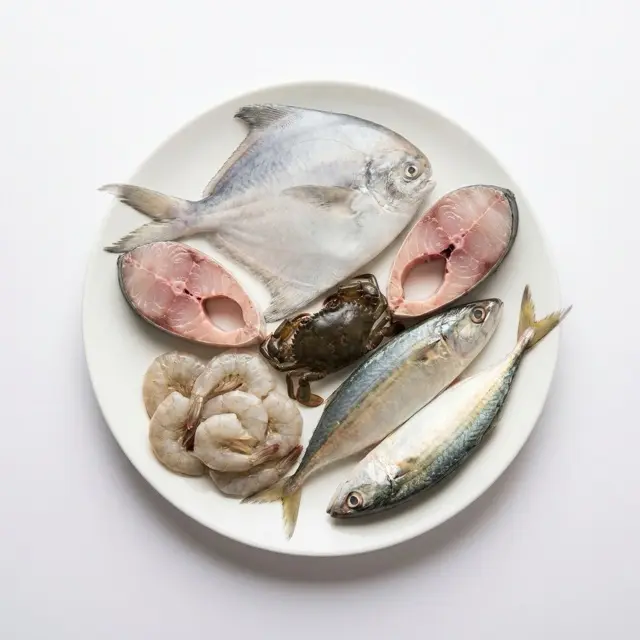
Fish in this guide: Bangda (Mackerel)Surmai (Kingfish)PomfretSardinePrawns Today's prices →
How Much Fish Should I Eat Per Week? A Practical Guide for Indian Families
Most healthy adults should eat about 200 g of sea fish a week, which is two fish meals of around 100 g each. That is the amount ICMR-NIN’s 2024 Dietary Guidelines for Indians suggest for omega-3 fats. You can eat more. ICMR-NIN allows 700 to 900 g a week of fish, poultry or lean meat in total. Fish can fill as much of that as your family enjoys.
Quick answer
- Minimum: about 200 g of sea fish a week, or two meals of 100 g each.
- Upper range: 700 to 900 g a week of fish, chicken and lean meat together.
- One adult serving is about the size of your palm.
- Pick oily sea fish like surmai, halwa, tarli, pomfret or bangda for omega-3.
- Skip shark, rotate species, and ask your doctor in pregnancy.
Every number in this post comes from a source listed under Sources at the bottom.
This is general information, not medical advice. If you are pregnant, have a heart, kidney or other health condition, or take medicines, please ask your doctor how much fish suits you.
The short answer, by source
Different health bodies phrase the advice differently, but they land in the same place.
| Source | Weekly advice | In grams |
|---|---|---|
| ICMR-NIN, India (2024) | Prefer marine fish, about 200 g a week, for long-chain omega-3 | About 200 g |
| ICMR-NIN, India (2024) | 700 to 900 g a week of fish, poultry or lean meat, for protein | 700 to 900 g in total |
| American Heart Association | At least 2 servings of fish a week, especially fatty fish; 1 serving is 3 ounces cooked | About 170 g cooked |
| US FDA / Dietary Guidelines for Americans | At least 8 ounces of seafood a week on a 2,000 kcal diet | About 227 g |
| FDA/EPA, pregnancy and breastfeeding | 8 to 12 ounces a week from lower-mercury fish | About 225 to 340 g |
Gram figures for ounces are our conversion (1 ounce is about 28 g).
So the floor is about 200 g of sea fish a week. The ceiling, for most healthy adults, is set by the 700 to 900 g flesh-food total and by mercury.
Why two numbers? Omega-3 and protein
ICMR-NIN gives two weekly figures because they answer two different questions.
The 200 g is about omega-3. Guideline 7 says: “Prefer marine fish such as salmon, mackerel, trout and tuna (~200gm/week) which are good sources of preferred LC n-3 fatty acids.” Mackerel is our bangda. Sea fish like surmai, halwa and pomfret also carry good omega-3 in Indian food tables.
The 700 to 900 g is about protein. Guideline 8 says non-vegetarians can get high-quality protein from 700 to 900 g a week of fish, poultry or lean meat, or from eggs. Fish, chicken and mutton all count towards this.
In practice:
- If you eat chicken most days, keep at least two fish meals in the week for omega-3.
- If fish is your main non-veg food, you can eat it most days. By our arithmetic, 700 to 900 g a week is 100 to 130 g a day.
For more on protein per fish, read our fish protein and nutrition guide.
What does a serving of fish look like?
Grams are hard to picture in the kitchen. These are easier guides.
| Guide | Size | Source |
|---|---|---|
| One adult serving | 4 ounces (about 113 g), about the size of the palm of your hand | US FDA |
| One heart-health serving | 3 ounces cooked (about 85 g), or three quarters of a cup of flaked fish | American Heart Association |
| Child, 1 to 3 years | 1 ounce (about 28 g) | US FDA/EPA |
| Child, 4 to 7 years | 2 ounces (about 57 g) | US FDA/EPA |
| Child, 8 to 10 years | 3 ounces (about 85 g) | US FDA/EPA |
| Child, 11 years | 4 ounces (about 113 g) | US FDA/EPA |
Two things to remember at the fish counter:
- Raw weighs more than cooked. Fish loses water as it cooks, so 100 g raw gives a smaller cooked piece.
- Whole weighs more than edible. A whole fish includes head, bones and guts. Bangda is usually 3 to 6 fish to a kilo. Ask the seller for the cleaned weight if you are counting closely.
A simple home rule: one palm-sized steak or curry piece per adult, per fish meal.
Which fish gets you to 200 g of omega-3-rich sea fish?
Not every fish carries the same omega-3. Here is what 100 g of raw fish gives, from India’s own food tables (IFCT 2017).
| Fish (Marathi / Mumbai name) | EPA + DHA per 100 g raw | 200 g a week gives (our calculation) |
|---|---|---|
| Surmai (king fish) | 1.05 g | 2.1 g |
| Halwa (black pomfret) | 0.81 g | 1.62 g |
| Tarli (oil sardine) | 0.61 g | 1.22 g |
| Pomfret (paplet) | 0.59 g | 1.18 g |
| Bangda (Indian mackerel) | 0.33 g | 0.66 g |
| Prawns (kolambi) | 0.12 g | 0.24 g |
| Salmon (imported) | 1.60 g | 3.2 g |
Prawns are a good protein, but they are low in omega-3. If prawns are your favourite, add one oily fish meal too. Our omega-3 fish guide has the full ranking.
How much is too much? Mercury and variety
Most fish sold in Thane and Mumbai are fine to eat often. The concern is a few large predatory fish that build up mercury.
- Avoid shark (mushi). The US FDA/EPA puts shark on its Choices to Avoid list.
- Go easy on surmai. Its close relative, king mackerel, is on the same avoid list. Surmai itself is not on the chart. So the cautious choice is to rotate it rather than eat it daily, and to skip it in pregnancy.
- Rotate species. Mixing bangda, pomfret, tarli and prawns through the week keeps you from eating a lot of any one fish.
- Fish from creeks or lakes caught by friends: the FDA says to check local advisories. Without one, eat only one serving and no other fish that week.
Pregnant women and young children need the most care. Read low-mercury fish for pregnancy for the fish-by-fish list.
Sample weeks for Thane and Mumbai families
These are examples, not prescriptions. Adjust them to your family’s tastes, budget and doctor’s advice.
A working couple who also eat chicken
| Day | Meal | Fish |
|---|---|---|
| Tuesday | Bangda kokum curry with rice | About 100 g each |
| Friday | Surmai tawa fry with bhakri and salad | About 100 g each |
| Other days | Chicken twice, eggs, dal | None |
That gives each adult about 200 g of sea fish, meeting ICMR-NIN’s omega-3 figure.
A family of four: two adults, a 6-year-old and a grandparent
| Day | Dish | Adults and grandparent | Child (4 to 7) |
|---|---|---|---|
| Monday | Pomfret curry | 100 g each | About 57 g |
| Wednesday | Prawn and vegetable sukka | 100 g each | Skip or a few pieces |
| Saturday | Steamed or tawa bangda | 100 g each | About 57 g, deboned |
Each adult gets about 300 g of fish, of which 200 g is oily sea fish. The child gets two FDA-sized servings. Soft steamed pomfret suits the grandparent; ICMR-NIN lists fish among nutrient-rich foods for elders.
A home where fish is the main non-veg food
| Day | Fish |
|---|---|
| Monday | Bangda curry |
| Tuesday | Prawns masala |
| Wednesday | Bombil fry |
| Thursday | Dal and vegetables, no fish |
| Friday | Surmai steaks |
| Saturday | Rawas curry |
| Sunday | Pomfret fry |
At 100 to 120 g a meal, this stays inside ICMR-NIN’s 700 to 900 g a week. Surmai appears only once, and the species change every day.
Little ones
For babies and toddlers, the amounts are much smaller. See when can babies eat fish and the best fish for kids.
Make the grams count: cooking matters
How you cook the fish changes the meal more than a few grams either way.
- ICMR-NIN suggests sautéing, steaming, grilling, boiling or baking instead of frying.
- It also suggests limiting cooking oil to 25 to 30 g a day for adults, and salt to 5 g a day.
- A curry or a tawa fry with a spoon of oil fits easily. A thick rava crust deep-fried in reused oil does not.
What to do next: plan your week’s fish in Thane
Planning two or three fish meals is easier when you can order ahead. On Relifish, verified sellers list what they have each day. Order for today or pre-order for a later day, choose how the fish is cleaned and cut, and pick a 2-hour delivery slot. Delivery covers Thane and nearby Mulund and Bhandup.
- See what is in today on today’s fish prices.
- Browse every fish in the shop.
- First time? Read how your first order works.
- When the fish arrives, check it: clear eyes, red gills, firm flesh and a clean sea smell. Our fish storage guide shows how to keep it until cooking day.
Related reading
- Healthiest Way to Cook Fish: Steam, Grill or Curry?
- Surmai Fish Benefits: Protein, Omega-3 and Mercury Facts
Sources
- ICMR-National Institute of Nutrition. Dietary Guidelines for Indians 2024. PDF at nin.res.in. Page 1 (cooking oil 25 to 30 g a day), page 12 (fish among nutrient-rich foods for elders), Guideline 7 (page 51: sautéing, steaming, grilling, boiling or baking instead of frying; page 56: ~200 g a week of marine fish), Guideline 8 (pages 58 to 59: 700 to 900 g a week of flesh foods), Guideline 11 (pages 73 to 74: salt 5 g a day).
- American Heart Association. Fish and Omega-3 Fatty Acids (last reviewed 23 Aug 2024). Two servings a week; serving of 3 ounces cooked.
- US FDA and EPA. Advice about Eating Fish. At least 8 ounces of seafood a week for adults; 8 to 12 ounces in pregnancy and breastfeeding; palm-sized 4-ounce serving; children’s servings; Best / Good / Avoid lists; locally caught fish.
- Longvah T, Ananthan R, Bhaskarachary K, Venkaiah K. Indian Food Composition Tables 2017. ICMR-NIN. PDF at nin.res.in. EPA and DHA per 100 g raw edible portion.
Frequently asked questions
How much fish should an adult eat per week in India?
About 200 g of sea fish a week is the base, according to ICMR-NIN's Dietary Guidelines for Indians (2024), which recommend marine fish for omega-3 fats. That is two fish meals of about 100 g each. For protein, ICMR-NIN suggests 700 to 900 g a week of fish, poultry or lean meat in total, so fish can fill much more of the week if you like.
Is it okay to eat fish every day?
For most healthy adults, yes, as long as the week's flesh-food total stays within ICMR-NIN's 700 to 900 g and you rotate species. By our arithmetic that is about 100 to 130 g a day if fish is your only flesh food. Keep shark off the menu, go easy on surmai, and ask your doctor if you are pregnant or have a health condition.
How big is one serving of fish?
The US FDA says one adult serving is 4 ounces, about 113 g, roughly the size of the palm of your hand. The American Heart Association uses 3 ounces of cooked fish, about 85 g or three quarters of a cup of flaked fish. Children need less: the FDA's average serving is 1 ounce at ages 1 to 3 and 2 ounces at 4 to 7.
How much fish should I eat per week during pregnancy?
The FDA/EPA advice for pregnancy and breastfeeding is 8 to 12 ounces a week, about 225 to 340 g, from lower-mercury fish. That is 2 to 3 servings from its Best Choices list, such as sardine, prawns, crab and sole. ICMR-NIN's pregnancy plate also lists marine fish or lean meat. Check the exact amount with your doctor.
Which fish gives the most omega-3 for 200 g a week?
Surmai gives the most among common Indian sea fish: 1.05 g of EPA plus DHA per 100 g raw in IFCT 2017, so 200 g gives about 2.1 g. Halwa gives 0.81 g per 100 g, tarli 0.61 g and pomfret 0.59 g. Bangda is lower at 0.33 g but is a good everyday fish. Rotating two or three of these works well.
How we write and check these guides: editorial standards
Share this article: