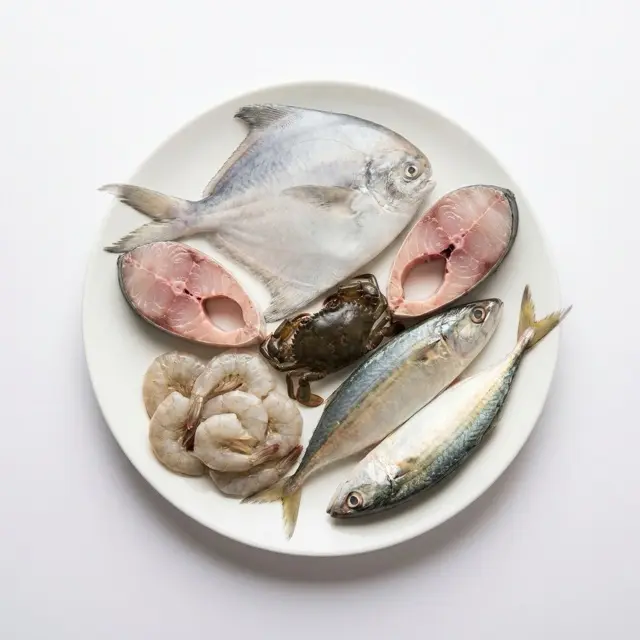
Fish in this guide: PomfretBangda (Mackerel)Surmai (Kingfish)Prawns Today's prices →
How to Check Formalin in Fish: An Honest Guide
To check formalin in fish, you need a rapid test kit or a lab. Smell, touch and colour cannot confirm it. India’s food regulator, FSSAI, and ICAR-CIFT in Kochi recommend a paper strip kit that changes colour in about two minutes. Even then, a positive result is only a first screen and needs a lab test to confirm. What you can do at home is check freshness, wash and cook fish well, and buy from sellers you trust. See today’s pomfret and other fish from verified sellers on fish price today.
Key points
- A strip test kit can flag formalin in about two minutes. Only a lab can confirm it.
- Eyes, gills, smell and touch tell you if fish is old, not if it has formalin.
- Washing under running water and cooking well lower formalin, but do not remove it fully.
- The best protection is a short supply chain and a seller who tells you when the fish came in.
This is general food safety information, not medical advice. If you feel unwell after eating fish, see a doctor.
What is formalin, and why is it a problem?
Formalin is formaldehyde dissolved in water. You may know it as the chemical used to preserve specimens in a lab.
In July 2018, FSSAI and ICAR-Central Institute of Fisheries Technology (CIFT) issued a joint guidance note on formalin in fish. Here is what it says.
- Why it is used: some traders and suppliers add formalin to extend the storage life of fresh or chilled fish. It also makes fish look fresher than it is.
- Where it was found: CIFT is FSSAI’s referral lab for fish. It reported residues in freshly sold fish and in inter-state consignments. It even found them in the ice used to transport fish.
- Can it be removed? The amount falls during storage, but it cannot be removed completely.
- Health effects: eating formalin-treated fish can cause abdominal discomfort, vomiting and kidney injury.
- Is it legal? No. Formaldehyde is not permitted in food under India’s Food Safety and Standards Regulations, 2011.
ICAR-CIFT also notes that the International Agency for Research on Cancer (IARC) lists formaldehyde as a cancer-causing agent.
Ammonia: the other adulterant
The same CIFT team built a second kit for ammonia. CIFT scientists have said ammonia is used to make fish look fresh and shiny. CIFT notes that regular intake can injure the lining of the mouth, throat, food pipe and stomach.
A small twist: some formaldehyde is natural
Fish can contain small amounts of formaldehyde naturally. That is why FSSAI later set interim limits for naturally occurring formaldehyde in fish. So a trace is not proof of cheating. The issue is formalin that someone added.
The ICAR-CIFT rapid test kit: how it works
ICAR-CIFT developed simple paper strip kits to detect formaldehyde and ammonia in fresh fish. FSSAI’s guidance recommends them to consumers, traders and food safety officers. CIFT licensed the technology to a Mumbai company for commercial production.
What is in a kit (per ICAR-CIFT):
| Item | Detail |
|---|---|
| Test strips | 25 paper strips |
| Reagent | A small bottle of solution |
| Colour chart | To compare your result |
| Time to result | Colour develops within 2 minutes |
How to use it, step by step:
- Rub a strip on the fish. Press it on the skin or surface and rub gently.
- Add the reagent. Put one or two drops on the strip.
- Wait up to two minutes. Do not read it too early.
- Compare with the chart. For the formalin kit, a blue colour means formalin is present. A yellow colour means it was not detected.
- Read the leaflet. Follow your kit’s own instructions if they differ.
What a kit result means
- Negative (no colour change): a good sign. It does not test for germs, staleness or other chemicals, so still check freshness.
- Positive: treat it as a warning, not a verdict. FSSAI says the kit is a preliminary test, and samples must go to a lab for confirmation. Do not eat the fish. Tell the seller, and you can report it to your state food safety department.
Freshness checks you can do at home
These checks will not detect formalin. But they catch the far more common problem: fish that is simply old. They follow the US FDA’s advice on selecting seafood safely.
| Check | Fresh fish | Walk away if |
|---|---|---|
| Eyes (dola) | Clear and shiny | Cloudy, dull or sunken |
| Gills | Bright red | Brown, grey or slimy |
| Flesh | Firm, springs back | Soft, stays dented |
| Smell | Fresh and mild, of the sea | Sour, rancid, fishy or ammonia-like |
| Steaks and fillets | Moist, glossy cut face | Dry, brown or curling edges |
| Frozen packs | Frozen hard, sealed pack | Frost, ice crystals, torn pack, bendable fish |
A note on popular tips. You may have heard that formalin fish has no flies on it, feels rubbery or smells sharp. None of these are official tests. Formalin is added exactly so that fish passes a quick look. If something feels off, trust that and skip the fish. But do not assume a fish is safe just because it passes these checks.
For fish-specific checks, our guide on how to clean pomfret shows what fresh paplet should look like. The bangda guide covers bangda.
What FSSAI advises you to do at home
FSSAI’s 2018 guidance, as reported by FSSAI’s own media page, gives consumers three simple steps:
- Wash fish well under running tap water. Formaldehyde dissolves in water. Rinse inside and out, especially for whole fish like bangda.
- Cook it thoroughly. FSSAI advises cooking fish to an internal temperature of 75°C or above, since heat also helps drive off formaldehyde.
- Buy from credible sources. This is the step that matters most.
Remember, washing and cooking reduce formalin. They do not remove it completely. So these steps are a safety net, not a fix for bad fish.
When is the risk higher?
Formalin is used to make fish last longer. So the risk logically rises when fish travels far or sits a long time before it is sold.
- Long-distance fish. CIFT found residues in inter-state consignments. Fish trucked in from far away has more reason to be “preserved”.
- The monsoon ban. From June to July, boats on the west coast stay ashore. More stored stock is sold. Stored fish kept on proper ice is fine, but ask the seller how old it is. See our monsoon fish guide.
- Fish that looks too perfect, too cheap or too late in the day. Not proof of anything, but a reason to ask questions.
FSSAI also asks traders to keep a proper cold chain, with good icing during transport. Fish kept cold does not need chemicals to stay fresh.
How to buy fish you can trust
You cannot test every fish you buy. So the best protection is who you buy from.
- Know the seller. Buy from people who tell you where and when the fish was landed.
- Prefer short supply chains. Fish landed on the Konkan coast and sold within a day or two has less reason to be treated.
- Ask questions. “When did this come in?” A good seller answers easily.
- Check every delivery. Look at eyes, gills, flesh and smell as soon as it reaches you. Our first order guide shows what to check at the door.
- Store it well. Put fish in the fridge at once and cook within two days, or freeze it. Our guide on how to store fish at home explains how.
Honest limits of home checks
We want to be clear about what is possible:
- Your eyes and nose can spot old fish. They cannot spot formalin.
- A strip kit can flag formalin. Only a lab can confirm it.
- Washing and cooking lower formalin. They do not remove it all.
- No single tip, video or “trick” replaces buying from a trusted source.
Buying fish on Relifish
On Relifish, verified sellers in Thane list the fish they have each day. You choose how the fish is cleaned and cut, pick a 2-hour delivery slot and pay online. The seller delivers. Use the freshness checks above on every order, as you would at any fish market.
Sellers deliver across Thane and nearby Mulund and Bhandup. Curious why fish tastes different now? Read why fish curry doesn’t taste the same anymore.
Related reading
- Farmed fish vs sea fish: which is healthier in India?
- How to store fish in the fridge and freezer
- Why fish prices change daily in Thane and Mumbai
What to do next: check today’s fish prices in Thane, or see fresh pomfret (paplet) from verified sellers and order on the shop.
Sources
- FSSAI and ICAR-CIFT. Guidance Note No. 01/2018: Formalin adulteration in fish. Why formalin is used, where residues were found, health effects, removal.
- ICAR-CIFT. Rapid detection kits for formaldehyde and ammonia adulteration in fresh fish. Kit contents, method, 2-minute result, IARC note, ammonia effects.
- FSSAI media archive. Huge demand for CIFT kit to detect formalin in fish (Times of India, July 2018). Washing under running water, cooking to 75°C, Food Safety and Standards Regulations 2011.
- FSSAI media archive. FSSAI asks consumers to test fish for formalin (Down To Earth, July 2018). Blue and yellow colour results; kit is a preliminary test needing lab confirmation.
- FSSAI media archive. CIFT to define limits for naturally occurring formaldehyde in fish (Times of India, July 2019). Interim limits for natural formaldehyde; ammonia used to make fish look shiny.
- US FDA. Selecting and serving fresh and frozen seafood safely.
Frequently asked questions
How can I check formalin in fish at home?
The only reliable home check is a rapid strip test kit, like the one developed by ICAR-CIFT in Kochi. You rub a paper strip on the fish, add one or two drops of reagent and compare the colour within about two minutes. Smell, touch and look cannot confirm formalin, and FSSAI says a positive kit result still needs a lab test to confirm.
Does washing fish remove formalin?
Washing helps but does not fully remove it. The FSSAI and ICAR-CIFT guidance asks consumers to wash fish well under running tap water, because formaldehyde dissolves in water. The same note says the amount of formalin in fish falls during storage but cannot be removed completely. So washing and cooking reduce risk, while buying from a trusted source matters most.
Why is formalin added to fish?
Formalin is a solution of formaldehyde in water. According to the FSSAI and ICAR-CIFT guidance note, some traders use it to extend the storage life of fresh or chilled fish and to make it look and feel fresher than it is. It is not permitted in food in India under the Food Safety and Standards Regulations, 2011.
What happens if you eat fish with formalin?
FSSAI's guidance says eating formalin-treated fish can cause abdominal discomfort, vomiting and kidney injury. ICAR-CIFT notes that the International Agency for Research on Cancer lists formaldehyde as a cancer-causing agent. If you feel unwell after eating fish, see a doctor. This is general information, not medical advice.
Can you tell formalin fish by smell or flies?
No, not reliably. Formalin is used precisely to make fish look and feel fresh, so a treated fish can pass a quick look. Popular tips about flies, stiffness or a sharp smell are not official tests. Use the eyes, gills and smell to judge freshness, and use a strip kit or a lab if you suspect formalin.
How we write and check these guides: editorial standards
Share this article: