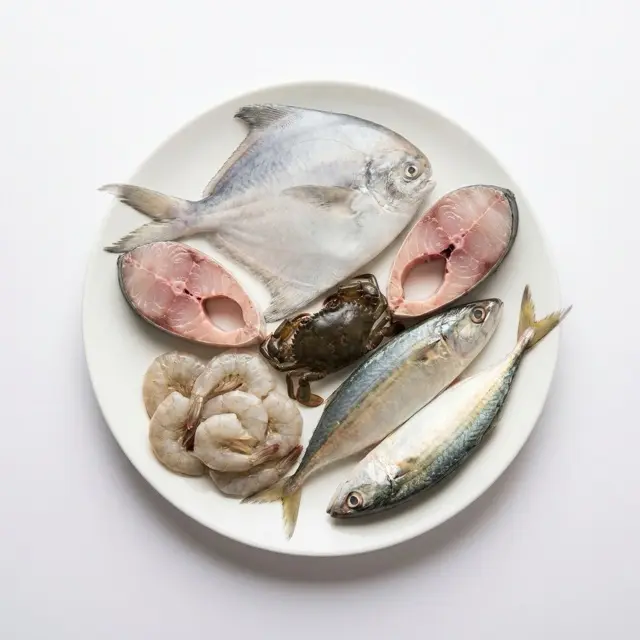
Fish in this guide: OysterPrawnsTuna (Kupa)SardinePomfret Today's prices →
Seafood for Thyroid: Iodine, Selenium and What It Can and Cannot Do
Seafood for thyroid health is mostly about iodine and selenium: fish, oysters and prawns supply both, and the thyroid needs iodine to make its hormones. In India, though, your main iodine source is iodised salt, not fish. Seafood adds to it. It does not replace it, and it does not treat thyroid disease.
Quick answer
- Adults need 150 mcg of iodine a day (NIH). Pregnancy needs 220 mcg and breastfeeding 290 mcg.
- In India, iodised salt is the main source. Keep using it, but keep it within 5 g a day.
- Oysters, sea fish and prawns (kolambi) add iodine and selenium on top. Two fish meals a week is a good habit.
- Too much iodine can also harm the thyroid. The risk is mostly from kelp and iodine tablets, not from fish.
- On thyroid medicine or before radioactive iodine treatment? Ask your doctor what to eat.
Every number below comes from a source listed under Sources.
This is general food information, not medical advice. If you have a thyroid condition, are pregnant, or take thyroid or blood pressure medicines, ask your doctor before changing your diet or taking supplements.
Why the thyroid needs iodine
The US NIH Office of Dietary Supplements (ODS) explains the basics clearly:
- Iodine is an essential part of the thyroid hormones T4 (thyroxine) and T3 (triiodothyronine).
- These hormones control many reactions in the body, including how fast you burn energy (metabolism).
- They are needed for normal bone and brain development in babies before and after birth.
- When iodine is short, the brain keeps signalling the thyroid with TSH (a hormone that tells the thyroid to work). The gland can swell into a goitre as it tries to trap more iodine.
The NIH also says iodine deficiency is the most common preventable cause of intellectual disability in the world. That is why India and many other countries add iodine to salt.
How much iodine do you need?
These are the NIH’s Recommended Dietary Allowances (RDAs), with the upper limit (UL) for adults.
| Group | Iodine per day |
|---|---|
| Children 1 to 8 years | 90 mcg |
| Children 9 to 13 years | 120 mcg |
| Teens and adults | 150 mcg |
| Pregnancy | 220 mcg |
| Breastfeeding | 290 mcg |
| Upper limit, adults 19+ | 1,100 mcg |
The WHO and partner agencies suggest a slightly higher 250 mcg a day in pregnancy, the NIH notes. These are US and international figures. If you are pregnant, your doctor will guide you on iodine along with iron and folic acid.
India’s main iodine source: iodised salt
India’s iodine story is mostly a salt story.
- ICMR-NIN’s Dietary Guidelines for Indians (2024) say “iodine is not an issue now as iodine fortified salt is available.” Its daily meal plans are built with 5 g of iodised salt, and its salt guideline simply says: use iodised salt.
- The Directorate General of Health Services runs the National Iodine Deficiency Disorders Control Programme. Its target is 100% household use of adequately iodised salt, meaning salt with at least 15 ppm of iodine.
- The WHO says all salt that is consumed should be iodised.
What does 15 ppm mean in your kitchen? It is 15 mcg of iodine per gram of salt. So 5 g of salt at that level carries about 75 mcg, before any loss in cooking. That is our own arithmetic, not an official figure, but it shows why salt matters so much.
There is a catch for people who cut salt for blood pressure. The NIH notes that women who restrict salt tend to have lower iodine levels. So keep your salt low, but keep it iodised.
Rock salt (sendha namak) and black salt (kala namak) are not a healthier swap. ICMR-NIN says their sodium is almost the same, and they are usually not iodised. Our guide to fish for high blood pressure covers the low-salt side.
Which seafood has iodine?
The NIH says seaweed is one of the best food sources, and fish, other seafood and eggs are also good sources. Its food table gives these values:
| Food | Iodine | % of daily value |
|---|---|---|
| Cod, baked, 3 ounces | 146 mcg | 97% |
| Nori seaweed, dried, 2 tablespoons (5 g) | 116 mcg | 77% |
| Oysters, cooked, 3 ounces | 93 mcg | 62% |
| Milk, nonfat, 1 cup | 84 mcg | 56% |
| Egg, hard boiled, 1 large | 31 mcg | 21% |
| Shrimp (prawns), cooked, 3 ounces | 13 mcg | 9% |
| Tuna, canned in water, 3 ounces | 7 mcg | 5% |
| Chicken breast, roasted, 3 ounces | 1 mcg | 1% |
Three ounces is about 85 g, roughly a palm-sized portion. A few things stand out:
- Seafood varies a lot. Cod and oysters are high. Prawns and canned tuna are modest.
- Cod is rich, but it is not sold in Thane. We could not find iodine values for Indian fish such as bangda (mackerel), paplet (pomfret) or surmai (kingfish) in the sources we use. So we do not give numbers for them.
- Seafood beats chicken and meat for iodine. Roasted chicken breast has almost none.
In plain terms, a fish or shellfish meal adds iodine on top of your salt. It is a helpful extra, not your base.
Selenium: the thyroid’s other seafood nutrient
The NIH says selenium is part of selenoproteins, which help protect the body from oxidative damage and support thyroid hormone metabolism. Adults need 55 mcg a day.
| Food (NIH, per 3 ounces) | Selenium |
|---|---|
| Yellowfin tuna, cooked | 92 mcg |
| Sardines, canned | 45 mcg |
| Shrimp, cooked | 42 mcg |
In Mumbai terms, that points to kupa (tuna), tarli (oil sardine) and kolambi (prawns). The NIH’s upper limit for selenium is 400 mcg a day for adults. Food is fine, but stacking supplements is not. Our post on zinc-rich seafood for men has more on selenium.
Hypothyroid or hyperthyroid? Read this first
This is the part most “thyroid diet” posts skip. More iodine is not always better.
- Excess iodine can cause the same problems as too little. The NIH says high intakes can cause goitre, raised TSH and hypothyroidism. Iodine-induced hyperthyroidism can also happen.
- Some people react at normal intakes. People with autoimmune thyroid disease (such as Hashimoto’s) may have side effects at intakes that are safe for others, the NIH notes.
- Supplements are the usual problem, not fish. Kelp tablets and iodine-only supplements can contain doses above the UL. Do not take them for the thyroid unless your doctor prescribes them.
- Antithyroid medicines. If you take medicines for hyperthyroidism, the NIH says high doses of iodine on top can push you into hypothyroidism.
- Blood pressure medicines. Potassium iodide with ACE inhibitors or potassium-sparing diuretics can raise blood potassium, the NIH warns.
- Radioactive iodine treatment. Before this treatment, doctors often prescribe a low-iodine diet. The NIH says it usually means avoiding iodised salt, fish and other seafood, seaweed, dairy and eggs for a week or two. Follow your doctor’s list exactly.
Seafood will not cure hypothyroidism, hyperthyroidism or goitre. Thyroid tablets and tests are for your doctor to manage.
A simple seafood week for thyroid health
For a healthy adult with no thyroid condition, this is a sensible pattern:
| Day | Meal idea | Why |
|---|---|---|
| Monday | Paplet (pomfret) curry with kokum | Sea fish, light gravy |
| Wednesday | Kolambi in a light masala | Iodine and selenium |
| Friday | Tarli or kupa tawa fry with little oil | Selenium, omega-3 |
| Daily | Iodised salt, within 5 g | India’s main iodine source |
| Daily | A glass of milk or a bowl of curd | Iodine and calcium |
Two fish meals a week also matches the American Heart Association’s advice, and ICMR-NIN suggests about 200 g of marine fish a week for omega-3. If you are pregnant, pick low-mercury fish; our low mercury fish guide has the list.
Buying and cooking tips
- Pick sea fish and shellfish. Iodine comes from the sea, so sea fish and shellfish are the useful picks. River fish like rohu and katla are not the ones to count on here.
- Keep the salt honest. Use iodised salt, but measure it. Dry fish and pickles add a lot of salt.
- Cook gently. A curry, steaming or a tawa fry with a spoon of oil keeps the meal light.
- Buy fresh. Prawns and oysters spoil fast. Buy them for the day you cook. Fresh prawns are firm, grey-clear and smell of the sea, not of ammonia.
- Portion for a family of four. About 500 g of fish or cleaned prawns makes one meal, roughly an 85 to 125 g serving each.
Prices change daily with the catch, so check today’s fish prices before you plan.
Getting seafood in Thane
Verified sellers on Relifish list paplet, kolambi, tarli and more when they have them. Choose how you want it cleaned and cut, order for today or pre-order, and pick a 2-hour delivery slot in Thane, Mulund or Bhandup.
You might also like: omega 3 fish in India, fish for women over 40, fish for breastfeeding mothers and foods for immunity.
What to do next: check prawns on Relifish or today’s fish prices, then order from verified sellers.
Sources
- US National Institutes of Health, Office of Dietary Supplements. Iodine: Fact Sheet for Health Professionals. Role in thyroid hormones, Table 1 (RDAs), WHO 250 mcg in pregnancy, Table 2 (iodine in foods), salt restriction and iodine status, Table 3 (ULs), excess iodine, medicine interactions, low-iodine diet.
- US National Institutes of Health, Office of Dietary Supplements. Selenium: Fact Sheet for Health Professionals. Thyroid role, 55 mcg RDA, food values, 400 mcg UL.
- ICMR-National Institute of Nutrition. Dietary Guidelines for Indians 2024. PDF at nin.res.in. Guideline 2 (iodine and iodised salt, pages 13 to 15), sample meal plans with 5 g iodised salt, Guideline 7 (~200 g a week marine fish, page 56), Guideline 11 (salt, rock and black salt, use iodised salt, pages 73 to 76).
- Directorate General of Health Services, Government of India. National Iodine Deficiency Disorders Control Programme. Target of 100% household use of adequately iodised salt (15 ppm).
- World Health Organization. Sodium reduction fact sheet. All salt consumed should be iodised.
- American Heart Association. Fish and Omega-3 Fatty Acids (last reviewed 23 Aug 2024).
Frequently asked questions
Is seafood good for the thyroid?
Seafood can be part of a thyroid-friendly diet because it supplies iodine and selenium, two nutrients the thyroid uses. The US NIH lists fish and other seafood among good food sources of iodine. But seafood does not treat thyroid disease. If you have hypothyroidism or hyperthyroidism, follow your doctor's advice on diet and medicines.
How much iodine does an adult need per day?
The US NIH Office of Dietary Supplements lists 150 mcg a day for adults, 220 mcg in pregnancy and 290 mcg while breastfeeding. The upper limit for adults is 1,100 mcg a day. In India, ICMR-NIN advises using iodised salt, and its 2024 guidelines say iodine is not an issue now because iodine-fortified salt is available.
Which seafood has the most iodine?
In the NIH iodine table, baked cod has 146 mcg per 3 ounces and cooked oysters 93 mcg. Cooked shrimp has 13 mcg and canned tuna 7 mcg per 3 ounces. Seaweed such as nori is among the richest sources. Iodine in fish varies a lot, and we found no iodine values for Indian species like bangda or paplet.
Can people with hypothyroidism eat fish and prawns?
For most people, yes, fish and prawns are normal food. The NIH notes that some people, such as those with autoimmune thyroid disease, may react to iodine intakes that are safe for others. That risk is mainly about high-dose supplements and kelp. If you are on thyroid medicine or preparing for radioactive iodine treatment, ask your doctor what to eat.
Should I stop iodised salt if I eat a lot of fish?
No, not without medical advice. ICMR-NIN and the WHO both say the salt you eat should be iodised. Keep the total amount low instead: ICMR-NIN advises no more than 5 g of salt a day. Seafood adds some iodine on top, but it is eaten too irregularly to replace iodised salt for most families.
How we write and check these guides: editorial standards
Share this article: