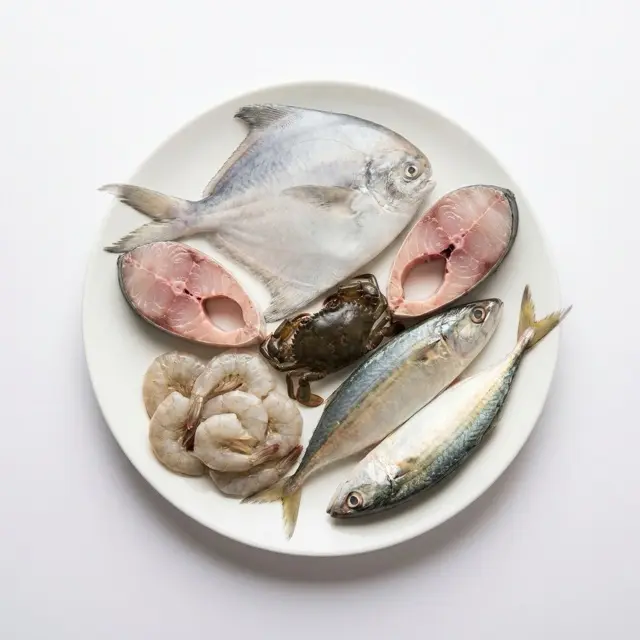
Fish in this guide: PrawnsCrabSardineHalwa (Black Pomfret)Clam Today's prices →
Foods for Immunity in India: What Fish Really Adds to Your Plate
The best foods for immunity in India are not one superfood but a varied, balanced plate. NIH says a nutritious variety of foods helps maintain a strong immune system. Fish earns its place on that plate because one meal gives protein, zinc, selenium, vitamin D and vitamin B12 together. Each of these has a known role in normal immune function. None of them “boosts” immunity beyond normal.
Quick answer
- No single food boosts immunity. A varied, balanced thali does the work.
- Fish gives protein, zinc, selenium, vitamin D and B12 in one meal.
- Shellfish (crab, kalva, tisrya) lead on zinc. Palva, halwa and tarli lead on vitamin D.
- Two fish meals a week, about 200 g of sea fish, fits ICMR-NIN advice.
- Skip “immunity” pills unless a doctor finds a deficiency.
This guide explains what the US National Institutes of Health (NIH) and India’s ICMR-NIN say. It shows which fish give what, and how to build a sensible week. Every number comes from a source listed under Sources.
This is general food information, not medical advice. If you fall ill often, have a long-term condition or take regular medicines, ask your doctor before changing your diet or taking supplements.
Why “boost your immunity” is the wrong goal
Search for immunity foods and you will see big promises. Kadha, capsules, powders, “immunity shots”. The evidence is much quieter.
NIH’s fact sheet on immune function makes three points worth remembering:
- Variety matters most. A nutritious variety of foods helps maintain overall good health and a strong immune system.
- Deficiencies hurt. Low levels of several vitamins and minerals might weaken immune function. NIH names vitamins A, B6, B12, C, D, E and K and folate. It also names copper, iodine, iron, magnesium, selenium and zinc.
- Extra does not add much. If you are not deficient, routine supplements probably do little to prevent or treat specific infections.
So the real goal is simple. Avoid shortfalls. Eat a balanced diet. Sleep, stay active and keep up with vaccines. NIH notes that vaccines work by training the adaptive immune system to recognise a germ.
ICMR-NIN’s Dietary Guidelines for Indians (2024) agree. They say a balanced diet is needed for immune function, among other things, and that no single food has all the nutrients. They also say fruits and vegetables enhance immune function and reduce the risk of infections.
Five nutrients in fish and what NIH says they do
1. Protein
ICMR-NIN says protein needs rise during infections, illness and physical stress. It also says animal proteins such as fish provide all the essential amino acids in the right proportions. The adult allowance is 0.83 g of protein per kg of body weight a day. For a 60 kg adult, that is about 50 g.
Per 100 g raw (IFCT 2017), surmai gives 22.28 g of protein, bangda 21.51 g and pomfret 19.02 g. For a deeper look, see our fish protein guide.
2. Zinc
NIH says zinc is needed for about 100 enzymes and plays a role in both the innate and adaptive immune systems. It helps keep tissue barriers, such as the lining of the airways, intact. Zinc deficiency impairs the making and maturing of white blood cells called lymphocytes.
Adult men need 11 mg a day and women 8 mg. Shellfish are the best seafood source:
| Seafood (Marathi) | Zinc per 100 g raw |
|---|---|
| Oyster (कालव) | 7.35 mg |
| Mud crab (खेकडा) | 3.30 mg |
| Sea crab (खेकडा) | 3.07 mg |
| Tiger prawns (कोळंबी) | 1.16 mg |
| Clams (तिसऱ्या) | 1.16 mg |
| Bangda (बांगडा) | 0.67 mg |
Source: IFCT 2017. Our zinc rich seafood guide has the full list.
3. Selenium
NIH says selenium helps support both arms of the immune system, through its role in T-cell maturation and natural killer cell activity. Low selenium status has been linked with weaker natural killer cell activity.
Adults need 55 mcg a day. Per 3 ounces (about 85 g), NIH lists 92 mcg in cooked yellowfin tuna, 45 mcg in canned sardines and 42 mcg in cooked shrimp. So one portion of tuna, tarli or prawns can cover most of a day.
4. Vitamin D
NIH says vitamin D plays a role in immune function. Almost all immune cells carry a vitamin D receptor. Deficiency has been linked with a higher risk of flu and other respiratory infections.
Low vitamin D is common in India. ICMR-NIN quotes the national CNNS survey: deficiency in 23.9% of adolescents aged 10 to 19. Very few foods have it naturally. Fatty fish is one of them.
| Fish (Marathi) | Vitamin D per 100 g raw (approx.) |
|---|---|
| Hilsa (पालवा) | 10.1 µg |
| Halwa (हलवा) | 5.6 µg |
| Tiger prawns (कोळंबी) | 4.8 µg |
| Tarli (तारली) | 3.5 µg or more |
| Surmai (सुरमई) | 1.9 µg |
Source: IFCT 2017, total vitamin D activity by IFCT’s method. NIH’s adult RDA is 15 µg a day. See our vitamin D rich fish chart for 14 fish.
5. Vitamin B12
NIH says B12 deficiency reduces the ability of neutrophils, a type of white blood cell, to swallow germs. Adults need 2.4 mcg a day. NIH lists 17 mcg in 3 ounces of cooked clams, and 2.5 mcg in canned light tuna. B12 comes naturally only from animal foods. More in our vitamin B12 fish guide.
Fish is one part: build the balanced plate
Fish covers protein, zinc, selenium, vitamin D and B12. It does not cover everything. NIH’s list also includes vitamins A, C and E, folate, iron and magnesium. Those come mostly from other food groups.
| Food group | What it adds | Easy Indian options |
|---|---|---|
| Fish and seafood | Protein, zinc, selenium, vitamin D, B12, omega-3 | Bangda curry, tarli fry, prawn curry |
| Vegetables and greens | Vitamins A and C, folate, fibre | Palak, methi, bhopla, cabbage |
| Fruits | Vitamin C | Guava, orange, amla, papaya |
| Dal and pulses | Protein, folate, iron | Toor dal, moong, chana |
| Whole grains | Energy, magnesium | Jowar or bajra bhakri, brown rice |
| Milk and curd | Protein, calcium | Dahi, taak |
| Nuts and seeds | Vitamin E | Peanuts, til |
ICMR-NIN also suggests about 200 g of marine fish a week for omega-3 fats. That is two meals of about 100 g.
A simple week of fish meals
| Day | Meal | Main reason |
|---|---|---|
| Monday | Bangda curry with kokum, rice, palak bhaji | Protein |
| Wednesday | Tarli tawa fry, bhakri, cabbage sabzi, guava | Vitamin D, selenium, omega-3 |
| Friday | Kolambi curry, dal, salad | Selenium, zinc |
| Sunday (once or twice a month) | Malvani crab masala or clam sukka | Zinc, B12 |
Tips that make it work
- Rotate species. Different fish bring different strengths. Rotation also keeps mercury from any one fish low.
- Cook light. A curry or a tawa fry with a spoon of oil beats deep frying.
- Add a fruit or raw vegetable. Fish has little vitamin C. A guava or a kachumber fixes that.
- Pregnant or breastfeeding? The US FDA lists sardine, shrimp, clams and oysters among its Best Choices, and shark among Choices to Avoid. See our low mercury fish guide.
- Recovering from illness? Read our guide to a diet after fever recovery for soft, easy fish meals.
Supplements: more is not better
NIH sets upper limits for adults. Going above them can cause harm.
| Nutrient | Adult upper limit | What too much can do (NIH) |
|---|---|---|
| Zinc | 40 mg a day | Nausea, vomiting, cramps. Long-term high doses can lower copper and reduce immune function |
| Selenium | 400 mcg a day | Garlic breath, metallic taste, hair and nail loss |
| Vitamin D | 100 mcg (4,000 IU) a day | Nausea, weakness, kidney stones. Severe cases harm the heart and kidneys |
Zinc supplements can also reduce absorption of some antibiotics, NIH notes. Food sources rarely reach these limits. Pills can. Take supplements only if your doctor finds a deficiency.
Food safety is part of staying well
Good food handling protects you from stomach infections. ICMR-NIN advises:
- Wash hands with soap and water for at least 20 seconds before cooking and eating.
- Store raw fish and cooked food separately in the fridge, below 5°C.
- Wash and cook fish thoroughly. The US FDA says cook fish to 63°C (145°F), or until it is opaque and flakes with a fork.
Buying fish for these meals in Thane
Verified sellers on Relifish list prawns, crab, tarli, bangda, halwa and sometimes clams, depending on the day’s catch. Choose how it is cleaned and cut, and pick a 2-hour delivery slot in Thane, Mulund or Bhandup.
What to ask for at the counter
| Seafood | Ask for | Freshness check |
|---|---|---|
| Prawns (kolambi) | Peeled and deveined, tail on or off | Firm, translucent, no black heads |
| Crab (khekda) | Live or just caught, cleaned and halved | Heavy for its size, legs move |
| Tarli | Scaled, gutted, head off | Shiny skin, firm belly |
| Halwa | Whole with slits, or thick slices | Dark shiny skin, firm flesh |
| Clams (tisrya) | Whole, washed | Shells shut, or close when tapped |
For a family of four, half a kilo of prawns or two to three medium crabs makes one meal with dal and rice. Our crab health guide covers cleaning and cooking crab.
Prices change daily, so check today’s fish prices before planning the week.
What to do next: pick one zinc-rich and one vitamin D-rich fish for this week, such as prawns and tarli, and order them from the shop.
Related reading
- Omega 3 for Mental Health: What Fish Can and Cannot Do
- Seafood for Thyroid: Iodine, Selenium and Safe Limits
Sources
- NIH Office of Dietary Supplements. Dietary Supplements for Immune Function and Infectious Diseases: Fact Sheet for Health Professionals. Variety of foods, deficiencies and immunity, routine supplementation, vaccines, roles of zinc, selenium, vitamin D, B12, upper limits and safety.
- NIH Office of Dietary Supplements. Zinc, Selenium, Vitamin D and Vitamin B12 fact sheets. RDAs and food tables.
- ICMR-National Institute of Nutrition. Dietary Guidelines for Indians 2024. Page 1 (balanced diet and immune function), page 9 (protein needs in infection and illness), page 47 (fruits and vegetables and immunity), page 56 (~200 g a week marine fish), page 58 (0.83 g/kg protein), pages 78 to 80 (food safety), Table II (CNNS data). PDF at nin.res.in.
- Longvah T, et al. Indian Food Composition Tables 2017 (IFCT 2017). ICMR-NIN, Hyderabad. Protein (Table 1), zinc (minerals table), vitamin D (Table 3). PDF at nin.res.in.
- US Food and Drug Administration. Advice about Eating Fish. Best Choices and Choices to Avoid.
- US Food and Drug Administration. Meat, Poultry & Seafood (Food Safety for Moms-to-Be). Cooking temperature for fish.
Frequently asked questions
Which foods help immunity in India?
No single food boosts immunity. NIH says a nutritious variety of foods helps maintain a strong immune system. ICMR-NIN adds that fruits and vegetables enhance immune function and reduce the risk of infections. Fish, eggs, dal and dairy supply protein, zinc, selenium, vitamin D and B12. A balanced Indian thali that combines these groups is the practical answer.
Is fish good for immunity?
Fish can be part of a diet that supports normal immune function. It gives complete protein plus zinc, selenium, vitamin D and vitamin B12, and NIH says deficiencies of these nutrients might weaken immunity. But fish is not a cure and will not stop you catching a cold. Eat it as one part of a varied, balanced plate.
Do immunity supplements work if I eat well?
Usually not much. NIH's immune function fact sheet says that in the absence of a deficiency, routine vitamin and mineral supplements probably do little to prevent or treat specific infections. Too much can harm. Zinc above 40 mg a day and selenium above 400 mcg a day exceed adult upper limits. Ask your doctor before taking any supplement.
Which seafood has the most zinc?
Oysters lead. In India's food tables (IFCT 2017), oysters (kalva) have 7.35 mg zinc per 100 g raw. Mud crab has 3.30 mg and sea crab 3.07 mg. Tiger prawns and clams have about 1.16 mg. Finfish like bangda and pomfret have under 1 mg. Adult men need 11 mg a day and women 8 mg, according to NIH.
Which Indian fish has the most vitamin D?
By ICMR-NIN's food tables (IFCT 2017), hilsa (palva) has the most at about 10 µg per 100 g raw. Halwa (black pomfret) has about 5.6 µg, tiger prawns about 4.8 µg and tarli at least 3.5 µg. NIH's adult RDA is 15 µg a day. Sunlight still matters, and a doctor can test your level if you are worried.
How we write and check these guides: editorial standards
Share this article: