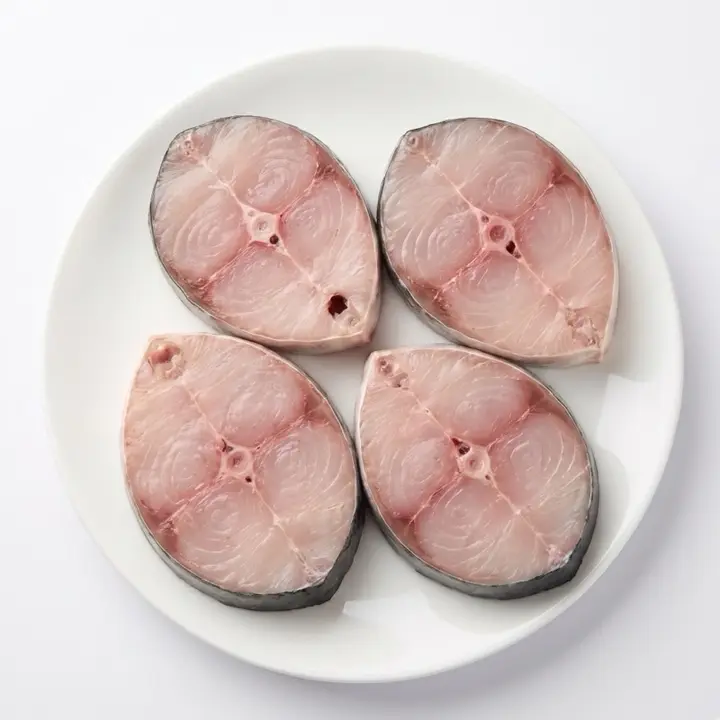
Fish in this guide: Surmai (Kingfish)SardineHalwa (Black Pomfret)PomfretBangda (Mackerel) Today's prices →
Omega 3 for Mental Health: An Honest Look at Fish and Mood
Is omega 3 good for mental health? The honest answer is that the research is mixed. In some studies, people who eat fish often have a lower risk of depression. But omega-3 capsules have not been shown to treat depression in a meaningful way.
Fish can be part of a healthy diet that supports your overall wellbeing. It is not a medicine, and it does not replace care from a doctor or counsellor.
Key points:
- Eating more fish is linked with lower depression risk. A link is not proof.
- Omega-3 capsules did not work as a treatment for depression in large reviews.
- Eat fish as food: about 200 g of sea fish a week, as ICMR-NIN suggests. Surmai, tarli (oil sardine) and halwa (black pomfret) have the most omega-3.
- Low mood for two weeks or more needs a doctor or counsellor. Tele-MANAS is free on 14416.
This guide explains what the US National Institutes of Health (NIH), the World Health Organization (WHO) and India’s ICMR-NIN actually say. Every number comes from a source listed under Sources.
This is general food information, not medical advice. If you feel low for weeks, or have thoughts of harming yourself, please talk to a doctor or counsellor. In India, Tele-MANAS gives free support on 14416 or 1-800 891 4416.
What omega-3s are, and why the brain comes up
Omega-3s are a family of fats. NIH says they are building blocks of the membranes around every cell. The two that matter most from fish are EPA and DHA. NIH notes that DHA is especially high in the retina, brain and sperm.
There is also a plant omega-3 called ALA. It is found in flaxseed, walnuts and some oils. But the body turns very little of it into DHA. NIH says less than 1% of ALA becomes DHA. So eating EPA and DHA directly, from fish, is the practical way to raise them.
NIH lists an adequate intake for ALA of 1.6 g a day for men and 1.1 g for women. It has set no official daily target for EPA and DHA.
Because DHA sits in the brain, people often assume more omega-3 means better mood. That sounds logical. But the studies tell a more careful story.
What the research actually says
Here is what the main health bodies report. We have kept their wording as close as possible.
| Source | What it found | What it means for you |
|---|---|---|
| NIH ODS, citing a 2016 meta-analysis of 26 studies | Higher fish intake was linked with a 17% lower risk of depression | A link, not proof. People who eat fish may differ in other ways too |
| NIH ODS, citing a 2015 Cochrane review of 26 studies | Not enough evidence that omega-3 supplements help major depression in adults. A small effect on symptoms was not clinically significant | Capsules did not work as a treatment |
| NIH NCCIH, citing a 2021 review of 35 studies (1,964 people) | Any effect may be too small to be meaningful. Evidence quality was low or very low | Still uncertain |
| NIH NCCIH, other reviews | If omega-3s help, EPA may matter more than DHA. They may work best alongside antidepressants, not instead of them | Never swap prescribed medicine for fish oil |
| NIH NCCIH, 2019 review on pregnancy | 9 of 14 studies found high DHA intake may reduce depression and anxiety symptoms during pregnancy. None showed an effect after delivery | More research needed |
So what does this add up to? People who eat fish often seem to do a little better. But taking omega-3 as a pill has not been shown to fix depression. NCCIH puts it plainly: depression can be a serious illness, and anyone who may have it should consult a health care provider.
Food first: why a fish meal beats a capsule for most people
If the evidence for pills is weak, why eat fish at all? Because fish is food, not a single nutrient. One meal gives protein, omega-3, vitamin D, B12 and minerals together. It fits easily into a regular Maharashtrian thali.
Capsules have their own downsides. NIH lists these common side effects of omega-3 capsules:
- unpleasant taste and bad breath
- heartburn, nausea and stomach upset
- diarrhoea and headache
NIH also warns that fish oil at high doses can affect clotting. People on blood thinners such as warfarin should talk to their doctor before taking it. Our fish oil vs eating fish guide covers this in more detail.
ICMR-NIN’s Dietary Guidelines for Indians (2024) also take a food-first view. They suggest marine fish, about 200 g a week, as a good source of long-chain omega-3 fats.
Omega-3 in Mumbai and Thane fish
These values are from India’s own food tables (IFCT 2017, ICMR-NIN), per 100 g raw edible portion.
| Fish (Marathi) | EPA + DHA per 100 g | Good for |
|---|---|---|
| Surmai (सुरमई) | 1.05 g | Tawa fry, curry |
| Halwa (हलवा, black pomfret) | 0.81 g | Fry, curry |
| Tarli (तारली, oil sardine) | 0.61 g | Tawa fry, kalvan |
| Pomfret (पापलेट, white) | 0.59 g | Steamed, fry, curry |
| Bangda (बांगडा) | 0.33 g | Curry, fry |
| Bombil (बोंबील) | 0.20 g | Fry, sukka |
| Prawns (कोळंबी) | 0.12 g | Curry |
| Rohu (रोहू) | 0.07 g | Curry |
Oily sea fish are clearly ahead. For the full ranking of 11 fish, see our omega 3 fish chart.
Regular meals, routine and mood
WHO’s advice on self-care for depression is practical. It is not about any one food. WHO suggests you:
- Stick to regular eating and sleeping habits as much as possible.
- Exercise regularly, even if it is just a short walk.
- Keep doing activities you used to enjoy.
- Stay connected to friends and family.
- Avoid or cut down on alcohol and do not use drugs, which can make depression worse.
- Talk to someone you trust, and seek help from a health care provider.
Food fits under the first point. Skipping meals, living on tea and biscuits, or eating at random hours makes any day harder. A steady routine of simple, home-cooked meals is something you can control.
How to build a simple fish routine
- Pick two fixed fish days. For example, Wednesday and Sunday. Routine is easier than willpower.
- Keep the cooking simple. A surmai fry with a spoon of oil takes 15 minutes. A bangda curry with kokum is a one-pot meal.
- Plan a balanced plate. Fish, a bowl of dal, a vegetable, rice or bhakri, and some fruit. ICMR-NIN says no single food has all the nutrients you need.
- Cook with family or a friend. Eating together is one easy way to stay connected.
- Pregnant or breastfeeding? Choose low-mercury fish. See our low mercury fish guide.
A sample week
| Day | Fish meal | Approx. fish |
|---|---|---|
| Wednesday | Tarli tawa fry with bhakri and a vegetable | 100 g |
| Sunday | Surmai or pomfret curry with rice and dal | 100 g |
| Optional third day | Bangda curry or prawn curry | 100 g |
Two meals of about 100 g each meet ICMR-NIN’s suggestion of about 200 g of marine fish a week.
When to seek help
Food can support your health. It cannot treat depression. WHO describes a depressive episode as low mood, or loss of interest in activities. It lasts most of the day, nearly every day, for at least two weeks. Other signs WHO lists include:
- poor concentration
- feeling guilty or worthless
- hopelessness about the future
- disturbed sleep
- changes in appetite or weight
- feeling very tired or low in energy
- thoughts about dying or suicide
WHO says depression is common. It estimates that 5.2% of adults worldwide have it: 6.2% of women and 4.1% of men. More than 10% of pregnant women and new mothers experience it. WHO also says there is effective treatment for mild, moderate and severe depression. Talk therapy is the first treatment. Medicines may be added for moderate or severe depression.
Where to get help in India:
- Tele-MANAS, the Government of India’s free mental health helpline: call 14416 or 1-800 891 4416.
- Your family doctor or a psychiatrist at a nearby hospital.
- If you or someone near you is in immediate danger, contact emergency services right away.
If someone close to you seems low, a simple “How are you, really?” can open the door.
Buying fish for these meals in Thane
Verified sellers on Relifish list surmai, tarli, halwa, pomfret and bangda, depending on the day’s catch. You choose how the fish is cleaned and cut. Then pick a 2-hour delivery slot in Thane, Mulund or Bhandup. That saves a trip to the market on a tired day.
- For tawa fry: ask for surmai steaks about 1 cm thick, or tarli whole and cleaned.
- For curry: ask for bangda or pomfret cleaned and cut into pieces.
- To check freshness: look for clear eyes, red gills and firm, shiny flesh with a clean sea smell. Oily fish like tarli and bangda spoil fast, so cook them the same day.
Prices change daily with the catch, so check today’s fish prices. For a wider view of fish and nutrition, read our fish protein guide.
What to do next: pick your two fish days, then order tarli (oil sardine) or see what is fresh today.
Related reading
- Fish for Brain Health: DHA for Kids, Adults and Elders
- Foods for Immunity in India: Where Fish Fits, Per NIH
Sources
- NIH Office of Dietary Supplements. Omega-3 Fatty Acids: Fact Sheet for Health Professionals. Cell membranes, DHA in the brain, ALA adequate intakes, depression section (2016 meta-analysis, 2015 Cochrane review), side effects, warfarin interaction.
- NIH Office of Dietary Supplements. Dietary Supplements for Immune Function: Fact Sheet for Health Professionals. ALA to DHA conversion under 1%.
- NIH National Center for Complementary and Integrative Health. Omega-3 Supplements: What You Need To Know (last updated November 2024). 2021 review of 35 studies, EPA vs DHA, pregnancy review.
- World Health Organization. Depressive disorder (depression) fact sheet. Prevalence, symptoms, treatment, self-care.
- Ministry of Health and Family Welfare, Government of India. Tele-MANAS. Toll-free numbers 14416 and 1-800 891 4416.
- ICMR-National Institute of Nutrition. Dietary Guidelines for Indians 2024. Page 1 (variety, no single food has all nutrients), page 56 (~200 g a week marine fish). PDF at nin.res.in.
- Longvah T, et al. Indian Food Composition Tables 2017 (IFCT 2017). ICMR-NIN, Hyderabad. Table 7, EPA and DHA. PDF at nin.res.in.
Frequently asked questions
Does omega-3 help with depression?
The evidence is mixed. NIH notes a 2016 analysis that linked higher fish intake with a 17% lower risk of depression. But a 2021 review of 35 studies found that any effect of omega-3 supplements on depression may be too small to matter, and the evidence was low quality. Omega-3 is not a treatment for depression. Please see a doctor or counsellor.
Which Indian fish has the most omega-3?
Among Indian sea fish in IFCT 2017, surmai has the most EPA and DHA at 1.05 g per 100 g raw. Halwa (black pomfret) has 0.81 g, tarli (oil sardine) 0.61 g and white pomfret 0.59 g. Bangda has 0.33 g. Prawns, rohu and bhetki have much less. Two meals a week of the oily sea fish cover ICMR-NIN's suggestion.
Should I take fish oil capsules for my mood?
Not without talking to your doctor. NIH's NCCIH says it is uncertain whether omega-3 supplements help depression. Fish oil can cause heartburn, nausea and a fishy taste. At high doses it may affect bleeding in people on blood thinners like warfarin. If you are on any medicine, ask your doctor first. Never stop prescribed medicine on your own.
How much fish should I eat in a week?
ICMR-NIN's Dietary Guidelines for Indians (2024) suggest about 200 g of marine fish a week for long-chain omega-3 fats. That is two meals of about 100 g each. Surmai, tarli, halwa, pomfret and bangda all work. Rotate the species, cook with little oil, and keep the rest of the plate balanced with dal, vegetables and grains.
When should I seek help for low mood?
WHO says a depressive episode lasts most of the day, nearly every day, for at least two weeks. If low mood, loss of interest, poor sleep or hopelessness last that long, talk to a doctor or counsellor. In India, Tele-MANAS gives free mental health support on 14416 or 1-800 891 4416. In an emergency, contact emergency services at once.
How we write and check these guides: editorial standards
Share this article: