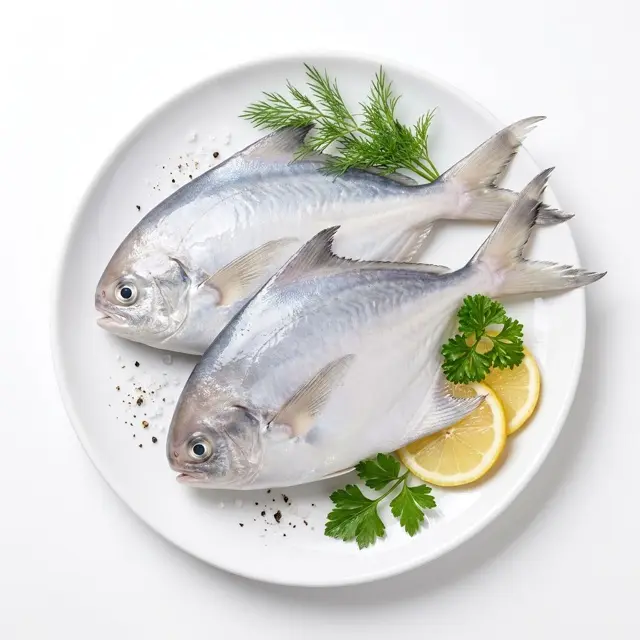
Fish in this guide: Surmai (Kingfish)Halwa (Black Pomfret)PomfretSardineBangda (Mackerel) Today's prices →
Fish for Brain Health: How DHA Helps From Childhood to Old Age
The best fish for brain health are oily sea fish rich in DHA, an omega-3 fat that is a building block of brain cells. Among common Mumbai fish, surmai, halwa, pomfret and tarli give the most. ICMR-NIN suggests about 200 g of marine fish a week. DHA matters most while the brain is growing. For adults and older people the evidence is more modest, and we explain it honestly below.
Quick answer
- Top DHA fish (IFCT 2017): surmai, halwa (black pomfret), white pomfret and tarli (oil sardine).
- How much: about 200 g of sea fish a week, or two meals of about 100 g.
- Children and pregnancy: pick low-mercury fish like tarli and prawns. Limit surmai.
- Older adults: fish fits a brain-friendly diet, but it is not a memory cure. Capsule trials showed no benefit in healthy elders.
- Capsules vs fish: fish wins, because it also gives protein, B12 and iodine.
Every number below comes from a source listed under Sources. Fish values are per 100 g raw edible portion.
This is general food information, not medical advice. If you or a family member has memory problems, a neurological condition, or takes blood thinners, please speak to your doctor before changing your diet or starting supplements.
Why does the brain need DHA?
The brain is mostly fat, and the type of fat matters. ICMR-NIN’s Dietary Guidelines for Indians (2024) explain it in simple terms:
- Brain cells and nerve tissue have high levels of omega-3 (n-3) fats.
- DHA is crucial for signals passing between nerve cells.
- Fish, sea foods and micro algae provide DHA and EPA directly.
- Plant foods give a shorter omega-3 called ALA. Only a small amount of ALA is turned into DHA and EPA in the body.
The US National Institutes of Health (NIH) adds that DHA is especially high in the retina and the brain. It also notes that DHA keeps building up in a baby’s brain for the first two years after birth.
So fish is one of the few everyday foods that brings DHA ready-made. For vegetarians, ICMR-NIN lists long-chain omega-3 as a nutrient of concern for this reason.
Does fish help the brain at every age?
The evidence is not the same for every age. Here is a plain summary.
| Stage of life | What the sources say | Source |
|---|---|---|
| Pregnancy and breastfeeding | Fish provide DHA, iron, iodine and choline that support a child’s brain development | US FDA |
| Pregnancy | A review of 29 studies linked about 4 ounces (113 g) of seafood a week with better child brain development | NIH |
| Babies and toddlers | DHA keeps building up in the brain for the first 2 years | NIH |
| Children and teens | Fish support a child’s brain development; choose low-mercury fish | US FDA |
| Adults | A lack of essential fatty acids and micronutrients can affect cognition, learning and memory | ICMR-NIN |
| Older adults | Some, but not all, studies link more fish with less mental decline. Capsule trials found no benefit in healthy elders | NIH |
Children: the growing years
The US FDA says fish provide key nutrients that support a child’s brain development. It names omega-3 (DHA and EPA), iron, iodine during pregnancy, and choline. It also lists protein, vitamin B12, vitamin D and selenium.
Vitamin B12 is worth a special mention. NIH says B12 is needed for a healthy nervous system. In India, ICMR-NIN quotes the national CNNS survey (Comprehensive National Nutrition Survey): 30.9% of teenagers aged 10 to 19 had low B12. Fish and shellfish are good B12 sources. Our vitamin B12 fish guide ranks them.
For portions by age and low-bone choices, see our best fish for kids guide.
Adults: the working years
For adults, sources speak about diet as a whole. ICMR-NIN warns that a lack of essential amino acids, fatty acids and micronutrients can affect cognition, learning ability and memory. It adds that regular physical activity improves brain function.
In other words, fish helps most as part of a balanced plate. It is not a pill for exam week or office deadlines.
Older adults: what the research really shows
This is where honest reporting matters. NIH’s omega-3 fact sheet says:
- Observational studies are mixed. These studies watch what people eat but cannot prove cause. In one Dutch study of 210 healthy men aged 70 to 89, eating fish was linked with less mental decline five years later. In the larger Rotterdam Study, an early link with lower dementia risk did not hold up after 6 years.
- Capsule trials did not help healthy elders. In a UK trial, 748 healthy adults aged 70 to 79 took 500 mg DHA and 200 mg EPA daily, or a placebo, for 24 months. Their thinking scores did not differ.
- Capsules did not slow Alzheimer’s disease. In one trial, 2 g of DHA a day for 18 months did not slow decline in 295 people with mild to moderate Alzheimer’s.
- Mild memory problems are an open question. Some reviews suggest small gains in attention and recall. NIH says these need confirming.
ICMR-NIN’s guideline for the elderly says balanced diets and regular activity can reduce the risk of many diseases, including dementia. Fish is one part of that, along with vegetables, fruits, pulses and milk.
Which Indian fish give the most DHA?
Here is DHA per 100 g raw edible portion, from India’s own food tables, IFCT 2017 (ICMR-NIN):
| Fish (Marathi name) | DHA (mg per 100 g) | EPA + DHA (g per 100 g) | Mercury note |
|---|---|---|---|
| Salmon (सॅलमन, imported) | 1,192 | 1.60 | FDA Best Choice |
| Surmai (सुरमई, kingfish) | 626 | 1.05 | Close relative of king mackerel, an FDA “avoid” fish |
| Halwa (हलवा, black pomfret) | 565 | 0.81 | Not on the FDA chart |
| Pomfret (पापलेट, white) | 423 | 0.59 | Not on the FDA chart |
| Tarli (तारली, oil sardine) | 317 | 0.61 | FDA Best Choice (sardine) |
| Bangda (बांगडा, Indian mackerel) | 259 | 0.33 | Not on the FDA chart |
| Katla (कटला) | 242 | 0.37 | FDA lists carp as a Good Choice |
| Bombil (बोंबील, Bombay duck) | 137 | 0.20 | Not on the FDA chart |
| Prawns (कोळंबी, tiger) | 50 | 0.12 | FDA Best Choice (shrimp) |
| Rohu (रोहू) | 47 | 0.07 | FDA lists carp as a Good Choice |
What the table tells you:
- Sea fish beat river fish. Halwa has about 12 times the DHA of rohu.
- Surmai is rich but best limited for children and pregnancy. The FDA lists king mackerel, its close relative, as a fish to avoid for mercury.
- Tarli is the all-rounder. Good DHA, low mercury, and a common everyday Konkan fish.
- Prawns are lean. They bring protein and B12, but little DHA.
Any fish varies with size, season and catch area. Treat these numbers as a guide. The full omega-3 ranking is in our omega 3 fish in India chart.
Are fish-oil capsules as good as fish?
Many families buy capsules “for memory”. The research above gives little reason to. NIH found no benefit from omega-3 supplements on thinking in healthy older adults or in people with Alzheimer’s disease.
Fish also brings more than DHA. A 100 g piece of bangda gives 21.51 g of protein, according to IFCT 2017. Fish also gives B12, iodine and vitamin D. A capsule gives none of these.
If your doctor has advised omega-3 capsules for a specific reason, follow that advice. Do not start or stop supplements on your own, especially with blood thinners.
How much fish should a family eat each week?
ICMR-NIN suggests about 200 g of marine fish a week. The US FDA suggests 2 to 3 servings a week of low-mercury fish for adults, with a serving of 4 ounces (about 113 g). Here is how a Thane family can meet it:
| Day | Meal | Why |
|---|---|---|
| Monday | Tarli fry with little oil, dal, rice | DHA, low mercury, kid-friendly when deboned |
| Thursday | Pomfret or halwa curry with kokum | DHA, few bones, soft for elders |
| Saturday | Prawn or bangda masala | Protein, B12, variety |
A few tips make it work:
- Rotate fish. Variety spreads out mercury and brings different nutrients.
- Size the portion to the person. The FDA’s average child serving is 1 ounce (about 28 g) at ages 1 to 3, rising to 4 ounces by age 11.
- Cook light. ICMR-NIN suggests grilling, baking, steaming or sautéing with minimal oil instead of frying.
- Pair with greens and dal. The brain needs a whole diet, not just one food.
- Keep moving. ICMR-NIN notes regular physical activity improves brain function.
For pregnancy, read our low mercury fish guide first. For new mothers, see fish for breastfeeding mothers.
How do you buy DHA-rich fish fresh?
Oily fish spoil faster than lean fish. ICMR-NIN describes fresh fish as having a stiff body, bright and bulging eyes, reddish gills and tight scales, with no stale smell.
- Tarli and bangda: buy for the day you cook. Ask the seller to gut and clean them.
- Pomfret and halwa: firm, shiny skin. Ask for curry pieces or whole cleaned fish.
- Surmai: sold in steaks. Look for moist, pinkish flesh with no dry edges.
Not sure of names? See our fish names in English and Marathi chart.
How to get DHA-rich fish in Thane
Verified sellers on Relifish list tarli, bangda, pomfret, halwa and surmai when they have them. Choose how it is cleaned and cut, order for today or pre-order for a later day, and pick a 2-hour delivery slot in Thane or nearby Mulund. Prices move with the catch, so check today’s fish prices or browse the shop.
What to do next: start with one tarli or pomfret meal this week. See today’s tarli and pomfret from verified sellers, and read fish oil capsules vs fish if you are weighing up supplements.
Related reading
- Omega 3 for Mental Health: What Fish Can and Cannot Do
- Fish for Eye Health: DHA, Vitamin A, Zinc (India Guide)
- Fish for Elderly Parents: Soft, Low-Bone Picks and Recipes
Sources
- ICMR-National Institute of Nutrition. Dietary Guidelines for Indians 2024. PDF at nin.res.in. Table II (CNNS 2019 data, B12 deficiency), page 2 (long-chain n-3 a concern for vegetarians), page 52 (n-3 fats in brain cells, DHA in neurotransmission, fish as a source), page 56 (marine fish about 200 g a week), page 66 (cooking methods), page 78 (signs of fresh fish), page 95 (lack of fatty acids and micronutrients can affect cognition and memory), pages 100 to 101 (elderly, physical activity and brain function).
- NIH Office of Dietary Supplements. Omega-3 Fatty Acids: Fact Sheet for Health Professionals. DHA in brain and retina, brain accumulation in first 2 years, maternal seafood review, Alzheimer’s disease, dementia and cognitive function section.
- US Food and Drug Administration. Advice about Eating Fish. Nutrients for a child’s brain development, serving sizes, Best Choices, Good Choices and Choices to Avoid.
- NIH Office of Dietary Supplements. Vitamin B12: Fact Sheet for Health Professionals. B12 and the nervous system.
- Longvah T, Ananthan R, Bhaskarachary K, Venkaiah K. Indian Food Composition Tables 2017. ICMR-NIN, Hyderabad. PDF at nin.res.in. Table 1 (protein) and Table 7 (EPA, DHA). Entries: Salmon P068, Vanjaram P087, Pomfret black P055, Pomfret white P057, Sardine P071, Mackerel P034, Catla S002, Bombay duck P007, Tiger prawns orange Q008, Rohu S006.
Frequently asked questions
Which fish is best for brain health?
Oily sea fish rich in DHA are the best picks. In India's food tables (IFCT 2017), surmai has 626 mg DHA per 100 g, halwa 565 mg, white pomfret 423 mg and tarli 317 mg. For children and pregnant women, choose low-mercury fish such as tarli and prawns. Rotate two or three fish through the week rather than eating only one.
Does eating fish improve memory?
Sources are careful here. NIH says some, but not all, observational studies link diets high in omega-3s with less cognitive decline in older adults. Clinical trials of omega-3 capsules in healthy older adults did not show better memory or thinking. So fish can be part of a brain-friendly diet, but it is not a memory cure.
Is fish good for a child's brain?
Yes, according to the US FDA. It says fish provide key nutrients, including DHA, iron and choline, that support a child's brain development during pregnancy, breastfeeding and early childhood. NIH notes DHA keeps building up in the brain for the first two years after birth. Pick low-mercury fish and remove all bones for young children.
How much fish should I eat a week for brain health?
ICMR-NIN's Dietary Guidelines for Indians (2024) suggest about 200 g of marine fish a week for long-chain omega-3 fats. That is two meals of about 100 g each. The US FDA suggests 2 to 3 servings a week of low-mercury fish for adults, with one serving being 4 ounces, about 113 g.
Are fish oil capsules as good as fish for the brain?
There is no strong case for capsules. NIH reports that omega-3 supplements did not change cognitive function in healthy older adults or in people with Alzheimer's disease in trials. Fish also brings protein, vitamin B12, iodine and other nutrients that capsules lack. If you are thinking about capsules, ask your doctor first.
How we write and check these guides: editorial standards
Share this article: