Fish in this guide: Surmai (Kingfish)PomfretSardineCrabOyster Today's prices →
Fish for Eye Health: What DHA, Vitamin A and Zinc Do for Your Eyes
Fish helps the eyes mainly through DHA, an omega-3 fat (a healthy fat) that forms part of the retina. Surmai (kingfish), pomfret (paplet), halwa (black pomfret) and tarli (oil sardine) are rich in DHA. Oysters and crab are rich in zinc.
Quick answer
- Best fish for DHA: surmai, halwa, pomfret and tarli.
- Best seafood for zinc: oysters (kalva) and crab (khekda).
- Fish has some vitamin A, but green and orange vegetables give far more.
- Eating fatty fish is linked with lower risk of age-related eye disease. Omega-3 capsules did not add benefit in a large trial.
- Fish cannot fix eyesight or replace glasses. Two fish meals a week is a good habit.
The US National Eye Institute (NEI) says fish high in omega-3 is good for your eyes.
Every number below comes from a source listed under Sources. Fish values are per 100 g raw edible portion unless stated.
This is general food information, not medical advice. If you have blurred vision, eye pain, diabetes or a family history of eye disease, see an eye doctor. Ask your doctor before taking any eye supplement.
How do your eyes use nutrients from fish?
The retina is the thin layer at the back of the eye that senses light. It needs three nutrients that fish can supply.
| Nutrient | What it does in the eye | What the source says |
|---|---|---|
| DHA (omega-3) | Part of the retina’s cell walls | NIH: DHA is especially high in the retina. ICMR-NIN: DHA is crucial for rhodopsin, the light-sensing protein |
| Vitamin A | Makes rhodopsin, which lets you see in dim light | NIH: the first sign of deficiency is night blindness |
| Zinc | Found in high amounts in the retina | NIH: the human retina has a high zinc concentration |
ICMR-NIN’s Dietary Guidelines for Indians (2024) add that omega-3 fats matter for a baby’s vision and brain before birth. NIH notes that DHA build-up in a baby’s retina is complete by birth. That is one reason the US FDA advises low-mercury fish in pregnancy.
Which fish give the most DHA?
From India’s food tables, IFCT 2017 (ICMR-NIN):
| Fish (Marathi name) | DHA (mg per 100 g) | EPA + DHA (g per 100 g) |
|---|---|---|
| Salmon (imported) | 1,192 | 1.60 |
| Surmai (सुरमई, kingfish) | 626 | 1.05 |
| Halwa (हलवा, black pomfret) | 565 | 0.81 |
| Pomfret (पापलेट, white) | 423 | 0.59 |
| Tarli (तारली, oil sardine) | 317 | 0.61 |
| Bangda (बांगडा, Indian mackerel) | 259 | 0.33 |
| Bombil (बोंबील, Bombay duck) | 137 | 0.20 |
| Prawns (कोळंबी, tiger) | 50 | 0.12 |
The NEI names salmon, tuna and halibut as examples. In Mumbai and Thane, surmai, halwa, pomfret and tarli are the everyday choices. See the full list in our omega-3 fish in India chart.
Is fish a good source of vitamin A?
Many people think fish is a big vitamin A source. Fish flesh actually has modest amounts. Here is retinol (the ready-made form of vitamin A) from IFCT 2017:
| Fish (Marathi name) | Retinol (µg per 100 g) |
|---|---|
| Surmai (सुरमई) | 81.90 |
| Pomfret (पापलेट, white) | 30.31 |
| Oyster (कालव) | 25.36 |
| Tuna (कुपा, kupa) | 16.65 |
| Bangda (बांगडा) | 16.34 |
| Salmon | 15.63 |
| Tarli (तारली) | 12.66 |
| Halwa (हलवा) | 10.55 |
| Mud crab (खेकडा) | 8.33 |
| Prawns (कोळंबी, tiger) | 6.55 |
| Bhetki (भेटकी) | 5.58 |
| Bombil (बोंबील) | 3.38 |
NIH puts the adult daily need at 900 µg for men and 700 µg for women. So 100 g of surmai covers about 12% of a woman’s day (82 of 700). Pomfret covers about 4%.
NIH’s own food table shows the same pattern. Three ounces (85 g) of cooked sockeye salmon gives 59 µg. Pickled herring gives 219 µg. Beef liver gives 6,582 µg.
Where Indians get vitamin A. ICMR-NIN says carotenoids (plant pigments the body turns into vitamin A) are plentiful in leafy greens, carrots, tomatoes, capsicum, sweet potato, papaya and mango. Vitamin A is needed for clear vision, even in dim light. When it runs low, the white of the eye can dry out and show Bitot’s spots. In severe cases, young children can go blind.
Deficiency is not rare. ICMR-NIN quotes the national CNNS survey: low vitamin A in 17.5% of children aged 1 to 4, 21.5% of those aged 5 to 9, and 15.6% of adolescents.
So the smart plate is fish plus a green or orange vegetable. ICMR-NIN notes that a little fat helps the body take up vitamin A. A fish curry with palak, or carrot koshimbir beside a tawa fry, does both jobs.
Which seafood gives the most zinc?
NIH says the retina has a high zinc concentration. Oysters have more zinc per serving than any other food. Adults need 11 mg a day (men) or 8 mg (women), per NIH.
From IFCT 2017, zinc per 100 g raw:
| Seafood (Marathi name) | Zinc (mg) |
|---|---|
| Oyster (कालव, kalva) | 7.35 |
| Mud crab (खेकडा) | 3.30 |
| Sea crab | 3.07 |
| Prawns (कोळंबी, tiger) | 1.16 |
| Tarli (तारली) | 0.89 |
| Surmai (सुरमई) | 0.74 |
| Pomfret (पापलेट, white) | 0.53 |
More on this in our zinc rich seafood guide.
Does fish protect against age-related eye disease?
Age-related macular degeneration (AMD) damages central vision. NIH calls it the leading cause of serious vision loss in older people. Here is the honest summary:
- Eating fish is linked with lower risk. NIH reports a European study of 2,275 people aged 65 and over. Those who ate fatty fish at least once a week had a 53% lower risk of wet AMD. This is an observed link, not proof.
- Omega-3 capsules did not add benefit. In the large AREDS2 trial, adding 350 mg DHA and 650 mg EPA to an eye supplement did not slow AMD further.
- A specific supplement does help some people. The AREDS formula with zinc, copper and antioxidants slowed AMD in people at high risk. This is a medical decision. NIH advises people with AMD to talk to their doctor about it.
So fish is a good food habit for the eyes. It is not a treatment.
Can fish help dry eyes from screens?
Most of us now spend hours on phones and laptops. The American Academy of Ophthalmology (AAO) says screens do not permanently damage your eyes. But they can cause digital eye strain: blurry vision, tired eyes and dryness.
Why? The AAO says we normally blink about 15 times a minute, but only 5 to 7 times a minute on screens.
So can fish help with dry eyes? The evidence is mixed. NIH notes a trial of 518 adults in northern India, where 1,000 mg of omega-3 a day for 3 months eased dry eye symptoms. But a larger 12-month trial found fish oil no better than placebo. NIH concludes there is no consistent link so far.
What works for screen strain, per the NEI and AAO:
- Follow 20-20-20. Every 20 minutes, look at something about 20 feet away for 20 seconds.
- Blink on purpose. Put a note on your screen if it helps.
- Sit at arm’s length. About 25 inches from the screen, looking slightly down.
- Match brightness to the room, and cut glare.
- Get a dilated eye exam. The NEI calls it the single best thing you can do for your eye health.
- Don’t smoke. The NEI says smoking raises the risk of macular degeneration and cataracts.
What are easy eye-friendly fish meals?
These pair DHA-rich fish with vegetables that bring carotenoids.
- Pomfret curry with a palak side. A light kokum or coconut gravy, and a bowl of palak bhaji. Try our Malvani pomfret curry.
- Surmai tawa fry with carrot koshimbir. Thin masala, little oil, and grated carrot with curd. See our surmai fry recipe.
- Tarli with methi. Shallow-fry tarli, and serve with methi or shepu bhaji.
- Prawn and pumpkin curry. Lal bhopla (red pumpkin) cooks soft in a prawn coconut gravy. Our kolambi curry is a good base.
- Crab masala once in a while. Zinc-rich and festive. See Malvani crab masala.
Cook light. ICMR-NIN suggests grilling, baking, steaming or sautéing with minimal oil instead of frying.
How do I buy fresh fish in Thane?
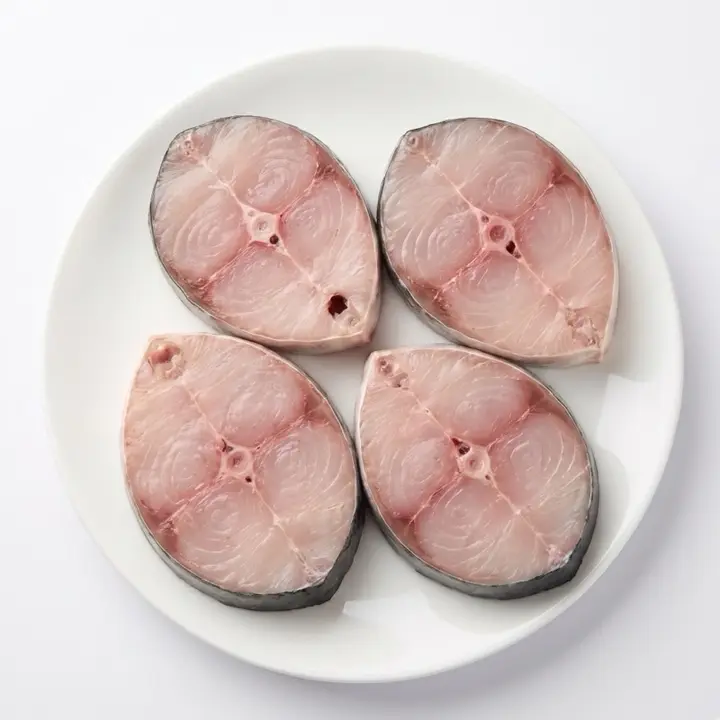
ICMR-NIN says fresh fish has a stiff body, bright and bulging eyes, reddish gills and tight scales, with no stale smell. Oily fish like tarli and bangda spoil fastest, so buy them for the day you cook. Surmai is sold in steaks; look for moist, pinkish flesh.
Verified sellers on Relifish list surmai, pomfret, tarli, crab and prawns when they have them. Choose how it is cleaned and cut. Order for today or pre-order, and pick a 2-hour delivery slot in Thane or nearby Mulund.
You might also like: fish for brain health and fish for elderly parents.
What to do next: see today’s surmai or pomfret, check today’s fish prices, or order from the shop.
Sources
- NIH Office of Dietary Supplements. Omega-3 fact sheet: retina, AMD and dry eye sections.
- NIH Office of Dietary Supplements. Vitamin A fact sheet.
- NIH Office of Dietary Supplements. Zinc fact sheet.
- National Eye Institute. Keep your eyes healthy.
- American Academy of Ophthalmology. Computers, digital devices and eye strain.
- ICMR-NIN. Dietary Guidelines for Indians 2024, Table II and pages 48, 52, 56, 66 and 78. PDF at nin.res.in.
- ICMR-NIN. Indian Food Composition Tables 2017: retinol, EPA, DHA and zinc tables. PDF at nin.res.in.
- US FDA. Advice about eating fish.
Frequently asked questions
Which fish is good for eyes?
Oily fish rich in DHA are the usual picks. The US National Eye Institute says fish high in omega-3, like salmon and tuna, are good for your eyes. Among Mumbai fish, surmai, halwa, pomfret and tarli have the most DHA in India's food tables (IFCT 2017). Surmai and pomfret also have the most vitamin A of common fish.
Does eating fish improve eyesight?
No food can correct your eyesight or replace glasses. Fish supplies DHA, which is part of the retina, plus some vitamin A and zinc. NIH says studies link eating fatty fish with a lower risk of age-related macular degeneration, but omega-3 capsules did not slow it in a large trial. Get regular eye check-ups.
Is fish rich in vitamin A?
Fish flesh has a modest amount. In IFCT 2017, surmai has 81.90 µg of retinol per 100 g and white pomfret 30.31 µg, against an adult need of 700 to 900 µg a day (NIH). Fish liver and pickled herring have far more. ICMR-NIN says green leafy and orange vegetables and fruits are the main vitamin A sources for Indians.
Do omega-3 fish help with dry eyes from screens?
The evidence is mixed. NIH notes one trial in northern India where omega-3 capsules eased dry eye symptoms, but a larger 12-month trial found fish oil no better than placebo. For screen strain, the American Academy of Ophthalmology advises blinking often, taking breaks and setting your screen at arm's length.
How often should I eat fish for my eyes?
Two fish meals a week is a sensible pattern. ICMR-NIN suggests about 200 g of marine fish a week for long-chain omega-3. NIH reports one European study where people aged 65 and over who ate fatty fish at least once a week had a lower risk of the wet form of macular degeneration than those who ate it less often.
How we write and check these guides: editorial standards
Share this article: